
MacGuffin (cipher): an experimental unbalanced Feistel block cipher
MacGuffin is a 1994 experimental block cipher by Bruce Schneier and Matt Blaze that explored Generalized Unbalanced Feistel Networks; it was designed for analysis and was broken quickly using differential cryptanalysis.
MacGuffin is an experimental block cipher introduced in 1994 as a research vehicle rather than a production algorithm. Created by Bruce Schneier and Matt Blaze and presented at a Fast Software Encryption workshop, the design aimed to explore the security properties of a particular Feistel-style structure called a Generalized Unbalanced Feistel Network. It is principally of interest in the history of cryptanalysis and cipher design rather than in practical deployments. For background on the field, see cryptography.
Image gallery
1 Image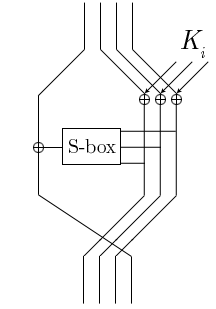
Design and structure
MacGuffin follows the broad Feistel-network approach used in many block ciphers, but departs from the classic balanced split by dividing the 64-bit data block into unequal halves. The designers adapted mechanisms familiar from the Data Encryption Standard (DES) and other Feistel ciphers to form a Generalized Unbalanced Feistel Network (GUFN). In this layout 48 bits of the 64-bit block are processed by the round function while the remaining 16 bits play the role of the other Feistel half and are combined with the round output via XOR.
The MacGuffin specification recommended a 128-bit key and suggested using a fairly large number of rounds (Schneier and Blaze recommended 32 rounds) to compensate for the asymmetry. The algorithm used a key schedule derived from a modified version of the cipher itself; this key schedule choice was part of the experimental design rather than a mature engineering decision. See the general entry on block ciphers for context, and the note on key schedules for why this component matters.
Operation and practical properties
Because MacGuffin is a Feistel-type construction, decryption is straightforward: the encryption process can be run in reverse with the round keys applied in the opposite order, which is a standard advantage of Feistel networks. The round function used S-boxes and other components conceptually similar to those in DES; the choice of S-boxes and round structure affects the cipher's resistance to differential and linear analyses. Some variant experiments replaced the original S-boxes with those taken directly from DES or other sources (S-boxes) to measure the impact on security.
Cryptanalysis and reception
MacGuffin was explicitly published to encourage public analysis, and the attempt succeeded rapidly: researchers Vincent Rijmen and Bart Preneel applied differential cryptanalysis at the same workshop and found practical weaknesses. Their work showed that the unbalanced structure used in MacGuffin made it more vulnerable to differential attacks than the designers had hoped. Rijmen and Preneel also tried variants with different S-boxes, which produced modest improvements but did not salvage the original scheme. The episode is documented in literature on cipher evaluation and cryptanalysis, and it is frequently cited when discussing the effectiveness of differential cryptanalysis.
Importance and lessons
MacGuffin's chief legacy is pedagogical. As an intentionally open research design it demonstrated the value of rapid, public cryptanalysis of new proposals and underscored a central maxim of the field: designing an algorithm only to resist known attacks is a weak basis for security. The project stimulated further study of unbalanced Feistel constructions and helped clarify how design choices such as split ratio, round count, S-box selection, and key schedule interact to influence resistance to attacks. It remains a frequently cited case study in cryptography textbooks and reviews of cipher design.
Notable facts and comparison
- Introduced in 1994 by Bruce Schneier and Matt Blaze as a research cipher.
- Uses a 64-bit block size with a 48/16 bit split in a GUFN-style Feistel network.
- Originally specified with a 128-bit key and a suggested 32 rounds.
- Broken quickly by differential cryptanalysis; researchers tested alternatives including different S-boxes.
- Serves as a cautionary example about relying on resistance to only known attacks (cryptanalysis, differential cryptanalysis).
For further reading about the theoretical frame and other designs that explored similar ideas, consult general surveys of block-cipher structures and proceedings from the Fast Software Encryption workshops. Additional background on Feistel networks and their variants is available via entries on block ciphers and on cryptography, while specific discussions of unbalanced Feistel approaches can be found under GUFNs and papers cited at research repositories (DES, key schedule, cryptanalysis, differential cryptanalysis).
Related articles
Author
AlegsaOnline.com MacGuffin (cipher): an experimental unbalanced Feistel block cipher Leandro Alegsa
URL: https://en.alegsaonline.com/art/60318
Sources
- schneier.com : The MacGuffin Block Cipher Algorithm
- citeseer.ist.psu.edu : Cryptanalysis of McGuffin