
Lua — lightweight embeddable scripting language
Lua is a compact, extensible scripting language created in 1993. It is designed for embedding, easy C integration, and rapid prototyping; widely used in games, embedded systems and extensible applications.
Overview
Lua is a small, high-level scripting language created in 1993 by Roberto Ierusalimschy, Luiz Henrique de Figueiredo and Waldemar Celes. It was designed as a lightweight, embeddable language suitable for extending applications and providing flexible configuration and automation facilities. Lua emphasizes a simple core with powerful primitives: dynamic typing, first-class functions, automatic memory management and a concise syntax aimed at being easy to learn and integrate.
Image gallery
1 Image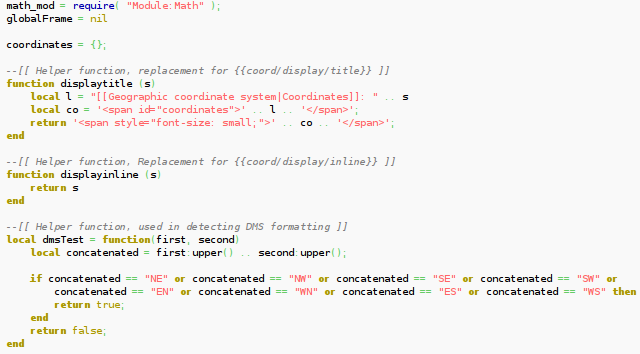
Design goals and philosophy
The language was developed with portability, small footprint and extensibility as primary goals. Instead of providing an extensive standard library, Lua offers a compact set of fundamental features that can be combined and extended by host applications. This approach keeps the runtime small and predictable while allowing developers to expose only the facilities they deem appropriate for a particular embedding.
Core concepts
Lua relies on a few core concepts that yield broad expressive power. Tables are the single, general-purpose data structure and are used to represent arrays, associative maps and ordinary objects. Functions are first-class values and support closures, enabling higher-order programming patterns. Metatables and metamethods provide customization hooks for operators and behavior, allowing developers to implement object-like patterns, operator overloading and proxy objects. Coroutines implement cooperative multitasking: they allow code to suspend and resume execution without relying on operating system threads, a model often used for scripting sequences, game logic and asynchronous workflows.
Implementation, embedding and C API
Lua is implemented as a compact interpreter and a register-based virtual machine that executes bytecode. The language provides a straightforward C API that makes it easy to embed a Lua interpreter inside a host program and to bind native libraries for use from scripts. This C interface is one reason Lua is popular in applications that need a small, efficient scripting layer. Alternative implementations and performance-oriented projects, most notably LuaJIT, provide just-in-time compilation and can yield substantial speed improvements for many workloads.
Variants, tooling and ecosystem
Over time a modest but active ecosystem has developed around Lua. Tooling includes debuggers, build tools, and package ecosystems provided by third parties. Variants and dialects have emerged to meet particular needs: for example, the Luau dialect used by the Roblox platform adapts Lua semantics and tooling for large-scale game scripting and safety checks. Many projects combine the compact Lua core with libraries to provide networking, serialization, GUI bindings and other domain-specific capabilities.
Common uses and adoption
Lua has been adopted widely where an embeddable scripting language is needed. It is especially common in the video-game industry because its small size, performance characteristics and straightforward C integration match game development workflows. Beyond games, Lua is used for configuration, scripting inside applications, rapid prototyping, automation and extensibility in embedded devices and desktop software. Changes in mobile platform policies and the permissive licensing of Lua have also contributed to its use in mobile and commercial applications.
Considerations
Lua’s minimal core and flexible extension model are strengths for embedding, but projects that need a large batteries-included standard library typically rely on third-party modules or embed additional libraries. The language’s simplicity also means that some higher-level conveniences present in other languages must be implemented or provided by application-specific bindings. For many developers, the trade-off between a small, predictable runtime and the need to assemble libraries is acceptable for the gains in control, portability and ease of integration.
Further reading and resources
- Official Lua resources
- Language reference and manual
- Historical notes and creators
- Games using Lua
- Transformice
- SimCity 4
- Roblox and the Luau dialect
- Apple platform changes and Lua
- iOS development context
- Platform SDK considerations
- Examples of Lua in consumer apps
- Angry Birds (example use case)
- Popularity and index listings
Related articles
Author
AlegsaOnline.com Lua — lightweight embeddable scripting language Leandro Alegsa
URL: https://en.alegsaonline.com/art/59640
Sources
- lua.org : "The evolution of Lua"
- acm.org : Proc. of ACM HOPL III
- doi.org : 10.1145/1238844.1238846
- lua.org : "Lua: About"
- lua.org : "Lua: version history"
- lua.org : "Lua: license"
- lua-users.org : "Lua Uses"
- roblox.wikia.com : "Lua"
- appleinsider.com : "Apple relaxes iOS SDK terms to allow Lua but block Flash"
- tiobe.com : "TIOBE Programming Community Index for June 2011"