
Lizard, Cornwall — village on the Lizard peninsula
Lizard is the most southerly village on mainland Britain, located on the Lizard peninsula in Cornwall. It is known for its large village green, distinctive geology and long maritime history.
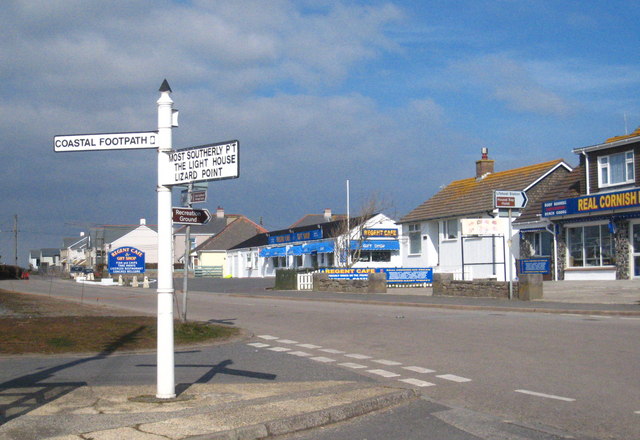
The village of Lizard sits near the tip of the Lizard peninsula in Cornwall, England, part of the United Kingdom. Roughly ten miles south of Helston, it holds the distinction of being the most southerly settlement on mainland Britain. The village is compact and characterful: a broad village green is surrounded by cafes, craft and gift shops, and small businesses that serve both local residents and visitors.
The name "Lizard" derives from Cornish elements often interpreted as lis (place) and ard (high), reflecting the area's Celtic linguistic heritage; the Cornish language and culture remain an element of local identity and place-names (Cornish). Administratively the village belongs to the parish of Landewednack, the most southerly civil parish on the British mainland.
Image gallery
3 Images

Geography and geology
The surrounding landscape combines low cliffs, rocky coves and heathland. The Lizard is famous among geologists for the so-called Lizard complex—ancient, unusual rocks including serpentinite and other metamorphic types that are of scientific and conservation interest. The coastline here is exposed to the Atlantic and has a rugged, windswept appearance that contributes to its scenic and ecological value.
History and maritime importance
For centuries the waters around the peninsula have been busy and hazardous for shipping. The coastline's shoals and changeable weather have led to shipwrecks, prompting the construction of navigational aids and the long-standing presence of coastal rescue services. Remnants of maritime activity and local seafaring traditions are part of the village's historical character.
Visitor attractions and amenities
- Large village green with cafes, pubs and souvenir shops, popular with visitors and day-trippers.
- Coastal walking routes and viewpoints offering sea views and opportunities for wildlife watching.
- Geological interest points and interpretation—many visitors come to see the distinctive rock formations of the peninsula.
- Local churches, community events and small museums or interpretation centres that explain local history and natural heritage.
Although small, Lizard functions as a local hub for tourism and outdoor recreation while retaining a quiet, rural character outside the peak season. Its combination of cultural roots, notable geology and coastal scenery make it a frequently cited destination within Cornwall and a place of interest for both walkers and those interested in Britain’s coastal heritage.
Related articles
Author
AlegsaOnline.com Lizard, Cornwall — village on the Lizard peninsula Leandro Alegsa
URL: https://en.alegsaonline.com/art/58655
Sources
- genuki.org.uk : GENUKI website; Landewednack