
Lifford, County Donegal: history, geography and local life
Lifford is the administrative centre of County Donegal in Ulster, Ireland. This article outlines its geography, development, historic sites, economy, and cross‑border role beside Strabane.
Lifford (Irish: Leifear) is the administrative centre and county town of County Donegal in the Province of Ulster in Ireland. It sits where two rivers meet — the River Finn and the River Mourne join to form the River Foyle — and occupies a strategic position in the Finn Valley of East Donegal. As the seat of local government, Lifford contains the county council offices and a number of civic and judicial buildings that serve the wider rural hinterland.
Image gallery
7 Images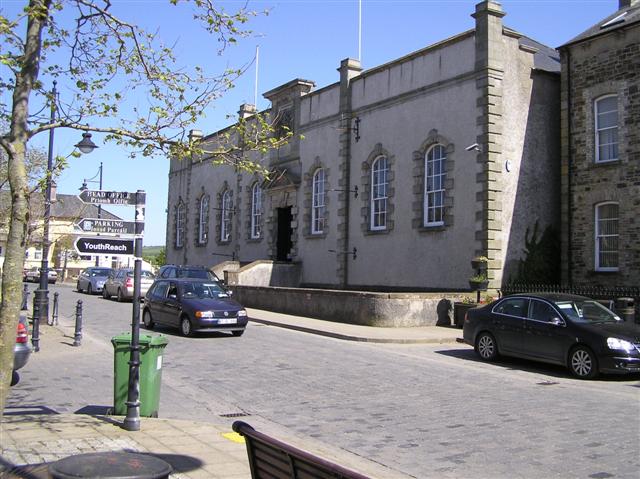




Geography and urban character
The town lies on the south bank of the River Foyle directly opposite the Northern Ireland town of Strabane, and the two are linked by Lifford Bridge. Its riverside location has shaped both its layout and its economy: low-lying riverlands and rolling uplands surround the built-up area. Lifford functions as a service and administrative centre for nearby villages and agricultural districts, with retail, professional services and public administration among the main local activities. For context, see links to the larger administrative and provincial units: county town, County Donegal, Ulster, and Ireland.
History and development
The modern settlement grew up around a 16th‑century stronghold established by Manus O'Donnell of the Gaelic O'Donnell dynasty. Over subsequent centuries the town was shaped by its frontier location: it became a garrison and administrative post under British rule and retained a military presence until the early 20th century. The political changes that accompanied Irish independence in 1922 and the partition of Ireland had a lasting effect on Lifford's role as a border town, influencing trade patterns and cross‑border relationships. Military and governmental associations are part of its recorded past; more about that context can be found via historical summaries of the British Army era.
Places of interest and notable buildings
- Site of the original castle and its surrounding historic area, which marks the medieval origins of the town.
- Civic buildings such as the county offices and courthouse that reflect Lifford's administrative role.
- Riverside promenades and the bridge connection to Strabane, illustrating both natural and built features of the town.
Economy, transport and cross‑border relations
Lifford's economy is largely local in scale: public administration, retail, small businesses and services geared to residents and neighbouring rural areas. Its riverside crossing to Strabane gives it a significant cross‑border dimension; daily life, commerce and commuting in the region frequently interact with communities on the far bank of the Foyle. The town is linked by road to surrounding towns and to larger regional centres, while the bridge and river crossings remain important for both practical travel and symbolic connections with Northern Ireland — for example with Strabane.
Modern role and distinctions
Today Lifford is best understood as a compact administrative town with deep historical roots and a continuing role as a local hub. Its mix of civic functions, riverside setting and borderland identity give it particular significance in County Donegal. Visitors and residents alike will encounter the remnants of older settlement patterns, municipal institutions, and the practical realities of life on the edge of two jurisdictions. For further civic and regional information consult local government and cultural sources referenced by this overview: county town, County Donegal, Ulster, Ireland, and material on the town's past military associations (British Army accounts) and neighbouring communities such as Strabane.
Related articles
Author
AlegsaOnline.com Lifford, County Donegal: history, geography and local life Leandro Alegsa
URL: https://en.alegsaonline.com/art/57912