
Lar gibbon (white-handed gibbon)
Small arboreal ape of Southeast Asia, known for long arms, variable coat colors and loud duets; lives in monogamous family groups and faces habitat loss and hunting pressure.
Overview
The lar gibbon (Hylobates lar), commonly called the white-handed gibbon, is a small ape of Southeast Asia. It belongs to the gibbon family, the Hylobatidae, and is one of the better-known members of the lesser apes. The species is frequently featured in zoos and wildlife centers, where its acrobatic brachiation and complex vocalizations attract attention. For a general classification reference see primate and for family-level information see gibbon family.
Image gallery
7 Images



Physical characteristics and locomotion
Lar gibbons have a lightweight, compact body with very long arms and shortened thumbs that facilitate swinging through the forest canopy. Fur coloration is unusually variable within the species, ranging from nearly black to sandy blond; many individuals display the pale hands and feet that inspire the common name. Facial markings also differ by population. They move primarily by brachiation, an energetic arm-swinging gait that allows rapid travel across branches.
Behavior and social structure
Active by day, lar gibbons are strictly diurnal and spend almost all of their lives above ground in trees, reflecting their strongly arboreal lifestyle. Typical social units are small family groups—usually a long-term pair and their immature offspring. Pairs defend a home range through loud, complex songs and duets; these vocalizations serve to reinforce bonds and to advertise ownership of a territory. Reproduction usually yields a single infant after a pregnancy of several months, and offspring remain dependent for a number of years.
Diet and adaptations
Lar gibbons are primarily frugivorous but have a flexible diet that includes leaves, flowers, and arthropods. Their feeding habits and digestive physiology reflect this mixed diet. Key adaptations include:
- Long, powerful arms and mobile shoulder joints for brachiation
- Strong vocal abilities used in territorial and social communication
- A generalist diet that permits seasonal shifts in food sources
Habitat, distribution and conservation
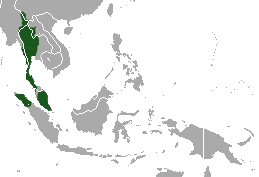
The species is native to the forests of mainland Southeast Asia and nearby islands, occurring historically in countries such as Thailand, Malaysia, Myanmar, Laos, Cambodia and parts of Indonesia. Lar gibbons inhabit tropical rainforests and closed-canopy woodlands where continuous canopy allows efficient arboreal travel. They are threatened across much of their range by deforestation, habitat fragmentation, and hunting, which have reduced population sizes and isolated groups. Conservation efforts focus on habitat protection, anti-poaching measures and captive breeding programs.
In captivity and human interactions
Lar gibbons are commonly kept in zoological collections, where they can live considerably longer than in the wild under managed care. In these settings they help educate the public about rainforest ecosystems and primate conservation. Observations in both wild and captive contexts have made the lar gibbon an important species for understanding primate locomotion, social monogamy among apes, and the role of vocal communication in territory and pair bonds.
For further reading and resources, see curated pages and conservation organizations: primate overview, family information, daily activity patterns, arboreal adaptations, territorial behavior.
Questions and answers
Q: What is the lar gibbon?
A: The lar gibbon is a primate in the gibbon family, also known as the white-handed gibbon.
Q: What is the fur coloring of the lar gibbon?
A: The fur coloring of the lar gibbon is not fixed and can range from black and dark-brown to light brown sandy colors.
Q: Where are lar gibbons typically found?
A: Lar gibbons are arboreal and live in rainforests.
Q: What is the behavior of the lar gibbon?
A: Lar gibbons are diurnal and family groups live in a firm territory which they protect from other gibbons by their calls.
Q: Where are lar gibbons often seen?
A: Lar gibbons are often seen in zoos.
Q: How long do lar gibbons typically live in the wild?
A: In the wild, lar gibbons live about 25 years.
Q: What family does the lar gibbon belong to?
A: The lar gibbon belongs to the gibbon family or Hylobatidae.
Related articles
Author
AlegsaOnline.com Lar gibbon (white-handed gibbon) Leandro Alegsa
URL: https://en.alegsaonline.com/art/56007
Sources
- commons.wikimedia.org : Lar Gibbon
- species.wikimedia.org : Lar Gibbon
- gibbons.de : Lar Gibbon photos
- gibbons.de : Lar Gibbon songs
- gibboncenter.org : Gibbon Conservation Center
- animaldiversity.ummz.umich.edu : Lar Gibbon
- gibbons.de : Gibbon Research Lab and Gibbon Network · web.archive.org · web.archive.org
- web.archive.org : Facts
- web.archive.org : Status