
Karachay-Balkar language
A Turkic language of the North Caucasus, Karachay‑Balkar is spoken by the Karachay and Balkar peoples and is notable for its Kipchak affiliation, two main dialects, agglutinative grammar and Cyrillic script use.
Overview
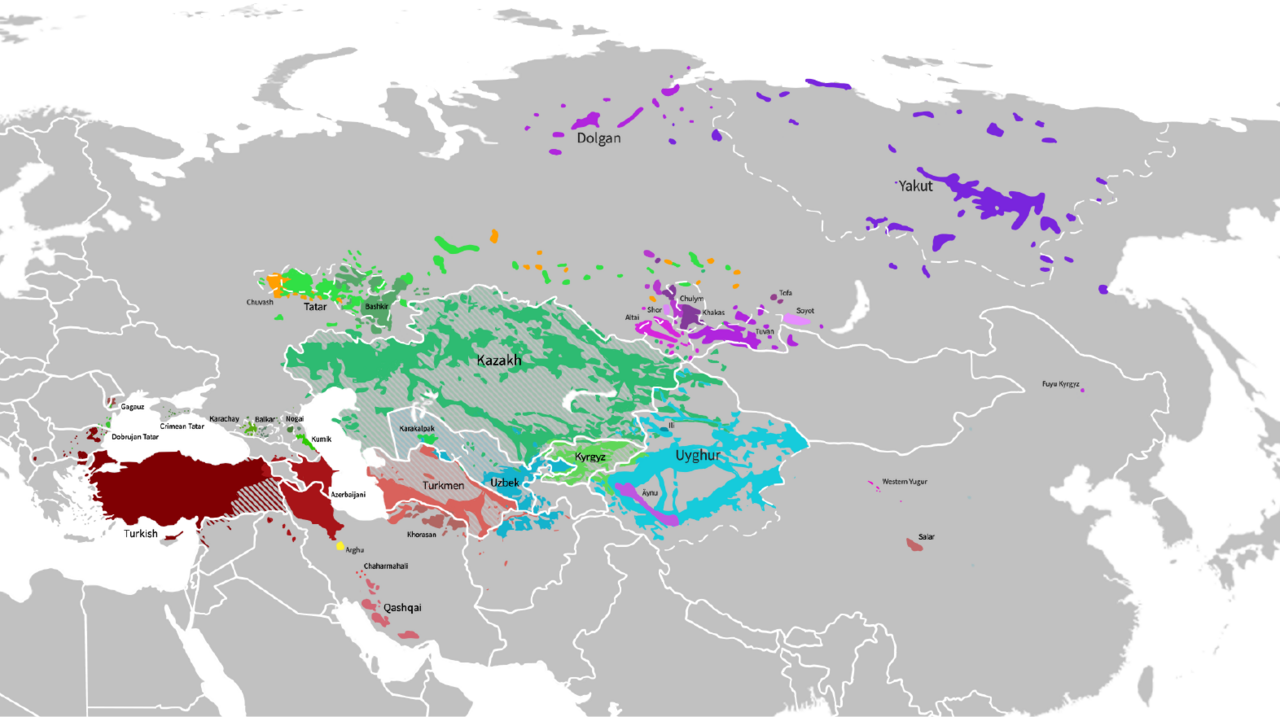
The Karachay‑Balkar language is a Turkic language spoken primarily by the Karachay and Balkar peoples in the North Caucasus region of Russia, with diasporas elsewhere. It belongs to the Kipchak branch of the Turkic family and is the vehicle for local oral tradition, regional media and some written literature. The language is used in daily life, cultural activities and increasingly in local schooling and broadcasting, though Russian remains dominant in official domains.
Image gallery
4 Images


Dialects and phonology
Karachay‑Balkar is commonly described as having two principal dialect groups: Karachay (Qarachay) and Balkar (Malkar). The dialects are mutually intelligible but differ in several phonetic features. One well known contrast involves a pair of affricate phonemes: the Karachay variety typically realizes them as /tʃ/ and /ʒ/, while the Balkar variety favors /ts/ and /z/. This contrast is discussed in descriptive works on the language and can be referenced further via affricate contrasts. The language also exhibits typical Turkic features such as vowel harmony and a rich consonant inventory influenced by contact with neighboring languages.
Grammar and linguistic characteristics
Karachay‑Balkar is agglutinative: grammatical relationships and meanings are expressed by stringing suffixes onto stems. Nouns inflect for number and a set of grammatical cases (for example nominative, genitive, dative, accusative, locative and ablative, among others), and verbs show tense, aspect and agreement with subject. Word order is generally subject–object–verb (SOV). Lexicon and morphosyntax reflect typical Kipchak patterns but also show regional innovations and borrowings from Russian and neighboring Caucasian languages.
History and development
The language descends from medieval Kipchak varieties that spread across the Eurasian steppe. Over centuries it absorbed local substrates and loanwords through contact with North Caucasian languages and later with Russian during imperial and Soviet periods. Writing systems have changed: earlier scripts included Perso‑Arabic variants and Latin alphabets in the early 20th century; today a Cyrillic-based orthography is standard for most community and official use.
Uses, literature and status
Karachay‑Balkar supports folk poetry, songs and oral history, and there is a tradition of modern literature, newspapers and radio programs in the language. It is an important symbol of identity for Karachay and Balkar communities. Like many regional minority languages, it faces pressures from dominant national languages, but community efforts and local institutions contribute to its maintenance through education, cultural events and media.
Distinctive facts
- Classification: part of the Kipchak subgroup of Turkic languages.
- Dialectal difference prominent in affricate pronunciation (/tʃ, ʒ/ vs /ts, z/).
- Typical Turkic features: vowel harmony, agglutination, SOV word order.
- Written today primarily in a Cyrillic orthography adopted during the Soviet era.
Further detailed descriptions of phonology, morphology and dialect geography are available in specialized grammars and linguistic surveys for readers who require in‑depth analysis.
Related articles
Author
AlegsaOnline.com Karachay-Balkar language Leandro Alegsa
URL: https://en.alegsaonline.com/art/52254
Sources
- ethnologue.com : ethnologue.com/show_family.asp?subid=90009
- wikidata.org : wikidata.org/wiki/Q33714
- d-nb.info : 4163305-2
- id.ndl.go.jp : 00577004