
John W. Cahn: Materials Scientist and Theorist of Phase Transformations
American materials scientist who applied thermodynamics to phase transformations; MIT professor and long-time NIST researcher; awarded the 1998 National Medal of Science.
John Werner Cahn (January 9, 1928 – March 14, 2016) was an American materials scientist whose theoretical work linked classical thermodynamics to the microscopic behaviour of alloys, polymers and other condensed-matter systems. He is widely credited with clarifying how phases form, separate and evolve in solids and fluids and with developing mathematical and conceptual tools now used across metallurgy, polymer science and computational materials design. Biographical and overview resources summarize his career and public outreach efforts biography and collected writings.
Image gallery
2 Images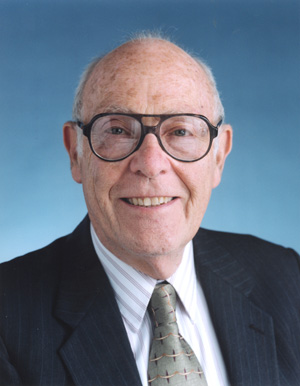

Research themes and major contributions
Cahn made lasting contributions to the theory of phase transformations and interfacial phenomena. Two topics most closely associated with his name are spinodal decomposition and the Cahn–Hilliard formulation. Spinodal decomposition describes how a uniform mixture can separate spontaneously into two or more phases without nucleation, producing characteristic patterns during early-stage separation. The Cahn–Hilliard framework provides continuum equations and free-energy descriptions for modeling diffuse interfaces and pattern formation; these ideas underpin modern phase-field methods used to simulate microstructure evolution.
Beyond spinodal decomposition, Cahn advanced the thermodynamics of interfaces and defects. He examined how surface and interfacial energies determine precipitate shapes, the stability of coherent interfaces, grain-boundary behaviour and ordering phenomena. His work emphasized the connection between free-energy landscapes, stability criteria and kinetic pathways, showing how classical thermodynamic principles can predict complex, time-dependent material behaviour.
Applications and methods
The concepts and models that grew from Cahn's work are applied broadly: in metallurgy to understand alloy treatments; in polymer science to describe phase separation in blends and block copolymers; in thin films and coatings to predict patterning; and in emerging nanostructured materials where interfacial energetics dominate properties. His approaches helped establish bridges between analytic theory, numerical simulation and experimental observation, contributing to the development of computational materials science and materials-by-design strategies.
Career and institutional roles
Cahn was a professor in the Department of Materials Science and Engineering at the Massachusetts Institute of Technology from 1964 to 1978, where he taught thermodynamics, phase transformations and materials theory. In the late 1970s he joined the National Bureau of Standards (later the National Institute of Standards and Technology) and continued research and policy-related work there NIST. His position at the standards institute gave him an opportunity to influence both fundamental science and practical standards important to industry and measurement science.
Recognition, writing and legacy
For his influential scientific career Cahn received many honours, including the United States National Medal of Science in 1998 National Medal of Science citation. He published widely in refereed journals and in review articles that have educated generations of researchers; his expositions on thermodynamic principles remain recommended reading in materials science curricula and technical references on thermodynamics. He is remembered as a teacher and mentor whose ideas persist in textbooks, simulation codes and the vocabulary of the field.
- Key concepts: spinodal decomposition, Cahn–Hilliard theory, interface thermodynamics, nucleation and growth, phase-field modelling.
- Impact: improved prediction and control of microstructures in metals, polymers and thin films; contributed to computational materials methods.
- Institutional influence: combined academic teaching with standards and measurement work at a national laboratory.
John W. Cahn's career exemplifies how careful application of thermodynamic principles can illuminate diverse phenomena in condensed matter. His work remains a foundational element of modern materials science, providing conceptual tools that continue to guide research into stability, pattern formation and the energetics of interfaces.
Related articles
Author
AlegsaOnline.com John W. Cahn: Materials Scientist and Theorist of Phase Transformations Leandro Alegsa
URL: https://en.alegsaonline.com/art/50847
Sources
- webcache.googleusercontent.com : The Selected Works of John W. Cahn (Page 13)
- ctcms.nist.gov : John W. Cahn