
Isomer (chemistry): types, properties, and significance
An isomer is one of two or more compounds with the same molecular formula but different arrangements of atoms. This article explains types, examples, historical context, identification methods, and practical importance.
An isomer is a molecule that shares the same molecular formula as another compound but differs in the way its atoms are connected or arranged in space. Although isomers contain the same numbers and types of atoms, their different structures often give rise to distinct physical and chemical properties such as melting point, boiling point, solubility, smell, taste, and biological activity. The phenomenon of isomerism is a central concept in organic chemistry and has important consequences in fields ranging from drug design to materials science.
Image gallery
3 Images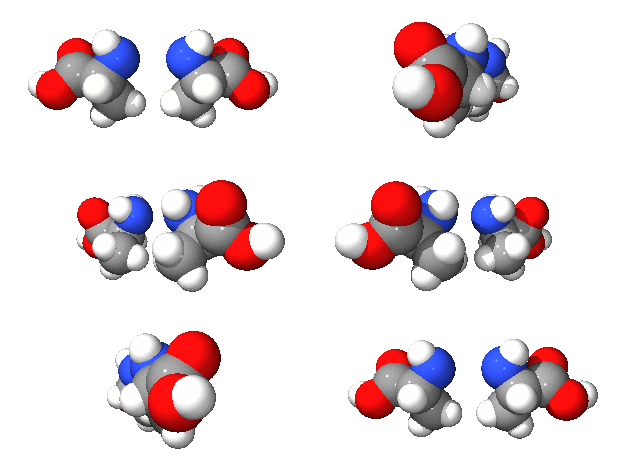


Major categories and common subtypes
Isomers fall into two broad categories: structural (constitutional) isomers and stereoisomers. Structural isomers differ in the connectivity of atoms; stereoisomers have the same connectivity but different spatial arrangements.
- Structural (constitutional) isomers: include chain isomers (different carbon skeletons), position isomers (functional groups or substituents at different positions), functional group isomers (different functional groups but same formula), tautomers (rapidly interconverting isomers such as keto–enol pairs), metamers, and ring–chain isomers. A simple example is butane vs isobutane (same formula C4H10 but different connectivity).
- Stereoisomers: subdivided into enantiomers and diastereomers. Enantiomers are non-superimposable mirror images; they often differ in optical activity and biological interactions. Diastereomers include geometrical isomers (cis/trans or E/Z) and other stereochemical arrangements. Conformational isomers arise from rotation about single bonds and can interconvert without breaking bonds (for example, staggered vs eclipsed conformations of ethane or butane).
Historical context and theoretical developments
The recognition that substances with identical composition could behave differently dates to the early 19th century, when chemists observed puzzling differences among compounds with the same elemental ratios. The word "isomer" derives from Greek roots meaning "equal parts." Later in the 19th century, chemists proposed three-dimensional models to explain optical activity and handedness in molecules; work by theorists who suggested tetrahedral bonding around carbon was instrumental in explaining why some compounds exist as non-superimposable mirror images. These ideas laid the groundwork for modern stereochemistry.
How isomers are identified
Analytical techniques distinguish isomers by probing structure and spatial arrangement. Nuclear magnetic resonance (NMR) spectroscopy provides detailed information about connectivity and local environments. Infrared (IR) spectroscopy helps identify functional groups. Mass spectrometry (MS) gives molecular weight and fragmentation patterns. Chromatography can separate isomers based on polarity or shape. For chiral isomers, optical rotation measurements and chiral chromatography reveal enantiomeric composition.
Practical importance and examples
Isomerism has wide practical implications. In pharmaceuticals, different isomers of a drug can have markedly different therapeutic effects or safety profiles; one enantiomer may be active while its mirror image is less active or harmful. In fragrances and flavors, stereochemistry influences scent and taste. Polymers and materials can show different properties depending on monomer connectivity and stereochemistry. Common textbook examples include cis– and trans-2-butene (geometrical isomers) and keto–enol tautomers frequently encountered in organic reactions.
Notable distinctions and concepts
Two molecules are isomers only if they share the same molecular formula. From there, the distinction between constitutional differences and spatial arrangements is crucial for understanding reactivity and function. Tautomerism is a dynamic form of isomerism where species interconvert under equilibrium; racemic mixtures contain equal amounts of enantiomers and are optically inactive overall. For further reading on basic terminology see chemical compound, the classification of structural isomers, and the special class of mirror-image stereoisomers called enantiomers.
Related articles
Author
AlegsaOnline.com Isomer (chemistry): types, properties, and significance Leandro Alegsa
URL: https://en.alegsaonline.com/art/48483