
Isotopes of Hydrogen: Protium, Deuterium, Tritium and Beyond
Summary of hydrogen isotopes — protium, deuterium and tritium — their nuclear properties, natural occurrence, synthetic heavier isotopes, uses in science and industry, and naming conventions.
Overview
Hydrogen, the lightest chemical element, occurs in several isotopic forms that differ only in the number of neutrons in their nucleus. The three principal isotopes are protium (mass number 1), deuterium (mass number 2) and tritium (mass number 3). Protium, the most common form, has no neutrons and accounts for the great majority of hydrogen atoms in nature. Deuterium contains one neutron and is stable; tritium contains two neutrons and is radioactive.
Image gallery
4 Images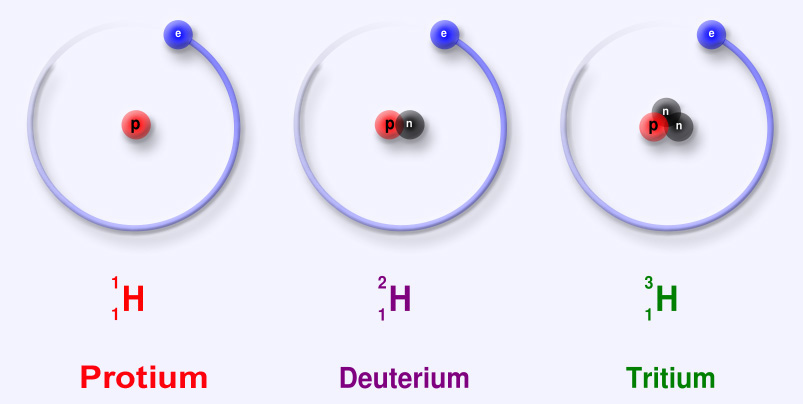


Properties and notation
The isotopes share the same chemical behaviour in many contexts but differ in mass and nuclear properties. Key points include:
- Atomic composition — protium: one proton, zero neutrons; deuterium: one proton, one neutron; tritium: one proton, two neutrons.
- Mass differences produce measurable effects on vibrational frequencies, reaction rates and physical properties such as boiling point and density.
- Common notations are 1H, 2H, 3H or, especially in older and applied contexts, D for deuterium and T for tritium. The IUPAC endorses the mass-number notation but D and T remain widely used in practice.
Natural occurrence and stability
Protium dominates naturally occurring hydrogen. Deuterium is rare but present at measurable concentrations in terrestrial water (tens of parts per million), and its relative abundance has become a useful tracer in environmental and geochemical studies. Tritium is produced in the upper atmosphere by cosmic rays and in small amounts in terrestrial processes; because it is radioactive it decays back to 3He with a characteristic half-life. Natural tritium levels are extremely low compared with protium and deuterium.
Heavier, synthetic isotopes
Beyond mass number 3, physicists have produced isotopes with mass numbers 4 through 7 in laboratory conditions. These heavier hydrogen isotopes are highly unstable and exist only briefly before decaying by particle emission. Such isotopes are of interest in nuclear physics because they probe the limits of nuclear binding for the lightest element, but they do not occur in ordinary terrestrial or cosmological settings.
Uses and importance
Isotopes of hydrogen have a range of scientific and practical applications:
- Deuterium is used in heavy water (D2O) as a neutron moderator in some types of nuclear reactors and as a non-radioactive tracer in chemical and biological experiments.
- Both deuterium and tritium are central to fusion research because their nuclei fuse under extreme conditions to release energy; tritium is also used in luminous devices and as a tracer in specialized studies.
- Stable isotope ratios of hydrogen are applied in hydrology, paleoclimatology and ecology to reconstruct sources and histories of water and organic material.
History, nomenclature and notable facts
The discovery and naming of hydrogen isotopes spans early 20th century advances in atomic physics. Deuterium was first identified spectroscopically and isolated in the early 1930s; tritium was identified later and characterized as radioactive. Unlike most elements, hydrogen’s principal isotopes have common names (protium, deuterium, tritium) that remain in everyday use. Practical distinctions — such as the use of D and T symbols, the chemical effects of increased mass, and the environmental and technological applications of isotopic analysis — make hydrogen isotopes important across chemistry, physics, earth science and engineering.
For further technical summaries and reference material, follow introductory resources on each isotope: protium, deuterium, tritium and general discussions of radioactivity and half-lives at half-life resources and the IUPAC nomenclature pages.
Questions and answers
Q: How many main isotopes of hydrogen are there?
A: There are three main isotopes of hydrogen: protium, deuterium, and tritium.
Q: Are protium and deuterium stable isotopes?
A: Yes, protium and deuterium are stable isotopes.
Q: What is the half-life of tritium?
A: Tritium is radioactive and has a half-life of about 12 years.
Q: How many other hydrogen isotopes have scientists created?
A: Scientists have created four other hydrogen isotopes: 4H to 7H.
Q: Do these four additional hydrogen isotopes exist naturally?
A: No, these isotopes are very unstable and do not exist naturally.
Q: What makes the main isotopes of hydrogen unique?
A: The main isotopes of hydrogen are unique because they are the only isotopes that have a name.
Q: Do deuterium and tritium have their own symbols?
A: Yes, deuterium and tritium sometimes get their own symbols: D and T. However, the International Union of Pure and Applied Chemistry does not like these names very much, even though they are often used.
Related articles
Author
AlegsaOnline.com Isotopes of Hydrogen: Protium, Deuterium, Tritium and Beyond Leandro Alegsa
URL: https://en.alegsaonline.com/art/48495