
Any Given Sunday (1999 film)
Oliver Stone's 1999 sports drama about professional American football, leadership and commercialization, starring Al Pacino and Jamie Foxx. Adapted from Pat Toomay's On Any Given Sunday.
Overview
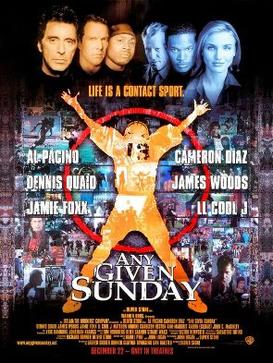
Any Given Sunday is a 1999 American sports drama film directed by Oliver Stone and released on December 22, 1999. Adapted from Pat Toomay's novel On Any Given Sunday, the film follows a fictional professional football team as players, coaches and owners confront injuries, media attention and the business pressures that shape modern sport. Stone blends on-field sequences with behind-the-scenes scenes to explore leadership, aging athletes and commercial spectacle, producing a film that alternates intimate character moments with large-scale game choreography.
Image gallery
2 Images
Plot and characters
The narrative centers on veteran coach Tony D'Amato (Al Pacino) and a rising young quarterback Willie Beamen (Jamie Foxx). Their evolving relationship reflects conflicts between experience and celebrity, team loyalty and individual ambition. An ensemble cast—including Cameron Diaz, Dennis Quaid, James Woods and LL Cool J—portrays owners, players, agents and media figures whose competing priorities drive the drama. Rather than a single plotline, the film interweaves personal arcs, business decisions and on-field crises to depict the pressures of a professional season.
Production
The film was produced by a group that included figures such as Richard Donner alongside Oliver Stone and others, and it made use of consultants with professional football experience to stage realistic game action and locker-room detail. Casting combined established stars with performers known for music and television to create a varied ensemble. Stone emphasized kinetic camerawork, rapid editing and a music-driven soundscape; production and press materials discussed these choices in relation to the film's ambition and scale (production notes). Technical aspects such as stunt coordination, makeup for injuries and the design of stadium sequences received particular attention during filming to balance spectacle with the actors' performances.
Style and themes
Cinematically the film is notable for its visceral depiction of contact sport: handheld cameras, close framings and editorial rhythms create a sense of immediacy. Thematically it interrogates the commercialization of athletics, the cult of personality around star players, and competing models of coaching and leadership. The work addresses how media, ownership and branding reshape competition, and it dramatizes ethical and personal dilemmas that arise when athletic performance becomes entertainment and business. Critics often remarked on the film's intensity and visual inventiveness while sometimes finding its tone uneven.
Reception and legacy
Upon release the film received mixed reviews and performed as a high-profile winter release. It holds a middling aggregated score on contemporary review sites and is frequently discussed for its memorable performances and striking game sequences; for example, see aggregator summaries and contemporary criticism (reviews and ratings). While some reviewers praised specific acting turns and the film's energy, others criticized structural unevenness. Over time Any Given Sunday has continued to be referenced in discussions of sports cinema, coaching philosophy and how Hollywood portrays the intersection of athletics, media and commerce.
Further reading
For more on the director's approach, the novel source and production context consult director biographies and the original book entry: director background, novel source. Additional production detail and contemporary interviews are available in studio materials and press coverage: production notes. General overviews of the film's genre placement and historical reception can be found through genre studies and review compilations: genre overview, producer background.
Related articles
Author
AlegsaOnline.com Any Given Sunday (1999 film) Leandro Alegsa
URL: https://en.alegsaonline.com/art/4811
Sources
- boxofficemojo.com : "Any Given Sunday"
- rottentomatoes.com : "Any Given Sunday"