
Extraversion and Introversion: A Personality Dimension
Overview of extraversion and introversion: traits, history, common misconceptions, practical implications, and distinctions within personality theory.
Overview
Extraversion and introversion describe a central axis used in many psychological models to characterise how people orient themselves toward the social world and where they draw mental energy. Often presented as opposite ends of a continuum, these terms are widely used in personality studies and popular discussion alike. The concept appears across multiple frameworks of temperament and trait psychology and helps explain differences in social behaviour, preferred stimulation levels, and modes of attention.
Image gallery
2 Images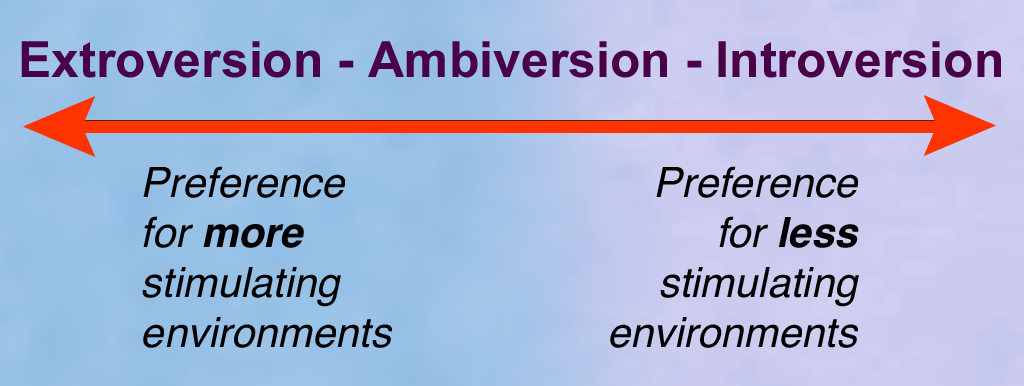

Core characteristics
Introversion is commonly associated with a preference for solitary or small-group settings, reflective activities, and lower levels of external stimulation. Extraversion is commonly associated with sociability, outward-focused attention, talkativeness, and a tendency to seek stimulating environments. These descriptions are tendencies, not absolute labels: individuals usually show a mix of both qualities, and context can alter behaviour.
Common misconceptions
- Shyness vs. introversion: Shyness is social anxiety or inhibition; introversion is a preference for lower stimulation and does not necessarily include fear of social situations.
- Affect and warmth: Introverts are not inherently unemotional and extraverts are not always more emotionally expressive in every situation.
- Capability: Introversion does not imply poor leadership or social skills; many introverts lead effectively using listening, reflection, and selective interaction.
History and theoretical development
The distinction gained prominence through the work of Swiss psychiatrist Carl Jung in the early 20th century, who described inward- and outward-oriented attitudes. Since then, the dimension has been incorporated into major trait models, including contemporary frameworks where extraversion is one of the Big Five personality factors. Researchers have refined definitions and measurement methods, treating extraversion/introversion as part of broader personality profiles rather than a single binary category.
Uses and practical importance
Understanding where someone falls on the extraversion–introversion spectrum has practical applications in education, workplace design, team composition, therapy, and personal development. For example, managers may balance team tasks to match people’s stimulation preferences, and educators can vary classroom activities to engage both reflective and outgoing learners. Personality inventories often include items measuring this trait to predict social engagement, job fit, and well-being.
Variations, measurement and notable facts
Different cultures and contexts influence how extraversion and introversion are expressed and valued. Surveys and research suggest proportions of self-described introverts and extraverts vary by population and by the measurement method used; claims about majorities in particular countries should be interpreted cautiously. Psychologists measure the dimension with questionnaires and behavioural observations, and many models recognise intermediate or ambivert profiles—people who show a balance of traits.
Further reading
- Introductory material on personality and trait theory: Personality overview.
- Historical sources and Jungian context: Carl Jung and typology.
Related articles
Author
AlegsaOnline.com Extraversion and Introversion: A Personality Dimension Leandro Alegsa
URL: https://en.alegsaonline.com/art/47881