
Interstate Highway System (United States)
The nationwide network of controlled‑access highways created mid‑20th century to connect American cities, support defense and commerce, and standardize long‑distance road travel.
The Interstate Highway System is a nationwide network of high‑capacity, limited‑access roads that form the principal long‑distance highway backbone of the United States. Designed for relatively high speeds and uninterrupted flow, the system links major cities, ports and military installations. Its routes vary from rural four‑lane divided highways to urban multi‑lane freeways, and they are integral to freight movement, commuter travel and emergency response.
Image gallery
10 Images


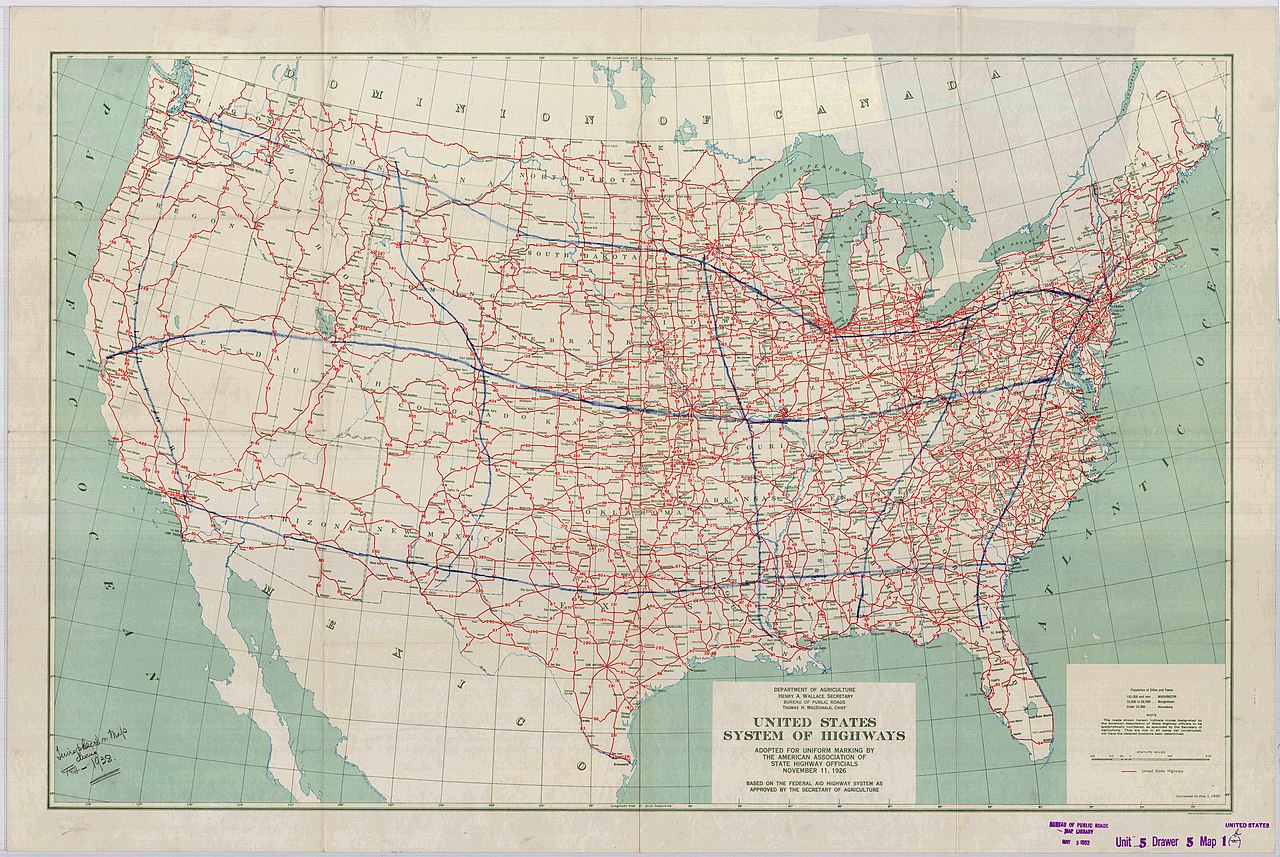


Design and standards
Interstate routes are built to specific engineering standards meant to maximize safety and traffic flow: continuous grade separation, controlled access (entrances and exits via ramps rather than intersections), wide lanes and shoulders, and limited curvature and steepness on major routes. Typical features include rest areas, service plazas or roadside facilities every several dozen miles, and consistent signage. While most mileage is toll‑free, some segments use tolling to fund construction or maintenance; toll collection practices vary by state and corridor. State departments of transportation perform daily maintenance while federal programs provide matching funds for larger projects.
Numbering system and examples
The numbering convention helps drivers understand direction and function. Two‑digit interstates: even numbers generally run east–west, odd numbers run north–south; numbers increase from south to north and west to east. Major transcontinental or long routes often end in 0 or 5. Three‑digit interstates are auxiliary routes—loops, spurs or bypasses—whose last two digits identify the parent route. Familiar examples include I‑95 on the East Coast, I‑10 across the southern states and I‑80 stretching coast to coast in the north.
History and development
The modern system grew from mid‑20th century planning and national priorities. Influenced by military logistics and by leaders who had seen limited‑access highways abroad, the federal government enacted the Federal Aid Highway Act of 1956 to create a coordinated program of construction and funding. President Dwight D. Eisenhower is commonly associated with championing the system. Most primary construction occurred from the late 1950s through the 1970s and into the 1980s, though new segments and upgrades continue to be added.
The Interstate system reshaped American life: it accelerated long‑distance travel and trucking, contributed to suburban growth, and influenced the location of industry and retail. At the same time it produced notable social and environmental consequences, including the displacement of neighborhoods during urban freeway construction and increased vehicle emissions. Its defense mission remains formalized in legislation that recognizes the network's strategic importance.
Today the network comprises roughly tens of thousands of miles and is managed cooperatively by federal and state agencies. Many corridors are the subject of ongoing modernization—adding lanes, improving interchanges, and incorporating intelligent transportation systems. Some segments use tolling or public‑private partnerships to finance major projects; for example, selected bridges and turnpikes collect fees to support operations and capital work. For further technical, historical or policy details follow official references and resources provided by transportation authorities and research organizations.
Additional resources: toll and financing information, and authoritative historical or planning documents available through national and state transportation agencies.
Related articles
Author
AlegsaOnline.com Interstate Highway System (United States) Leandro Alegsa
URL: https://en.alegsaonline.com/art/47833
Sources
- history.com : "The Interstate Highway System"
- interstate-guide.com : "All About Interstate Highways"