
Il Canto degli Italiani (Inno di Mameli)
Overview of Italy's national anthem: origins, authorship, musical setting, role in the Risorgimento, adoption by the Republic, and its cultural uses and distinctions.
Overview
Il Canto degli Italiani, commonly called Inno di Mameli or by its opening words Fratelli d'Italia, is the anthem most closely associated with the modern Italian state. Written as a patriotic hymn in 1847, it became widely linked to the Risorgimento — the 19th-century movement for Italian unification — and later came to serve as the national anthem of the Italian Republic. The song is known both for its stirring text and for a brisk, march-like musical setting that has been used in official and public ceremonies.
Image gallery
10 Images







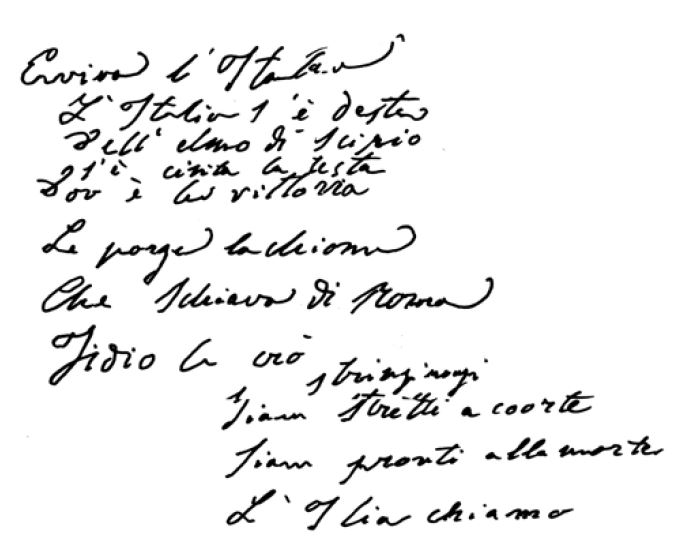
Words and music
The lyrics were composed by the young poet and patriot Goffredo Mameli in Genoa in 1847. The text expresses appeals to unity and liberty, beginning with the famous line "Fratelli d'Italia" ("Brothers of Italy"). In the same year the poet's words were set to music by Michele Novaro. Performances commonly present the first stanza and the refrain rather than the entire poem, which contains several verses reflecting the political hopes of its time.
Characteristics and structure
- Form: hymn-like march with a clear refrain that reinforces the central appeal to national unity.
- Textual tone: patriotic and forward-looking, using direct exhortations and historical references customary in 19th-century national songs.
- Typical performance: abridged renditions (first stanza and chorus) are used at sporting events, official ceremonies, and television broadcasts.
Historical background
The song emerged during the Risorgimento, when various regional and republican movements sought to end foreign rule and consolidate the Italian peninsula into a single nation. After the proclamation of the Kingdom of Italy in 1861, the royal anthem Marcia Reale (the Royal March of the House of Savoy) served as the official anthem for decades. Following the referendum that established the Italian Republic in 1946, Il Canto degli Italiani acquired its role as the primary anthem of the new republic and has been used in national contexts ever since.
Adoption, legal status and education
While the hymn was embraced by public sentiment after 1946, its use has been regulated and reinforced through subsequent government decrees and educational policies. In recent decades Italian authorities have encouraged knowledge of the anthem in schools: for example, in 2012 a parliamentary measure promoted teaching the anthem's opening lines in classrooms so that pupils would learn the words and their historical significance. The precise legal formalities that define anthem protocols are set out in national regulations and ceremonial guidelines.
Uses, cultural importance and notable facts
Il Canto degli Italiani functions as a symbol of national identity and is performed at state ceremonies, military events, and international sports fixtures. Its opening line, often cited alone, has become a recognizable national motto and is used in cultural and political discourse. The anthem's author and composer remain notable figures in Italian cultural memory: Goffredo Mameli for his youthful patriotism and Michele Novaro for a melody that retained popular appeal through changing political regimes. The city of Genoa is frequently associated with the song's origin, and historical references to the pre-unification era explain many of the poem's images and calls to arms. For more general reading on the anthem's place in Italy's history, see official histories and educational resources available through public institutions and cultural archives (further information).
Distinctions and related names
The hymn is often referred to interchangeably as Il Canto degli Italiani, Inno di Mameli (honoring its lyricist) and Fratelli d'Italia (from its opening words). These alternative names reflect different emphases — authorial, textual, and popular — and all are commonly used in media and scholarship. Although many national events feature the anthem in an abridged form, full-text editions are preserved in historical anthologies that document its original verses and variants from the period of the Risorgimento.
Overall, the hymn remains a prominent and widely recognized emblem of modern Italy, linking nineteenth-century aspirations with twentieth- and twenty-first-century civic life.
Related articles
Author
AlegsaOnline.com Il Canto degli Italiani (Inno di Mameli) Leandro Alegsa
URL: https://en.alegsaonline.com/art/46669