
Ideal gas law
The ideal gas law relates pressure, volume, temperature and amount of a hypothetical ideal gas (pV = nRT). Covers its meaning, assumptions, history, applications, and limitations versus real gases.
The ideal gas law is a fundamental equation in thermodynamics and physical chemistry that links four macroscopic properties of a simple gas: pressure (p), volume (V), absolute temperature (T) and amount of substance (n). In its most common form it is written as pV = nRT, where R is the universal gas constant. This relation expresses how a sample of gas responds when one of its state variables changes, assuming the gas behaves ideally.
Image gallery
2 Images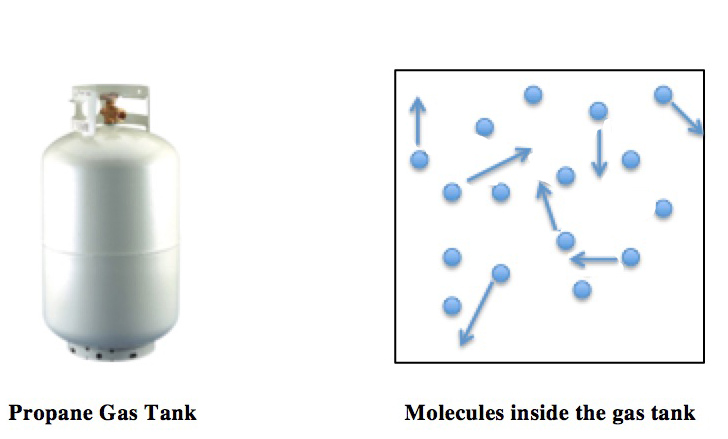

Variables and forms
Each symbol in the equation has a clear meaning: p is pressure, typically measured in pascals (Pa); V is the volume occupied by the gas (m3 in SI); n is the amount in moles; T is absolute temperature in kelvins; and R is the gas constant (approximately 8.314 J·mol−1·K−1). Equivalent formulations are used in kinetic theory, for example pV = NkB T, where N is the number of particles and kB is Boltzmann's constant. For quick calculations the law can be rearranged to find any single variable: n = pV/(RT), V = nRT/p, and so on.
Assumptions and limitations
The ideal gas law is an approximation that applies when gas particles are small compared with the distances between them and interparticle forces are negligible except during elastic collisions. These conditions are approached at low pressure and high temperature. Deviations occur for dense gases, low temperatures, or gases with significant intermolecular forces. Corrections and more elaborate models—such as the van der Waals equation or virial expansions—account for finite molecular size and attractions and produce better agreement with measured behavior.
History and theoretical basis
The formula unites earlier empirical laws: Boyle’s law (p∝1/V at constant T), Charles’s law (V∝T at constant p), and Avogadro’s hypothesis (equal volumes contain equal numbers of molecules at the same T and p). The combinaton was discussed in the nineteenth century by scientists such as Benoît Paul Émile Clapeyron and later given a kinetic interpretation by molecular theories that relate pressure to particle momentum transfer.
Uses and examples
- Chemistry laboratories and stoichiometry: converting gas volumes to moles and vice versa for reactions that involve gases.
- Engineering and HVAC: estimating how pressure and temperature changes affect contained gases in engines, compressors, and storage vessels.
- Atmospheric science and meteorology: first-order models of air parcels and buoyancy use ideal-gas relations.
- Education and problem solving: the law provides a simple context to illustrate relationships among state variables and to introduce kinetic theory.
Related concepts and notable facts
The ideal gas law connects macroscopic measurements with microscopic ideas: temperature is proportional to average kinetic energy of particles, and pressure arises from momentum transfer in collisions. When comparing gases, the law implies that equal moles occupy equal volumes at a given temperature and pressure. Practical use often requires awareness of the law’s limits; engineers and scientists apply correction factors such as the compressibility factor (Z) to gauge how closely a real gas follows ideal behavior.
For further reading on the conceptual definition of an ideal gas or on how to quantify an amount of gas, consult introductory thermodynamics or physical chemistry resources.
Related articles
Author
AlegsaOnline.com Ideal gas law Leandro Alegsa
URL: https://en.alegsaonline.com/art/46516