
I Am Legend (novel)
1954 horror novel by Richard Matheson that reimagined vampires as a disease-driven apocalypse, influencing zombie fiction and adapted for several films.
Overview
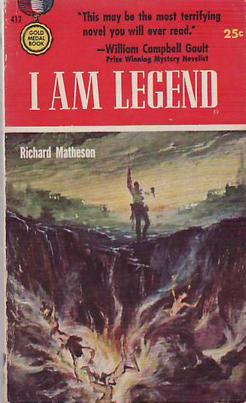
I Am Legend is a 1954 horror novel by Richard Matheson. Told mainly in the voice of the lone survivor Robert Neville, it combines elements of horror and speculative science fiction to examine isolation, fear, and what makes someone "monstrous". Matheson frames supernatural phenomena in clinical terms, which was a departure from traditional gothic vampire tales.
Image gallery
3 Images

Plot and themes
The story follows Neville as the apparent last human in a world overrun by creatures that resemble vampires. He spends his days scavenging, researching the cause of the plague, and experimenting in an effort to understand and reverse the condition. The book explores themes of solitude, survival, scientific method versus superstition, and the relativity of normality: as a new social order emerges, Neville comes to be seen as a dangerous anomaly rather than a hero.
Publication and adaptations
The novel was commercially successful and adapted for film several times. Notable screen versions include:
- The Last Man on Earth (1964), a relatively faithful black-and-white adaptation.
- The Omega Man (1971), a more action-oriented, color reimagining.
- I Am Legend (2007), a major Hollywood film that modernized setting and effects and altered key narrative elements.
- A direct-to-video production titled I Am Omega appeared in 2007, borrowing the premise for a low-budget release.
Influence and legacy
Matheson’s novel is frequently cited as an important influence on later depictions of the undead and on post-apocalyptic fiction more broadly. Its idea of a widespread, disease-like affliction helped shift popular horror from purely supernatural explanations toward biological or societal collapse scenarios. Filmmakers and writers working in the zombie and pandemic subgenres have acknowledged or shown the novel’s impact, and the book is often mentioned in discussions of works such as Night of the Living Dead, which expanded the concept into the modern zombie film.
Notable distinctions
Two aspects make the novel distinct: its insistence on a pseudo-scientific explanation for vampirism, and its moral reversal at the close, where the survivor becomes a legend to the new community of infected. These choices invite readers to question who deserves the label "monster" and to consider how cultural norms can flip under extreme change.
Related articles
Author
AlegsaOnline.com I Am Legend (novel) Leandro Alegsa
URL: https://en.alegsaonline.com/art/46249