
Howl's Moving Castle (2004 film)
2004 Japanese animated fantasy film directed by Hayao Miyazaki and produced by Studio Ghibli; adapted from Diana Wynne Jones's novel. Known for hand-drawn animation, music by Joe Hisaishi, and anti-war themes.
Howl's Moving Castle is a 2004 Japanese animated fantasy film directed by Hayao Miyazaki and produced by Studio Ghibli. It is an adaptation of the novel by Diana Wynne Jones and was released internationally with an English-language version handled by a major distributor. The film blends fairy-tale elements, imaginative mechanical design, and a human-scale story of change and courage. For background on the original novel see Diana Wynne Jones and for studio information see Studio materials.
Image gallery
9 Images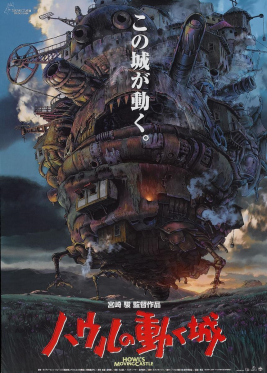



Visual style and music
Miyazaki's film features traditional hand-drawn animation, detailed painted backgrounds, and inventive mechanical imagery centered on the titular walking castle. The visual approach emphasizes fluid character motion and richly textured environments. The musical score, composed to complement the film's moods, supports both intimate scenes and larger, more dramatic sequences.
Plot overview
The story follows Sophie, a young hatmaker who is transformed into an elderly woman by a witch's curse and seeks refuge with the mysterious wizard Howl. Inside Howl's moving castle she meets a fire demon bound to the house and becomes entangled in Howl's struggle to avoid involvement in a war that threatens their world. The narrative mixes personal transformation with external conflict, using magical motifs to explore identity and responsibility.
Characters and elements
- Sophie: protagonist whose unexpected change forces self-discovery.
- Howl: charismatic, sometimes vain wizard with a hidden vulnerability.
- Calcifer: a living flame bound to the castle, central to its motion.
- Witch of the Waste and the walking castle: catalysts for the plot.
Themes and adaptation
The film emphasizes themes of transformation, love, and the human cost of war. Miyazaki's adaptation changes and rearranges aspects of the source novel, placing greater visual and emotional emphasis on anti-war sentiment and on the film's atmosphere. These choices reflect the director's recurrent interests in pacifism, the burdens of adulthood, and the dignity of ordinary people.
Release and reception
Released widely in Japan and internationally, the film drew critical praise for its artistry, imaginative production design, and emotional warmth. It helped further establish Studio Ghibli and Hayao Miyazaki in global cinema, and has been discussed in studies of animation, adaptation, and contemporary fantasy film. For a general film entry and release details see film information and for director-related resources see Hayao Miyazaki.
Howl's Moving Castle remains a frequently cited example of modern animated filmmaking that combines literary adaptation with a distinctive visual and moral sensibility. Its mixture of small-scale character moments and larger social concerns continues to invite both popular appreciation and scholarly attention.
Related articles
Author
AlegsaOnline.com Howl's Moving Castle (2004 film) Leandro Alegsa
URL: https://en.alegsaonline.com/art/45452