
House of Representatives (Netherlands) — Tweede Kamer
The Tweede Kamer is the directly elected lower house of the Dutch parliament. It has 150 members, strong legislative and oversight powers, and plays a central role in forming and scrutinising government.
Overview
The House of Representatives, commonly called the Tweede Kamer, is the lower chamber of the bicameral States General of the Netherlands. As the directly elected house it leads parliamentary scrutiny, proposes and amends legislation, and holds the government accountable. Its procedures and authority make it the dominant partner in the Dutch legislative process.
Image gallery
4 Images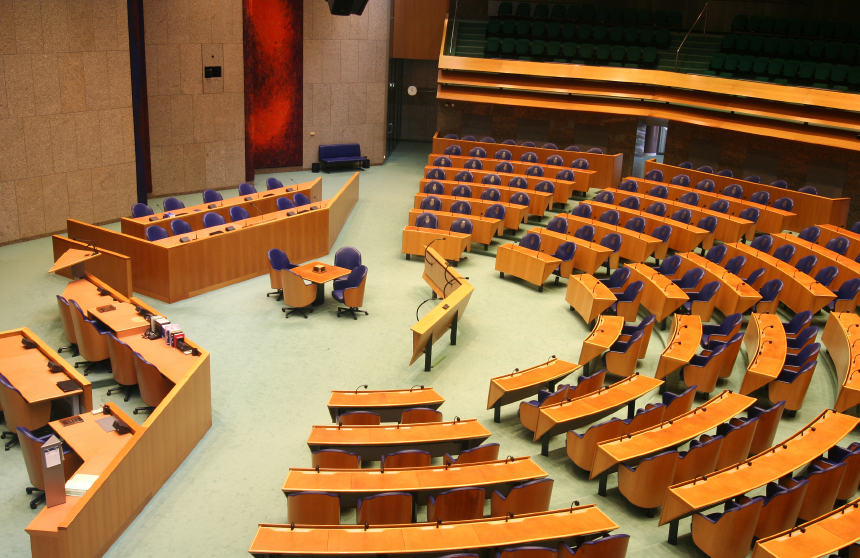


Composition and elections
The chamber consists of 150 members elected by direct popular vote for a maximum four-year term; early elections can occur if the government falls. Representatives are chosen by nationwide party lists under a system of proportional representation, so a single seat corresponds to roughly one one-hundred-and-fiftieth of the vote (about 0.67%), which encourages a multiparty parliament. Voters may influence which candidates on a list are elected through preference votes.
Powers and functions
The Tweede Kamer has broad powers: it can initiate and amend legislation, approve budgets, and must give confidence to the cabinet. It exercises oversight by questioning ministers, holding debates, and passing motions including motions of no confidence. The chamber can also set up parliamentary inquiry committees to investigate issues of public concern and relies on permanent committees to scrutinise proposed laws and monitor policy areas.
History and seat
The modern Tweede Kamer evolved from earlier representative assemblies and was shaped by constitutional reforms in the 19th and early 20th centuries that strengthened parliamentary government and introduced proportional representation. The chamber meets in the Binnenhof complex in The Hague; its sessions are public and widely reported, reflecting its central role in national politics.
Role in government formation and notable features
Because Dutch politics is highly plural, the Tweede Kamer often contains many parties and coalition-building is routine. Election outcomes determine negotiations to form a governing coalition and a policy agreement that the cabinet must defend in the chamber. Compared with the upper house (Eerste Kamer), which only reviews and accepts or rejects laws, the Tweede Kamer actively shapes legislation and exercises day-to-day scrutiny of ministers and policy.
- Members: 150
- Term: up to four years (early dissolution possible)
- Main roles: legislate, amend bills, scrutinise government, authorise budgets
Related articles
Author
AlegsaOnline.com House of Representatives (Netherlands) — Tweede Kamer Leandro Alegsa
URL: https://en.alegsaonline.com/art/45332
Sources
- houseofrepresentatives.nl : Official website
- kiesraad.nl : www.kiesraad.nl