
House of Councillors (Japan)
The upper chamber of Japan’s National Diet, the House of Councillors reviews legislation, represents prefectural and national electoral interests, and serves as a deliberative check on the lower house.
Overview
The House of Councillors (参議院, Sangiin) is the upper house of the National Diet of Japan. It sits alongside the House of Representatives, which is the lower house, forming Japan’s bicameral legislature under the postwar constitution. The chamber plays a central role in debating, amending and approving national laws.
Image gallery
3 Images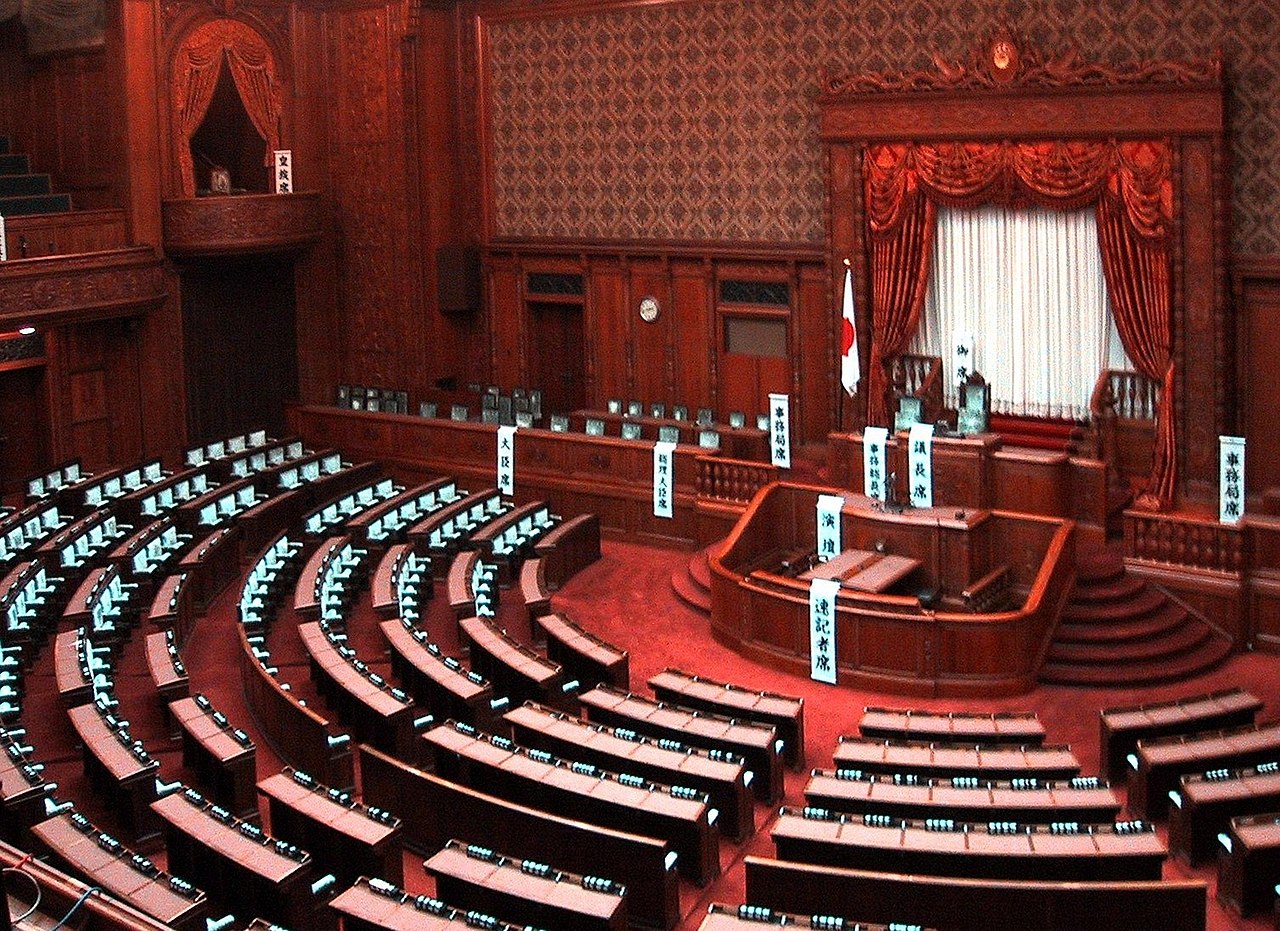


Structure and membership
The House of Councillors currently has 242 members who serve six‑year terms. Membership is staggered so that roughly half of the seats are contested in elections every three years. Candidates must meet a minimum age requirement (30 years) that is higher than that of the lower house. The chamber includes officers such as the President and Vice‑President, who are chosen from among its members to preside over sessions and manage proceedings.
Electoral system and composition
Members are elected by a mixed system: a portion represent prefectural constituencies and another portion are chosen from nationwide party lists under proportional representation. This combination is intended to balance local interests with nationwide party support. Because the chamber cannot be dissolved, its membership provides continuity across administrations.
Powers and role
The House of Councillors examines bills, budgets and treaties, proposes amendments, and conducts inquiries and committee hearings. While it has significant deliberative authority, certain constitutional provisions give the lower house primacy in specific cases—notably budgetary measures, treaty decisions and the selection of the prime minister—and the lower chamber can override the upper chamber under defined procedures.
History and notable features
Established by the post‑war constitution, the House of Councillors replaced the prewar aristocratic House of Peers and was designed to be a reflective, less partisan body. It emphasizes committee work and review rather than direct executive formation. Its fixed terms, staggered renewals and mixed electoral base distinguish it from the often more politically volatile lower house.
Importance and contemporary role
As a revising chamber, the House of Councillors contributes to legislative scrutiny and policy debate, helping to moderate rapid shifts in law and to represent regional voices. Its composition and procedures influence how legislation is shaped and how political balance is maintained within Japan’s parliamentary system.
Related articles
Author
AlegsaOnline.com House of Councillors (Japan) Leandro Alegsa
URL: https://en.alegsaonline.com/art/45307