
Annie Jump Cannon
Annie Jump Cannon (1863–1941), American astronomer who developed the Harvard spectral classification, cataloged hundreds of thousands of stars, and helped professionalize women’s roles in astronomy.
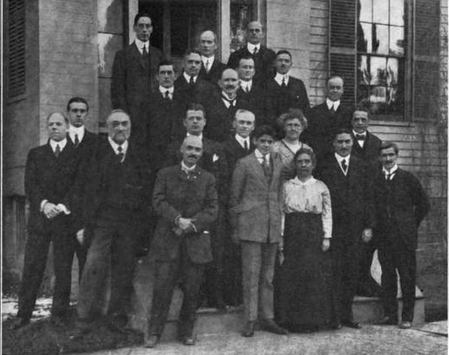
Annie Jump Cannon was an American astronomer born on December 11, 1863, in Dover, Delaware. She died on April 13, 1941, in Cambridge, Massachusetts. For a concise life summary see biographical sources. Cannon spent most of her professional life at the Harvard College Observatory, where she became one of the best known members of the group of women assistants often called the "Harvard Computers."
Image gallery
6 Images


Contributions to spectral classification
Cannon is best known for developing a practical, reproducible system for classifying stellar spectra. Building on earlier work at Harvard, she simplified and ordered spectral types into the sequence O, B, A, F, G, K, M, arranged by decreasing surface temperature. Her system emphasized observable patterns in photographic spectra and consistent standards that could be applied across large plate collections.
Work and methodology
Working with photographic plates, Cannon compared absorption features and arranged stars into classes by eye, using standard reference spectra she helped define. She combined systematic visual comparison with meticulous record-keeping and was responsible for the classification of hundreds of thousands of stars. Her careful curation of photographic records and catalogues made large datasets usable for later research in stellar astrophysics.
Role at Harvard and collaboration
At the Harvard College Observatory she worked under the direction of Edward C. Pickering and alongside colleagues such as Williamina Fleming and Henrietta Swan Leavitt. The collective effort at Harvard produced major catalogues, including contributions to the Henry Draper Catalogue, which made spectral data widely available to astronomers around the world.
Impact and legacy
Cannon's classification scheme provided an observational foundation for studies of stellar temperature, composition and evolution and remains the basis for spectral type labels used in modern astronomy. She helped establish standards that allowed astronomers to compare results from different observatories and eras. An award named in her honor recognizes the achievements of early-career astronomers and commemorates her role in supporting women in science.
Personal notes
Cannon lived much of her life with partial hearing loss and devoted herself to research and teaching rather than a conventional domestic life. She received recognition during and after her career in the form of honors and honorary degrees; her professional example opened doors for women in observational astronomy and archival work.
Further reading
- Survey of Cannon's scientific contributions and cataloguing work: see institutional archives and historical surveys at major observatories (biographies and curated collections).
- Context on the Harvard Computers and the Henry Draper Catalogue in histories of astronomy and archival literature (astronomical histories).
Related articles
Author
AlegsaOnline.com Annie Jump Cannon Leandro Alegsa
URL: https://en.alegsaonline.com/art/4461