
Annie Oakley: American sharpshooter and cultural icon
Phoebe Ann 'Annie Oakley' Mosey (1860–1926) was a celebrated American sharpshooter best known for her Wild West performances, trick shooting feats, and influence on popular perceptions of women and marksmanship.
Overview
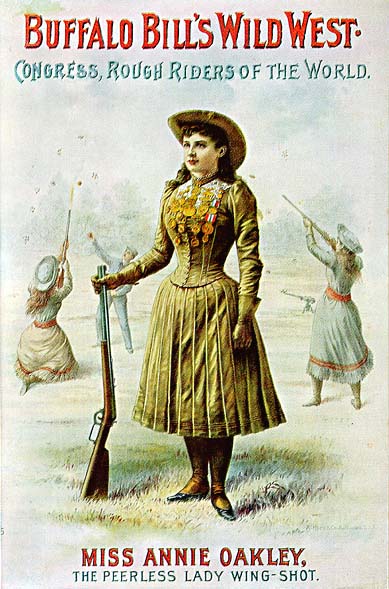
Phoebe Ann "Annie Oakley" Mosey (August 13, 1860 – November 3, 1926) was an American sharpshooter who became internationally famous for her precise rifle and pistol work and for performing as a star attraction in touring spectacles. Billed as "Little Sure Shot," Oakley combined technical skill with theatrical showmanship to reach large audiences in the United States and Europe. Her public persona helped make shooting sports familiar to civilians and helped broaden ideas about women’s capabilities in a changing society.
Image gallery
7 Images


Early life and beginnings
Oakley was born in rural Ohio to Jacob and Susan Mosey. Her childhood included hardship and limited formal education, circumstances that led her to develop practical skills, among them hunting to help feed the family. Oakley learned to shoot at a young age and began entering local shooting contests, where she demonstrated remarkable accuracy. These early contests established her reputation and provided a pathway from modest local notice to professional exhibition work.
Career and public performances
In 1882 she married fellow marksman Frank E. Butler; the two later joined William F. Cody's touring extravaganza and became fixtures of Buffalo Bill's Wild West. Oakley traveled widely with the show and also performed in standalone engagements, presenting routines designed both to astonish and entertain. She and Butler toured extensively, including performances before European audiences. Contemporary accounts report that she shot for members of royalty and state leaders, among them appearances before figures such as Queen Victoria and Kaiser Wilhelm II.
Style, repertoire and notable feats
Oakley’s act mixed competitive accuracy with daring trick shots executed under theatrical conditions. Her repertoire included demonstrations of hitting small moving and stationary targets at distance, breaking multiple objects with single shots, and routine feats that required steady aim and timing. She became known for precision stunts such as shooting small objects held by an assistant and hitting targets while mounted or on the move.
- Teaching and demonstration: Oakley sometimes instructed others in shooting technique and promoted safe firearm handling.
- Trick shooting: A steady, practiced style that emphasized repeatable accuracy more than spectacle alone.
- Public image: She maintained a professional demeanor and often rejected sensationalism that might have endangered others.
Later life, advocacy and death
Oakley left the touring company in the early 1900s and later pursued occasional stage and film work while remaining a public figure. During the First World War era she offered to support national defense efforts by promoting marksmanship and reportedly sought to organize or train women for sharpshooting roles, though formal military enlistment of women in that capacity did not materialize. In her final years she suffered from pernicious anemia, a condition linked to vitamin B12 deficiency that at the time was often fatal. Oakley died in 1926 and was buried in Greenville, Ohio; her husband Frank Butler died shortly thereafter.
Legacy and cultural influence
Annie Oakley left a lasting cultural legacy that extends beyond her onstage accomplishments. She became a symbol of female independence and technical excellence in an era when public roles for women were expanding. Oakley’s life inspired popular portrayals and artistic works that often fictionalized events but kept her name in the public imagination; one of the most widely known is the stage musical that drew on aspects of her career and popularized an embellished version of her story. Her influence is also evident in the growth of recreational shooting, the acceptance of women in certain sporting disciplines, and the continuing interest in American frontier entertainment traditions.
Notable facts
- She was born Phoebe Ann Mosey and later adopted the stage name "Annie Oakley."
- She married fellow marksman Frank E. Butler in 1882; they often performed together.
- Oakley toured internationally and performed for prominent heads of state in Europe.
- Her death was attributed to pernicious anemia, and she was laid to rest in Greenville, Ohio (Ohio).
For further reading and archival materials about Oakley’s life and performances, see collections and exhibitions that focus on American frontier shows and the development of popular entertainment in the late 19th and early 20th centuries: Buffalo Bill collections, contemporary press archives, and specialized museums and libraries hold extensive primary sources on her career.
Related articles
Author
AlegsaOnline.com Annie Oakley: American sharpshooter and cultural icon Leandro Alegsa
URL: https://en.alegsaonline.com/art/4463
Sources
- news.google.com : "Woman Rifle Expert Dies"
- books.google.com : "Annie Oakley:She Was the World's Best Woman Shot"