
Anne Hathaway (wife of William Shakespeare)
Anne Hathaway (c.1555–1623) was the wife of playwright William Shakespeare. Little documentary evidence survives; she lived in Stratford-upon-Avon, bore three children, and is buried beside her husband.
Overview
Anne Hathaway (c.1555/56–6 August 1623) is best known as the spouse of the English dramatist William Shakespeare. Compared with her husband, documentary traces of Anne are sparse. What is known comes mainly from parish records, the marriage licence and later references in Shakespeare's will. She spent most of her life in the Stratford area rather than in London, where her husband pursued his career.
Image gallery
7 Images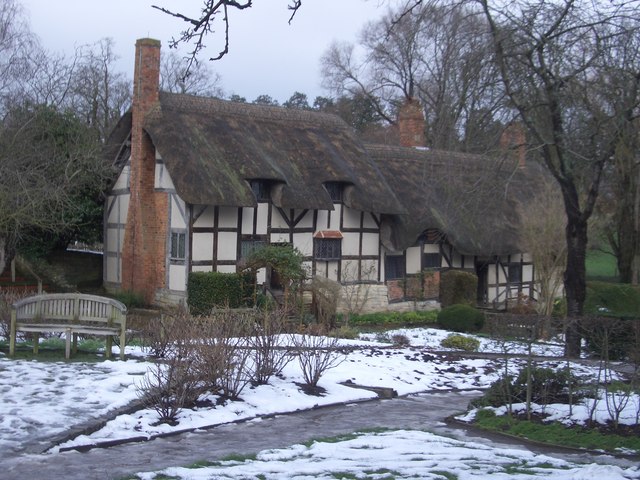


Life and family
Anne is believed to have been born in the mid-1550s and grew up in the village of Shottery near Stratford-upon-Avon. She married Shakespeare in November 1582 at Temple Grafton; the couple's first child, Susanna, was baptized in May 1583. Two years later twins Hamnet and Judith were baptized. Hamnet died in childhood in 1596. Little else about her personal activities, education or daily life is documented.
Marriage, household and will
The marriage has prompted much speculation because Shakespeare spent long periods in London while his family remained in Stratford. Surviving legal records include the marriage licence and the parish entries for baptisms and burials. When Shakespeare died in 1616 his will made a famously brief and enigmatic bequest to Anne — the "second-best bed" — while leaving the bulk of his estate to their daughter and other heirs. Scholars disagree about whether this was an affectionate gesture, a customary domestic arrangement, or evidence of strained relations.
Legacy and cultural image
Anne Hathaway's image has shifted over time. In the eighteenth and nineteenth centuries she was sometimes depicted as a neglected or shrewish wife, but modern historians caution that such characterizations rest on limited evidence. Today she is a figure of public interest largely because of her association with Shakespeare: her cottage in Shottery is preserved and visited, and the couple are buried together in the chancel of Holy Trinity Church in Stratford-upon-Avon.
Notable facts
- Marriage took place in late 1582 at Temple Grafton, near Stratford; parish records record the baptisms of Susanna and the twins.
- Anne remained in Stratford while her husband worked in London; their domestic arrangements are a subject of ongoing inquiry.
- The bequest of the "second-best bed" in Shakespeare's will is one of the most discussed personal details linking the couple.
- Her life and reputation have inspired literary and dramatic portrayals that reflect changing attitudes to women and marriage; see also cultural studies of Shakespeare's personal life for context.
Because primary sources about Anne Hathaway are limited, many aspects of her life remain a matter of careful interpretation rather than established fact. Her historical importance derives largely from her place within Shakespeare's biography and the social history of Tudor and early Stuart England.
Tags
Related articles
Author
AlegsaOnline.com Anne Hathaway (wife of William Shakespeare) Leandro Alegsa
URL: https://en.alegsaonline.com/art/4418
Sources
- william-shakespeare.info : "Anne Hathaway Biography"