
Hercule Poirot: Agatha Christie’s methodical Belgian detective
Hercule Poirot, created by Agatha Christie, is a Belgian private detective who appears in novels and short stories (1920–1975). Known for his 'little grey cells', meticulous habits and enduring cultural legacy.
Hercule Poirot is a fictional detective created by the English writer Agatha Christie. He first appeared in 1920 and went on to feature in thirty-three novels and fifty-one short stories published between 1920 and 1975. Poirot is often described simply as a fictional detective who relies on psychology, deduction and precise reasoning—what he calls his "little grey cells"—rather than violence or physical pursuit.
Image gallery
8 Images



Character and methods
Poirot is presented as a Belgian former police officer who settles in England as a private investigator. Christie gives him distinct personal traits: a carefully groomed waxed moustache, a fastidiousness about order, formal dress and a fondness for neat, elliptical speech. His technique emphasizes motive, opportunity and the careful arrangement of clues; he routinely observes small inconsistencies and contradictions in testimony and uses logical reconstruction to expose a culprit.
Supporting cast and recurring elements
Many stories use a recurring ensemble to support the detective plot. Captain Arthur Hastings often acts as a friend and narrator in early tales; Inspector Japp represents Scotland Yard and conducts official inquiries; Ariadne Oliver, a novelist, provides comic commentary and meta-fictional insight into Christie’s own craft. Country houses, trains and exotic locations provide varied backdrops, but the classical puzzle structure—with clues, red herrings and a final denouement—remains central.
Publication history and themes
Across five decades Christie adapted Poirot to changing tastes. The early works are tightly plotted puzzles; later novels sometimes probe character psychology and moral ambiguity. Recurring themes include justice versus vengeance, the reliability of testimony and the interplay of surface respectability and hidden motives. The last novel to feature Poirot was published in 1975, and the stories remain in continuous print and study.
Adaptations and portrayals
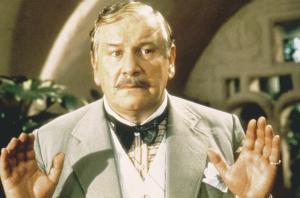
Poirot has been widely adapted for stage, radio, film and television. Notable actors who have played him include John Moffatt, Albert Finney, Sir Peter Ustinov, Sir Ian Holm, Tony Randall, Alfred Molina and David Suchet. David Suchet’s long-running television interpretation is particularly praised for its fidelity to Christie’s physical and psychological details, while film portrayals have varied in tone from reverent to broadly comic.
Legacy and critical reception
Poirot remains one of the most recognisable figures in detective fiction and a touchstone for the genre. Critics and readers value him as an exemplar of the cerebral sleuth, a character whose victories depend on intellect and moral clarity. Scholarly commentary often examines how Christie uses the detective figure to explore issues of class, truth and narrative form, and how Poirot’s ritualised mannerisms contribute to his lasting appeal.
Selected works
- The Mysterious Affair at Styles (1920) — Poirot’s debut.
- Murder on the Orient Express (1934) — a celebrated closed-circle mystery.
- Death on the Nile (1937) — a novel combining exotic setting and character tensions.
- Curtain (published 1975) — Poirot’s final appearance, concluding a long career.
Poirot’s influence extends beyond the books into film, television and popular culture. For readers approaching Christie for the first time, the Poirot stories offer a clear example of the classical detective novel: careful plotting, an emphasis on reasoning, and a memorable central figure whose habits and moral sense shape each investigation.
Related articles
Author
AlegsaOnline.com Hercule Poirot: Agatha Christie’s methodical Belgian detective Leandro Alegsa
URL: https://en.alegsaonline.com/art/43718