
Grendel (Beowulf)
Grendel is a principal antagonist in the Old English epic Beowulf. Often read as a monstrous descendant of Cain, the figure has inspired varied literary, historical, and critical interpretations.
Overview
Grendel appears as one of the principal antagonists in the Old English epic Beowulf, a poem composed between roughly the 8th and 11th centuries. In the narrative he is a hostile creature who attacks the Danish mead-hall Heorot at night, slaughtering warriors and spreading fear until the Geatish hero Beowulf comes to confront him. The poem identifies Grendel as a descendant of the biblical Cain, a detail used to explain his estrangement from human society and to link the story to a Christian moral framework (Cain).
Image gallery
3 Images
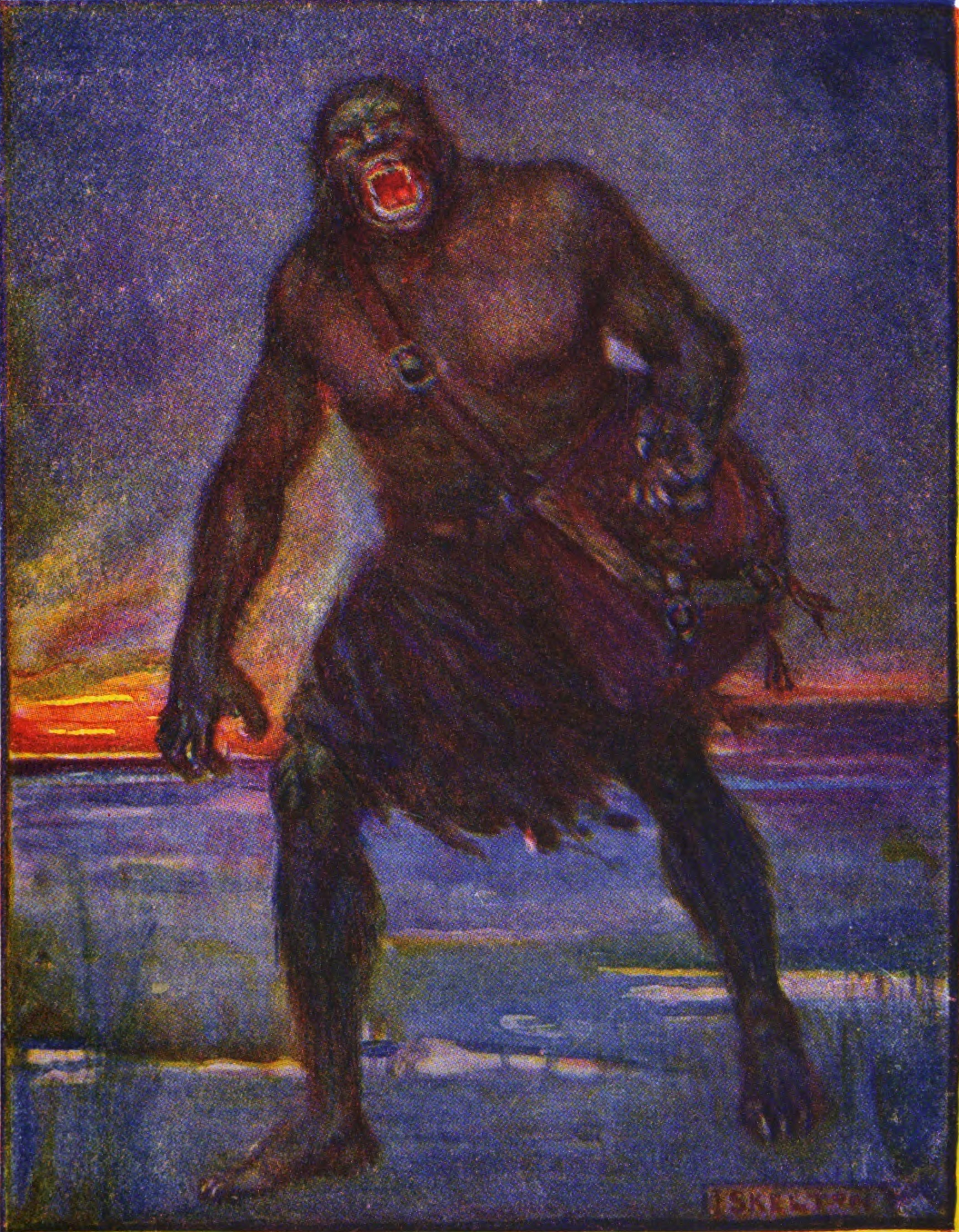

Characteristics and depiction
The text gives only a limited physical description, and as a result Grendel’s exact form is a matter of interpretation. Scholars and readers have variously imagined him as a gigantic humanoid, a monstrous beast, a demonic spirit, or a symbolic embodiment of social disorder. The poem emphasizes his isolation, nocturnal raids, and hatred of joy and music within Heorot, suggesting an antagonism toward communal life and human culture. Debate continues about whether the word choices in the poem indicate a fully supernatural being or a violent, alienated human-like figure (monster).
Literary context and origins
Grendel belongs to a tradition of monstrous antagonists in Germanic heroic literature. The poem situates him within a genealogy tracing back to Cain, aligning older pagan motifs of monsters with a Christian explanatory model. This blend of elements is characteristic of the manuscript’s cultural moment, in which oral heroic traditions were adapted and recorded by Christian scribes. The poem itself is often treated as a bridge between pagan legend and Christian moralizing storytelling (three antagonists).
Role in the poem
Within the narrative, Grendel’s incursions create a moral and social crisis that only Beowulf can resolve. The hero fights Grendel unarmed and ultimately mortally wounds him by tearing off his arm; later Grendel’s mother seeks revenge and is herself killed. These episodes underscore themes of heroism, kinship, vengeance, and the limits of earthly fame. Grendel’s defeat is a pivotal demonstration of Beowulf’s strength and the restoration of order to the community.
Interpretations and cultural influence
Scholars have read Grendel in many ways: as a literal monster, an embodiment of exile and otherness, a psychological symbol of the shadow self, or a representation of social anxieties in early medieval Scandinavia and England. The figure has had a lively afterlife in modern culture. Notable treatments include retellings and reinterpretations in novels, theatre, film, and academic studies. Examples include John Gardner’s novel that gives Grendel a first-person voice and numerous dramatic adaptations that examine morality and perspective.
Notable facts and distinctions
- Grendel is explicitly linked to Cain in the poem, a detail used to cast him as an outcast and a perpetual enemy of human society (Cain).
- The poem’s ambiguous language has allowed multiple visual and critical portrayals, from bestial fiend to tragic alienated creature (monster).
- Scholarly debate treats Grendel alongside two other major antagonists in the tale—the mother and the dragon—highlighting differing threats to community life (three antagonists).
- Modern readers often encounter Grendel through translations of Beowulf or through subsequent works that retell the story from alternative viewpoints (Beowulf).
Because the original poem survives in a single medieval manuscript and leaves many descriptive gaps, Grendel remains a rich subject for interpretation. His continuing presence in literature and criticism reflects enduring interest in questions of violence, exile, monstrosity, and the boundary between human and other.
Author
AlegsaOnline.com Grendel (Beowulf) Leandro Alegsa
URL: https://en.alegsaonline.com/art/40844