
Ginga (Astro‑C): Japanese X‑ray Astronomy Satellite
Ginga (Astro‑C) was a Japanese X‑ray astronomy satellite launched in 1987 by ISAS. It carried large‑area detectors and an all‑sky monitor to study X‑ray binaries, transients, and compact objects.
Overview
Ginga (Japanese: ぎんが, literally "galaxy") was a Japanese satellite dedicated to X‑ray astronomy. Sometimes identified as Astro‑C, it was designed to observe cosmic X‑ray sources with improved sensitivity and timing precision compared with earlier national efforts. The spacecraft provided important broadband spectral and temporal data on accreting neutron stars, black hole candidates, and transient X‑ray events.
Image gallery
3 Images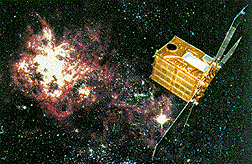


Instruments and characteristics
Ginga carried a compact suite of instruments optimized for bright and transient X‑ray phenomena. Key capabilities included:
- Large‑area proportional detectors to collect high count rates and enable detailed timing studies.
- An all‑sky monitor to detect and localize transient X‑ray outbursts and enable follow‑up observations.
- Spectroscopic and timing modes that allowed measurements across a broad X‑ray energy band, improving understanding of spectral features and variability.
Launch and mission history
The mission was developed and launched under the auspices of the Institute of Space and Astronautical Science of the University of Tokyo. The satellite was placed into orbit on February 5, 1987, beginning several years of scientific operations. Ginga remained active through the late 1980s and into the early 1990s, during which it carried out observations across the X‑ray sky.
Scientific contributions and legacy
Ginga made notable contributions by monitoring X‑ray transients, tracking rapid variability of compact objects, and providing better spectroscopic constraints for bright sources. Its combination of a large detector area and an all‑sky monitoring capability helped establish observational baselines for later missions and informed models of accretion and high‑energy emission from neutron stars and black holes. Results from Ginga influenced subsequent satellite designs and coordinated multiwavelength campaigns.
Distinctions and further reading
As a national milestone in Japanese X‑ray astronomy, Ginga is often cited as the third major 'Astro' mission and a bridge between early exploratory satellites and more modern observatories. For technical details, mission logs, and archived data summaries see mission pages and archives referenced by project documentation: mission overview.
Related articles
Author
AlegsaOnline.com Ginga (Astro‑C): Japanese X‑ray Astronomy Satellite Leandro Alegsa
URL: https://en.alegsaonline.com/art/38883
Sources
- isas.ac.jp : "Catalogue of ISAS Missions"