
AND gate (logical conjunction)
A digital logic gate that outputs true only when all inputs are true. Describes behavior, notation, truth table, common implementations, uses (masking, control, arithmetic), and related concepts.
Overview
An AND gate is a fundamental digital logic element that performs logical conjunction: its output is true (1) only when every input is true. In Boolean algebra the operation is written A AND B, A·B, or A ∧ B, and it behaves like multiplication of binary values where 1 represents true and 0 represents false. For a two-input gate the rule is simple: if either input is 0, the output is 0; only when both are 1 does the output become 1. For background on basic logic elements see logic gate overview.
Image gallery
3 Images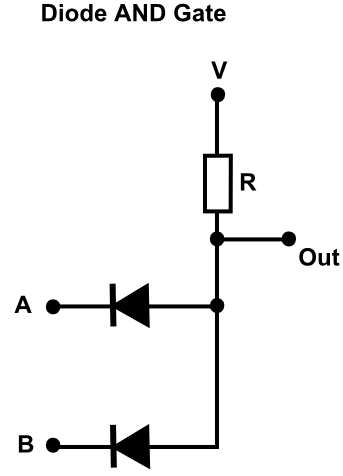
Truth table and notation
The two-input AND gate has four possible input combinations and the following outputs:
- 0 AND 0 = 0
- 0 AND 1 = 0
- 1 AND 0 = 0
- 1 AND 1 = 1
Because the operation mirrors multiplication in binary arithmetic, it is often treated as a product: A × B or A·B. For a broader mathematical discussion of multiplication as an analogy, consult multiplication resources. The analogy extends to continuous ideas of "zero times anything is zero" as noted in basic algebra multiplication of real numbers.
Symbols and variants
Schematics depict AND gates with distinctive symbols. The common American symbol is a curved D-shaped device with inputs on the left and output on the right; the IEC and other standards use different pictograms. Gates can have two or more inputs: a multi-input AND outputs 1 only when every input is 1. A NAND gate is the logical complement (NOT of AND) and is widely used because NAND and NOR gates are functionally complete: they can build any other logic function.
Implementations
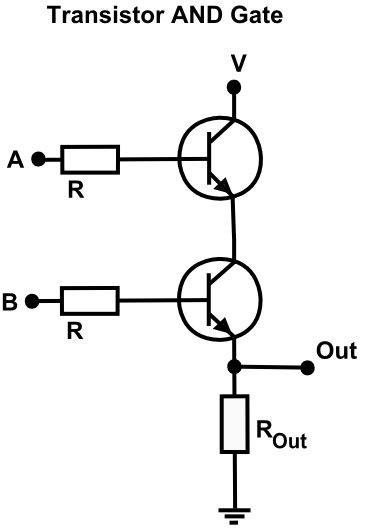
AND logic appears in many hardware forms: discrete transistor circuits, transistor-transistor logic (TTL), and CMOS integrated circuits. At the transistor level the gate is constructed so that a conducting path to the output exists only when all input-control transistors are in the conducting state. In programmable devices such as FPGAs, AND functions are realized inside lookup tables or configurable logic blocks.
Uses and examples
Practical uses of AND gates include enabling or gating signals, combining control conditions, and bitwise operations in software and hardware. In computing a bitwise AND masks selected bits of a word (clearing others), and in binary addition the generation of a carry bit for two single-bit addends is performed by an AND. Safety interlocks often use AND logic: multiple conditions must be satisfied before a machine starts.
Related concepts and notable facts
AND is one of the basic Boolean operators alongside OR and NOT. De Morgan's laws relate AND and OR through negation: NOT(A AND B) = NOT A OR NOT B. Designers must also consider real-world issues such as propagation delay, input loading, and hazards when combining gates; changes in inputs can produce transient glitches unless circuits are properly synchronized or buffered.
For introductory diagrams, tutorials, and practical examples consult general resources on logic gates and digital design: basic gates, arithmetic analogies, and algebraic foundations.
Tags
Related articles
Author
AlegsaOnline.com AND gate (logical conjunction) Leandro Alegsa
URL: https://en.alegsaonline.com/art/3867