
Fullmetal Alchemist
Japanese manga and anime by Hiromu Arakawa following brothers Edward and Alphonse Elric, their practice of alchemy, and a quest to restore lost bodies; noted for moral themes, worldbuilding, and multiple adaptations.
Fullmetal Alchemist is a widely known Japanese manga and anime franchise created by Hiromu Arakawa. The original Japanese title is 鋼の錬金術師. The narrative centers on a detailed, industrialized fictional world in which alchemy operates under strict rules and the principle of equivalent exchange. Across its print and animated forms the series mixes adventure, tragedy, and philosophical reflection, and it reached international audiences through official translations and several screen adaptations.
Image gallery
2 Images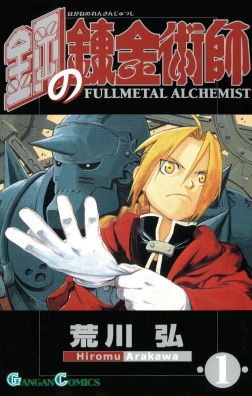

Premise and characters
The core story follows brothers Edward and Alphonse Elric, young alchemists who suffer devastating consequences after an attempt to restore their deceased mother goes wrong. Edward loses limbs and Alphonse loses his body, and the brothers pursue the mythical Philosopher's Stone as a possible means of restoration. The cast includes allies and antagonists from different social and political spheres: State Alchemists, soldiers, automail engineers, refugees, and figures known as the Homunculi. Supporting characters such as Roy Mustang and Winry Rockbell play recurring roles in both personal and political arcs. The series explores identity, responsibility, and the cost of seeking power.Publication and main adaptations
Arakawa's manga was serialized in Monthly Shonen Gangan and published in collected volumes by Enix, now part of Square Enix. The property has been adapted into two distinct television anime productions: a 2003 series that departs from the then-ongoing manga and an omnibus 2009 series, commonly referred to as "Brotherhood," that follows the completed manga storyline more closely. Both adaptations led to theatrical films: the 2003 continuity was concluded with a feature, and the later anime also received its own film release; the franchise has additionally produced a live-action film, novels, stage plays and games. For more on print editions see the manga entry and for broadcast and home-video releases see the anime entry.Themes and style
Fullmetal Alchemist is noted for balancing action-driven plot momentum with ethical and philosophical questions: the nature of sacrifice, the consequences of scientific experimentation, state power and militarism, and what it means to be human. Visual motifs and consistent internal rules for alchemy give the story a coherent logic that supports character development and moral dilemmas. The tone ranges from dark and tragic to moments of humor and warmth, with family and friendship forming a recurring emotional center.Reception and legacy
The franchise has achieved broad critical and popular recognition, often cited for its strong plotting, well-drawn characters and thematic depth. Scholars and fans frequently discuss its approach to moral ambiguity, its worldbuilding (including technologies like automail prosthetics), and the way it stages political and personal conflict. Fullmetal Alchemist remains a reference point in contemporary manga and anime, and it continues to be recommended to readers and viewers who seek mature storytelling within a fantasy-adventure framework.Practical notes
The two anime adaptations present different experiences: the earlier series develops an original conclusion, while the later adaptation adheres closely to the manga's ending. Readers and viewers new to the franchise may choose to begin with the manga or with the 2009 anime for the most faithful single-creator storyline. Be advised that the narrative includes scenes of violence, loss, and themes intended for older teens and adults.Questions and answers
Q: What is Fullmetal Alchemist?
A: Fullmetal Alchemist is a popular manga and anime series created by Hiromu Arakawa.
Q: What does the title 'Hagane no Renkinjutsushi' mean?
A: 'Hagane no Renkinjutsushi' is the Japanese title for Fullmetal Alchemist which means 'Alchemist of Steel'.
Q: What company serialized Fullmetal Alchemist?
A: Fullmetal Alchemist was serialized in Enix's (now Square Enix) Monthly Shonen Gangan.
Q: How many different anime shows were made based on Fullmetal Alchemist?
A: Two different anime shows were made based on Fullmetal Alchemist.
Q: Did the two different anime shows follow the same story?
A: No, the two different anime shows did not follow the same story.
Q: Were any films made based on Fullmetal Alchemist?
A: Yes, two films were made based on Fullmetal Alchemist - The Conqueror of Shamballa for the 2003 show and The Sacred Star of Milos for the 2012 show.
Q: Who created Fullmetal Alchemist?
A: Fullmetal Alchemist was created by Hiromu Arakawa.
Related articles
Author
AlegsaOnline.com Fullmetal Alchemist Leandro Alegsa
URL: https://en.alegsaonline.com/art/36984
Sources
- viz.com : "The Official Website for Fullmetal Alchemist"
- animenewsnetwork.com : "Fullmetal Alchemist's Arakawa Draws Cover for Irish Novelist"
- b2c.hachettebookgroup.com : Fullmetal Alchemist – Yen Press