
Front crawl: the fastest swimming stroke
Overview of the front crawl (crawl), its technique, history, uses in competitive freestyle, variations, and common training considerations.
Overview
The front crawl, commonly called the crawl or simply freestyle in informal contexts, is a forward-propulsion swimming stroke characterized by alternating overarm strokes and a continuous flutter kick. It is widely accepted as the fastest surface stroke and therefore the dominant choice for competitive freestyle events and open-water racing. Recreational swimmers also favor it for efficiency over longer distances.
Image gallery
7 Images


Key characteristics and technique
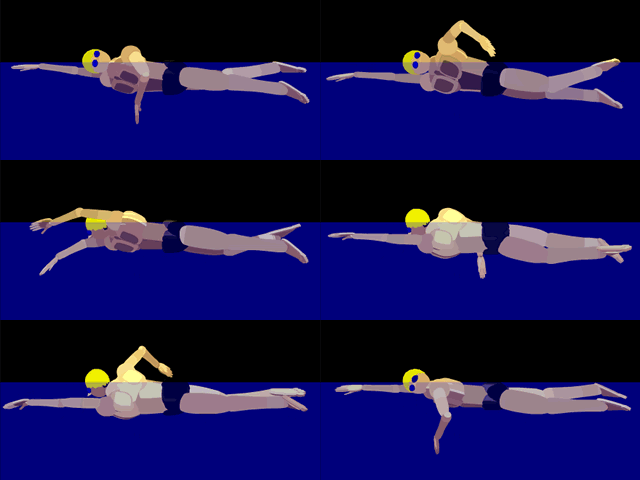
Efficient front crawl relies on a nearly horizontal body line, small head rotation for breathing, and an alternating arm cycle: one arm pulls underwater from entry to finish while the other recovers over the water. The flutter kick provides stabilizing thrust and helps maintain balance. Common technical elements include a high elbow during the underwater pull, a streamlined hand entry, rhythmic breathing (often on one or both sides), and core rotation that links arm and leg actions.
Components and common drills
- Body position: horizontal, hips near the surface to reduce drag.
- Arm action: continuous alternating pull with a propulsive catch and high-elbow pull.
- Kick: compact, fast flutter kick originating from the hips.
- Breathing: timed roll to the side rather than lifting the head.
Drills used in training include single-arm swims, catch-up, fingertip drag, and kicking with a board. Swimmers often use equipment such as fins, paddles, and snorkels to isolate and improve particular aspects of the stroke.
History and development
The crawl evolved during the late 19th and early 20th centuries as variations of overarm strokes and alternating kicks were combined and refined. Swimmers and coaches from different regions contributed to its development, which supplanted earlier front-and-side strokes because of superior speed and efficiency. Over decades it became standardized in competitive swimming technique and instruction.
Uses, advantages, and notable facts
Because it is the fastest stroke, front crawl is the default in freestyle races and a principal skill for triathletes and lifesavers. Its continuous propulsion makes it well suited to both sprint and endurance events. However, repetitive shoulder motion can lead to overuse injuries (often called swimmer's shoulder) if technique and conditioning are neglected.
Distinctions and practical guidance
Although ‘‘freestyle’’ races permit any stroke, front crawl is used almost universally at competitive levels due to its speed. Recreational swimmers should emphasize relaxed breathing, body rotation, and efficient hand entry before increasing pace. Beginners commonly work on balance and breath timing before layering on power and distance.
Further technical resources and coaching materials can be found through general swimming organizations and coaching guides; for basic references see entries on swimming technique and competitive freestyle rules.
Related articles
Author
AlegsaOnline.com Front crawl: the fastest swimming stroke Leandro Alegsa
URL: https://en.alegsaonline.com/art/36822
Sources
- books.google.com : Swimming Fastest
- swimswam.com : "The Origin of Freestyle, The Australian Crawl"