
Futsal: indoor five-a-side football — rules, history, and global influence
Futsal is a fast-paced, five-a-side variant of football played on a hard indoor court. This article explains its rules, court and ball, history, major competitions, and how it shapes player development worldwide.
Overview
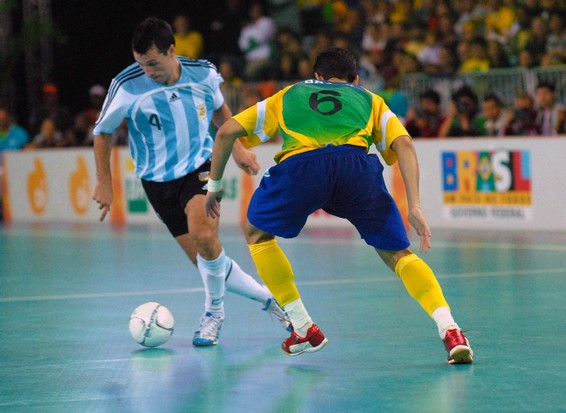
Futsal is a form of small-sided football played indoors on a hard, smooth surface. Its name derives from the Portuguese futebol de salão and the Spanish fútbol de sala, reflecting its roots in Latin languages and cultures. Because the game shares many principles with association football while using a smaller playing area and fewer players, it emphasizes close control, quick passing and fast decision-making. Futsal is particularly popular in parts of South America, especially in countries such as Brazil and Argentina, and it is played at amateur and professional levels around the world, including in urban and youth development programmes.
Image gallery
9 Images



Basic rules and match structure
A standard futsal match is contested by two teams of five players each on the court, including a goalkeeper. Matches are divided into two periods of twenty minutes of effective playing time (the clock stops at every dead ball), which is shorter than traditional 45‑minute halves in outdoor football. Substitutions are unlimited and are made on the fly from a designated substitution zone. Standard disciplinary measures apply: referees may issue yellow and red cards. A player sent off with a red card cannot return for the remainder of the match, and the team normally plays short-handed for a set period or until the opposing side scores.
Court, ball and equipment
The playing surface in futsal is a hard court rather than grass; typical dimensions are smaller than an outdoor pitch. Official recommendations place the court length and width within specified ranges, and a typical indoor court will be notably shorter and narrower than a football field. For example, standard guidance covers a futsal pitch and suggested dimensional ranges to suit competitive play. The ball used in futsal is smaller and has reduced bounce compared with a regular football, encouraging ground passing and ball control. There is no offside rule in futsal, which changes tactical patterns and allows for more fluid attacking movement compared with outdoor football; see the note on the offside rule for contrast.
Origins and development
Futsal emerged in the early 20th century as an adaptation of football suitable for indoor or hard-surface play in urban areas. A Uruguayan teacher and sports organiser, Juan Carlos Ceriani, is widely credited with developing an early codified form in the 1930s. Rules and formats continued to evolve in South American cities such as São Paulo, where local variants formalized aspects of the game in the 1930s and later. Its rule-set draws on influences from several sports; for example, organizers adapted ideas from basketball and handball to suit the indoor environment and to manage substitutions, timekeeping and court layout.
Competitions, governance and milestones
Futsal has been governed by different bodies over time, including regional federations and global organizations. The sport’s early international competitions date back to world events staged in South America, with notable tournaments taking place in locations such as Rio de Janeiro. The first globally recognised FIFA-sanctioned world championship was hosted in Rotterdam in the late 1980s, after which the tournament established a regular cadence and expanded participation across continents, including many European and Asian nations. While futsal enjoys strong followings and major multi-nation tournaments, it has not been established as an official medal sport at the Summer Olympics; discussions about broader inclusion surfaced around events such as the 2016 Olympics and other international gatherings.
Playing style, development and notable distinctions
Futsal’s compact field and smaller ball reward technical skill, tight-space creativity and rapid tactical adjustments. Clubs and national associations use futsal to develop young players’ ball mastery and decision speed; many famous outdoor footballers credit early futsal experience for their close control and quick thinking. Key distinctions from outdoor football include the number of players, the playing surface, the shorter official periods, and substitutions. The sport’s popularity in particular countries—such as Brazil, Argentina and Uruguay—has influenced coaching philosophies worldwide.
Practical uses and examples
- Youth coaching: Futsal is widely used to teach technical skills and situational awareness in youth academies.
- Urban recreation: The smaller court fits indoor centres, school gyms and community halls.
- Professional competition: National leagues and continental tournaments provide a pathway for elite futsal athletes.
For further reading on related sports and regulations, see references to association football, language origins in Portuguese and Spanish, as well as historical connections to basketball and handball. International governance and tournament histories also point to events in Europe, such as in the Netherlands, and to major South American hubs like Rio de Janeiro. These resources can help readers trace how a compact, fast form of football developed into the globally practised sport known today.
Questions and answers
Q: What is Futsal?
A: Futsal is a sport that is similar to association football, but played on hard court surfaces. It is most popular in South American countries like Brazil, Argentina and Uruguay, but it is also played in many other countries.
Q: How many players are there per team?
A: Each team has five players on the court at any one time. There can be up to nine substitutes available for each team.
Q: How long are the halves of a game?
A: The halves of a futsal game are both twenty minutes long, which is shorter than the usual 45 minutes in football.
Q: What happens if a player breaks the rules?
A: If a player breaks the rules they can receive either a yellow or red card depending on how serious their offence was. If they receive a red card then they cannot play anymore in that game and their team must play with one less player for two minutes or until the other team scores a goal.
Q: How big is the pitch compared to football?
A: The pitch for futsal games is shorter and narrower than football pitches; it measures between 38 and 42 metres long by 20-25 metres wide.
Q: Who created Futsal?
A: Futsal was created by Juan Carlos Ceriani from Uruguay in 1930 using rule templates from Football (soccer), Basketball, and Handball.
Q: When did Futsal become an Olympic sport?
A: Futsal became an official Olympic sport for the first time at the 2016 Summer Olympics held in Rio de Janeiro, Brazil.
Related articles
Author
AlegsaOnline.com Futsal: indoor five-a-side football — rules, history, and global influence Leandro Alegsa
URL: https://en.alegsaonline.com/art/37095