
Foundation series
A landmark science-fiction sequence by Isaac Asimov exploring psychohistory, the fall and renewal of a galactic civilization, and its influence on the genre and popular culture.
Overview
The Foundation series is a landmark body of science-fiction works by Isaac Asimov that follows the rise and preservation of knowledge during the decline of a vast galactic civilization. Central to the stories is the fictive discipline called psychohistory, a statistical science that predicts the broad course of societies, and the figure of Hari Seldon, the planner who establishes a long-term strategy to shorten an era of chaos. The narratives range across centuries and examine political, social and technological change on a grand scale. For more on the author and context see Isaac Asimov.
Image gallery
2 Images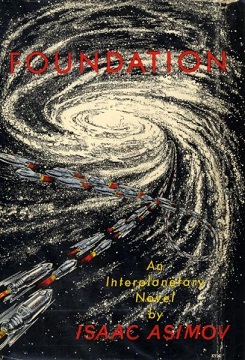
Structure and main elements
Originally composed as short stories and later reorganized into longer volumes, the sequence became known for its episodic sweep and focus on ideas over individual action. Recurring motifs include the Seldon Plan (an engineered roadmap for civilization), the Encyclopedia project, competing power centers known as the Foundation and the Second Foundation, and exceptional individuals who can disrupt large-scale forecasts. The books move between political intrigue, scientific debate and the consequences of long-range planning.
Core books
The series grew into a set of seven main books that together trace the Seldon Plan and its aftermath. These volumes are commonly presented in three early books followed by sequels and prequels that link the series into a larger future history. Readers often encounter the sequence either in publication order or internal chronological order; both arrangements highlight different aspects of character development and theme. See an overview collection at Foundation series.
History and development
The material began as stories published in science-fiction magazines and was later collected and revised into novels. Over time Asimov returned to the setting to extend and reinterpret earlier ideas, producing additional volumes that tied the Foundation milieu into a broader fictional future. The gradual expansion allowed shifts in tone—from short, puzzle-like episodes to longer novels that explore character motives and philosophical implications.
Influence and adaptations
The Foundation sequence has had a wide influence on science-fiction literature, inspiring writers and creators who adopt its grand historical perspective and its use of sociology and mathematics as plot devices. It has been adapted in various forms, including radio, comics and televised dramatizations; these adaptations often reinterpret elements of the books for different audiences and media.
Notable distinctions
Among its notable features are the scale of its timeline, the centrality of an idea-driven plot (psychohistory), and the interplay between deterministic social forces and the unpredictable role of individuals. The series is frequently cited in discussions of science-fiction worldbuilding and of narratives that treat history as a calculable subject rather than only human drama.
- Main themes: prediction of social change, preservation of knowledge, political strategy.
- Reading approaches: publication vs. internal chronology.
- Legacy: foundational influence on later science fiction and popular culture.
Related articles
Author
AlegsaOnline.com Foundation series Leandro Alegsa
URL: https://en.alegsaonline.com/art/35861