
Fortune Head — GSSP site for the Precambrian–Cambrian boundary (Newfoundland)
Fortune Head, a coastal headland near Fortune, Newfoundland, contains the GSSP marking the Precambrian–Cambrian boundary (~541 Ma). It is valued for its fossil-rich cliffs, clear stratigraphy and accessibility.
Overview
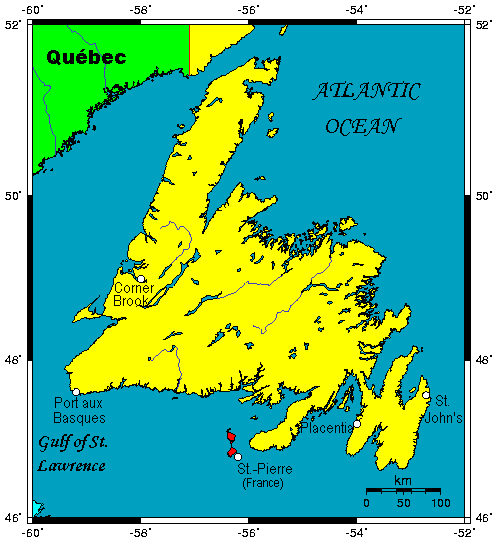
Fortune Head is a rocky headland close to the town of Fortune on the Burin Peninsula in southeastern Newfoundland. The site is best known among geologists because a well-preserved cliff section there was selected as the Global Boundary Stratotype Section and Point (GSSP) that marks the base of the Cambrian Period and the end of the Precambrian. The headland’s exposures provide a continuous, accessible record of sedimentary rock around 541 million years old.
Image gallery
2 Images
Geology and defining markers
The nominated GSSP at Fortune Head is a cliff-face succession roughly 140 metres thick that records a transition in sedimentary facies and biological activity. Stratigraphers identify the Precambrian–Cambrian boundary by the first appearance of particular trace fossils, most notably the burrow-like traces attributed to Treptichnus pedum. Such trace fossils indicate a change in behavior and ecology that helps define the start of the Cambrian. The formal GSSP designation ties a point in the rock to the global time scale so other sections can be correlated against it.
Why Fortune Head was chosen
Fortune Head was selected in 1992 after international comparison with candidate sections in Siberia and elsewhere. The selection emphasized several practical and scientific advantages: the continuity and thickness of the rock succession, the abundance of diagnostic trace fossils and other faunal indicators, and easy access for study and teaching. The competing candidates included exposures in Siberia, parts of Russia, and sections in China, but Fortune Head’s combination of clarity and accessibility led to its ratification.
Scientific and educational importance
As the formal reference point for the Precambrian–Cambrian boundary, Fortune Head plays a central role in studies of early animal life, the evolution of complex behavior, and sedimentary environments at the dawn of the Phanerozoic. The site is often cited in discussions of how trace fossils and soft-bodied organisms appear in the rock record. Researchers and students use the section to compare local rock sequences with global patterns and to refine biostratigraphic and chemostratigraphic correlations.
Visiting and context
The headland lies on the Burin Peninsula and is near the town of Fortune; it is commonly visited by geologists and interested members of the public. Information about the local geology, fossils and conservation measures is available through regional resources. The site is part of broader studies of late Precambrian and early Cambrian geology, and it connects to general topics such as the Precambrian history and the Cambrian explosion of animal diversity.
Notable features
- Designated GSSP for the Precambrian–Cambrian boundary (ratified 1992).
- Approximately 140 m of continuous, fossil-containing strata in cliff exposures.
- Key trace-fossil marker: first occurrence of Treptichnus-type burrows and associated ichnofossils.
- Selected for scientific clarity and accessibility compared with alternatives in Siberia, Russia and China.
For introductory material on the location and to follow up with regional guides or conservation information, see local and national geology resources and visitor centers. General summaries of fossils and their role in defining boundaries are available in educational references on fossils and stratigraphic practice (site overview, time-scale context, deep time background).
Questions and answers
Q: What is Fortune Head?
A: Fortune Head is a headland on the Burin Peninsula in southeastern Newfoundland.
Q: What is the Global Boundary Stratotype Section and Point (GSSP)?
A: The Global Boundary Stratotype Section and Point (GSSP) is a 140m thick section of rock along the cliffs of Fortune Head.
Q: What does the GSSP represent?
A: The GSSP represents the boundary between the Precambrian era and the Cambrian period, which occurred 541 million years ago.
Q: Why was Fortune Head chosen as the site for the GSSP?
A: Fortune Head was chosen as the site for the GSSP due to its accessibility and the many fossils found in the area, compared to similar rock sections in Siberia, Russia, and Meischucum, China.
Q: What other places were considered for the GSSP?
A: Other rock sections in Siberia, Russia, and Meischucum, China were considered for the GSSP.
Q: When was Fortune Head selected for the GSSP?
A: Fortune Head was selected for the GSSP in 1992.
Q: What is the significance of the GSSP at Fortune Head?
A: The GSSP at Fortune Head is significant because it marks a major geological boundary and has many fossils that provide insight into the early history of life on Earth.
Related articles
Author
AlegsaOnline.com Fortune Head — GSSP site for the Precambrian–Cambrian boundary (Newfoundland) Leandro Alegsa
URL: https://en.alegsaonline.com/art/35814
Sources
- k12.nf.ca : "Fortune Head Ecological Reserve"
- env.gov.nl.ca : "Fortune Head Ecological Reserve"
- tools.wmflabs.org : 47°04′27″N 55°51′26″W / 47.07417°N 55.85722°W / 47.07417; -55.85722