
Flip-flop (electronics): bistable circuits for digital storage
Flip-flops are bistable electronic circuits used to store one bit of binary information. This article explains types, operation, timing, history, applications, and distinctions from latches.
For the footwear of the same name, see Flip-flops or Flip-flops (sandals). In electronics, a flip-flop is a bistable device — a circuit with two stable output states — that stores a single binary digit (bit). Flip-flops are the fundamental storage elements in synchronous sequential logic, forming registers, counters, state machines and many other digital building blocks. They hold their state until a control signal causes them to change, converting combinations of inputs and clock transitions into predictable output behavior.
Image gallery
9 Images



Basic characteristics and operation
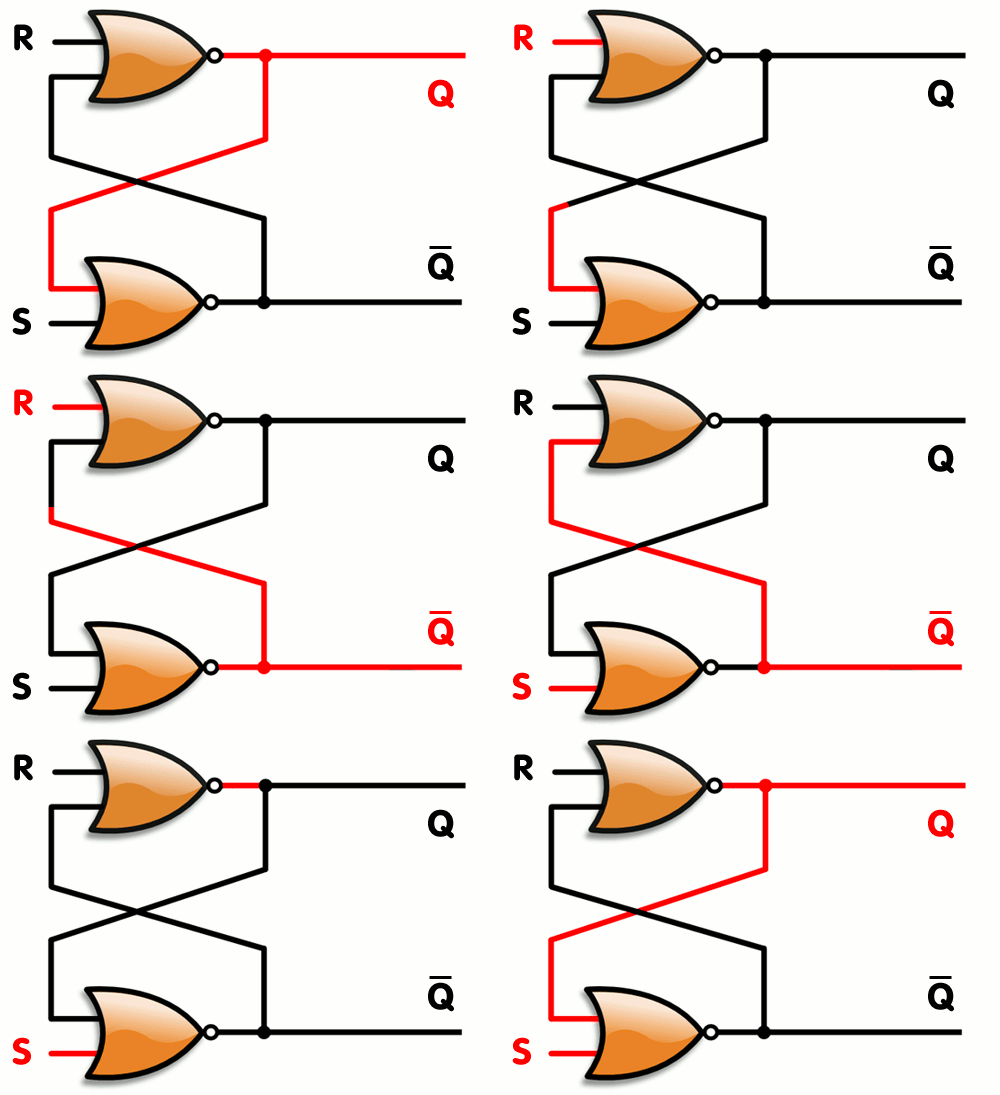
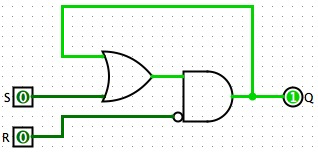
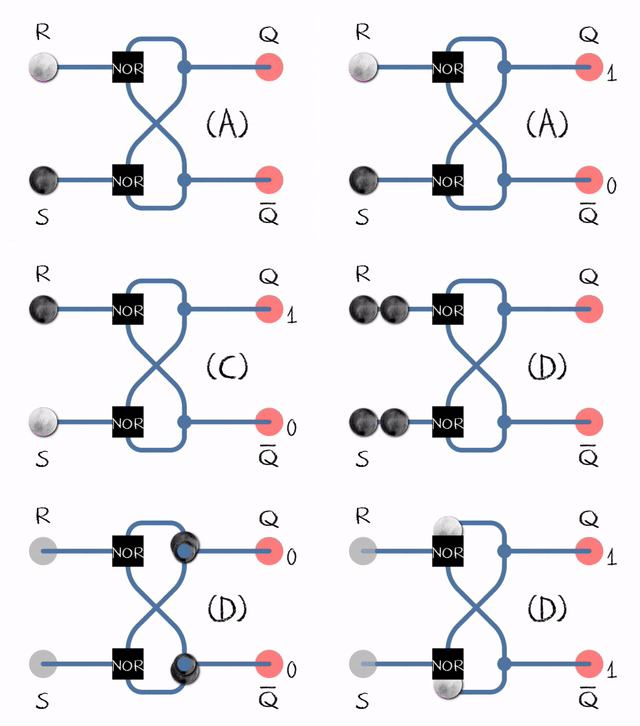
A flip-flop maintains one bit by using feedback between logic gates or transistors so that the outputs reinforce one of two stable states. Key characteristics include the current state (Q), its complement (not-Q), control inputs (for example, set, reset, clock, or data) and timing constraints such as setup time, hold time and propagation delay. Flip-flops may be level-sensitive (often called latches) or edge-triggered, which change state only on a transition (rising or falling edge) of a clock signal. The master–slave arrangement is a classic technique to convert level-sensitive stages into an edge-triggered device.
Common types
- SR (Set–Reset): the simplest form with separate set and reset inputs; ambiguous when both inputs are active.
- D (Data or Delay): captures input D on the active clock and avoids SR ambiguity; widely used for registers.
- JK: an extension of SR that resolves the invalid state and can toggle when both inputs are true.
- T (Toggle): flips its output when the T input is asserted; commonly used in counters.
Timing, implementation and notable issues
Designers must respect timing parameters: setup time (data stable before clock), hold time (data stable after clock) and propagation delay (time for outputs to respond). Violating setup or hold times can cause metastability, where the circuit enters an indeterminate state for an unpredictable interval; synchronization techniques and synchronizer flip-flops help mitigate this in asynchronous interfaces. Physically, flip-flops can be implemented with discrete gates, bipolar TTL, CMOS static structures or transmission-gate master–slave pairs; trade-offs include speed, area and power consumption.
History and development
Bistable devices have roots in early relay and vacuum-tube circuits. The bistable multivibrator and the Eccles–Jordan trigger were important milestones that demonstrated electronic memory elements. With the invention of the transistor and later integrated circuit technologies, flip-flops became compact, fast and reliable components in processors and digital systems. Over decades, improvements in fabrication and design have optimized flip-flops for low power, high speed, and resistance to metastability.
Uses, examples and distinctions
Flip-flops are used to build registers, shift registers, finite-state machines, frequency dividers and synchronous counters. While they store bits at the granularity of single elements in registers, large-capacity memory (SRAM, DRAM) usually uses different cell architectures optimized for density. A related distinction: a latch is level-sensitive and can change state while the enable is active, whereas a flip-flop is typically edge-triggered and changes only at clock transitions. Understanding these differences is essential when designing timing, clocking, and synchronization for digital systems.
Further reading
- Compare latch vs flip-flop behavior when designing clocked systems.
- Consider metastability and synchronizer design for crossing clock domains.
- Explore implementation choices (CMOS vs TTL) for trade-offs in speed, power and area.
Related articles
Author
AlegsaOnline.com Flip-flop (electronics): bistable circuits for digital storage Leandro Alegsa
URL: https://en.alegsaonline.com/art/35132