
Flag of the Soviet Union
National banner of the USSR: a red field charged with a gold hammer and sickle and a gold-bordered red star, adopted with the Union’s foundation and used until the state’s 1991 dissolution.
The flag of the Union of Soviet Socialist Republics (USSR) was the principal state emblem of the Soviet state from its founding in 1922 until the union’s breakup in 1991. Recognizable for its vivid red field and the gold hammer-and-sickle beneath a gold-bordered red star in the upper hoist, the flag became an international symbol of Soviet power and of 20th‑century communism more broadly.
Image gallery
7 Images


Design and symbolism
The national flag combined three key elements placed in the upper canton near the hoist: a stylized gold hammer crossed with a gold sickle, surmounted by a red five‑pointed star outlined in gold, all set against a plain red background. The red field recalled the revolutionary and workers’ movements; the hammer and sickle represented industrial workers and agricultural peasants united; the star signified the Communist Party and the aspiration to world socialism. Over time, the exact graphic proportions and finishing details were clarified in official regulations, but the overall composition remained stable and immediately identifiable.
History and adoption
The flag emerged with the creation of the USSR at the end of 1922 when republican and communist banners were adapted into a single national standard. It built on earlier red banners used in the Russian Revolution and by soviets and labor organizations. During the Soviet period, the flag was used at government buildings, diplomatic missions, military parades, and international events. It featured prominently in wartime and victory imagery, most famously associated with the photograph of Red Army soldiers raising a flag over the Reichstag in 1945.
Variants, protocol and use
- State and naval versions: variants existed for naval ensigns, military flags and the presidential standard; these adapted the basic motif to specific contexts.
- Regulation: official specifications governed placement, color shades and relative sizes of the hammer, sickle and star for production of government flags.
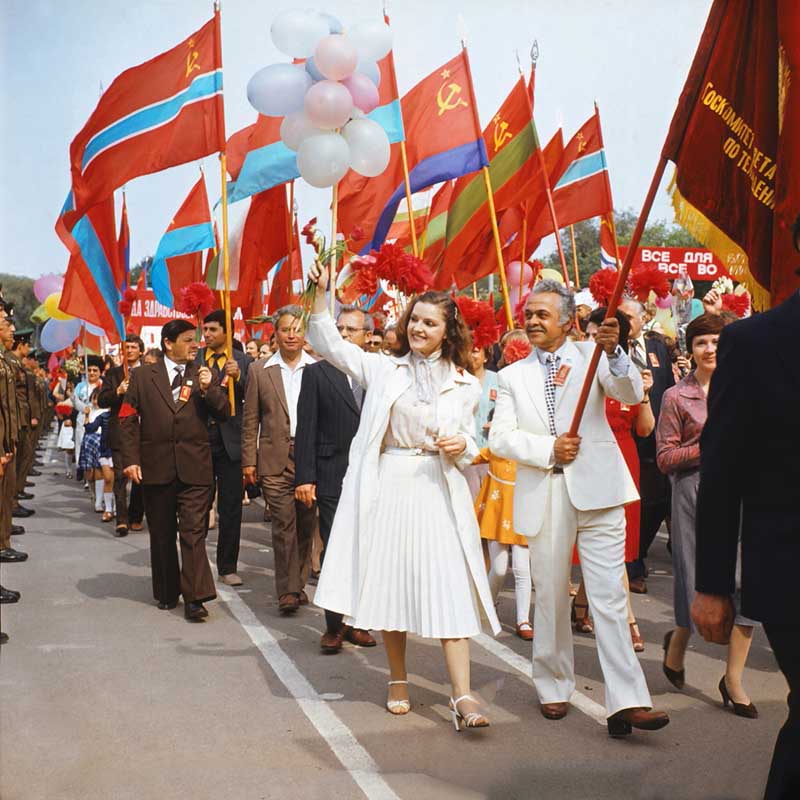
- Republic flags: each of the Soviet republics had its own flag, typically combining the red field and hammer-and-sickle motif with republic-specific elements and inscriptions.
Legacy and notable facts
The Soviet flag remains a potent historical symbol. After the collapse of the USSR in late 1991 it ceased to be a national flag, though it is still used in historical commemorations, by some political groups and in popular culture. Its simple, bold iconography influenced many socialist and communist movements worldwide and continues to be widely recognized as a shorthand for the Soviet era and its political ideals.
Related articles
Author
AlegsaOnline.com Flag of the Soviet Union Leandro Alegsa
URL: https://en.alegsaonline.com/art/34939
Sources
- britannica.com : "Flag of Union of Soviet Socialist Republics"
- worldcat.org : Flags and arms across the world