
Filippo Brunelleschi — Architect and Engineer of the Early Italian Renaissance
Filippo Brunelleschi (1377–1446) was an Italian architect and engineer whose innovations—most notably the dome of Florence Cathedral—shaped Renaissance architecture and the rules of linear perspective.
Filippo Brunelleschi (1377 – 15 April 1446) was a central figure of the early Italian Renaissance. Trained originally in craft and metalwork, he is best known as an architect and an inventive engineer. Nearly all his major projects and lasting monuments are located in Florence, Italy, where his combination of classical forms and practical construction techniques helped redefine the built environment of the fifteenth century.
Image gallery
10 Images


Major works and innovations
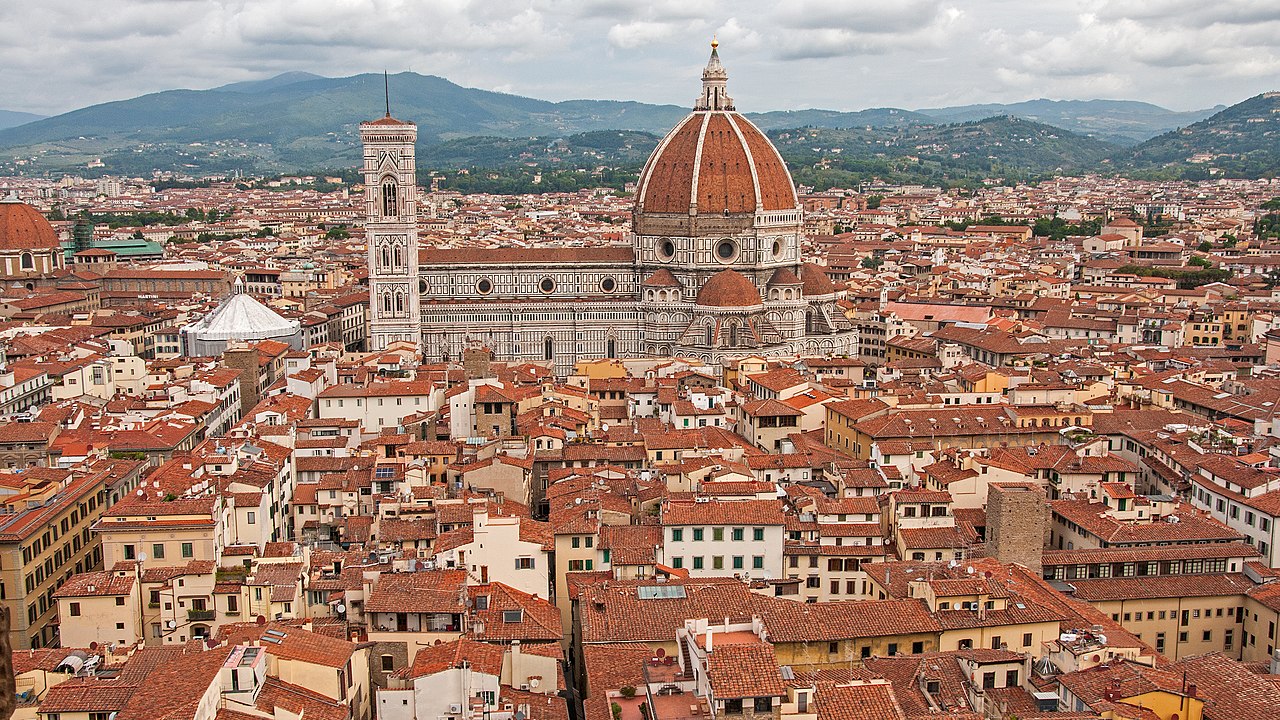
Brunelleschi's most celebrated achievement is the dome of Santa Maria del Fiore (the Florence Cathedral). Faced with the challenge of spanning the cathedral's wide octagonal drum without traditional wooden centering, he devised a new method of construction that employed a double shell, horizontal rings, and a stepped brick pattern. Beyond the dome, his important works include the Ospedale degli Innocenti (a public foundling hospital), the Old Sacristy of San Lorenzo, and the Pazzi Chapel—each notable for clarity of proportion, use of classical orders, and restrained ornament.
Methods, engineering and perspective
Brunelleschi combined empirical engineering with an interest in classical architecture discovered during studies of Roman ruins. He developed specialized machines and hoisting devices to lift heavy materials during construction of the dome. Equally influential was his work on linear perspective: through experiments and demonstrations he established rules for representing three-dimensional space on a flat surface, a technique that became fundamental to Renaissance painting and architectural drawing.
Historical context and influence
Active in the transition away from Gothic complexity, Brunelleschi favored geometry, symmetry and the measured use of columns, pilasters and lintels drawn from antiquity. His approach informed contemporaries such as Donatello and later generations of architects across Europe. The methods he introduced for large-scale construction and spatial representation helped make Renaissance architecture recognizably distinct from medieval precedents.
Notable facts and distinctions
- Early in his career he participated in the 1401 competition to design the Baptistery doors of Florence—a contest won by Lorenzo Ghiberti.
- He is often credited with designing new machines and lifting gear to enable ambitious building projects without full wooden scaffolding.
- His investigations into perspective influenced painters and architects and laid groundwork for technical drawing as a design tool.
Selected works
- Dome of Santa Maria del Fiore (Florence Cathedral)
- Ospedale degli Innocenti (Foundling Hospital)
- Old Sacristy, San Lorenzo
- Pazzi Chapel, Santa Croce
- Contributions to Santo Spirito and other Florentine sites
Brunelleschi's legacy endures in the language of Western architecture and in the practical techniques used to realize ambitious forms. His fusion of theoretical ideas, careful observation of classical examples, and inventive engineering continues to be studied by architects, historians and engineers interested in the origins of Renaissance design.
Related articles
Author
AlegsaOnline.com Filippo Brunelleschi — Architect and Engineer of the Early Italian Renaissance Leandro Alegsa
URL: https://en.alegsaonline.com/art/34309