
Eure (river) — left-bank tributary of the Seine in northwestern France
The Eure is a river in northwestern France that feeds the Seine. It has notable tributaries like the Avre and the Iton, flows through historic towns such as Évreux, and gave its name to two departments.
Overview
The Eure is a river in northwestern France and a left-bank tributary of the Seine. It drains a predominantly rural and wooded basin and has played a distinct role in regional settlement, industry and landscape. The river's name has been given to two French departments: Eure-et-Loir and Eure.
Image gallery
2 Images
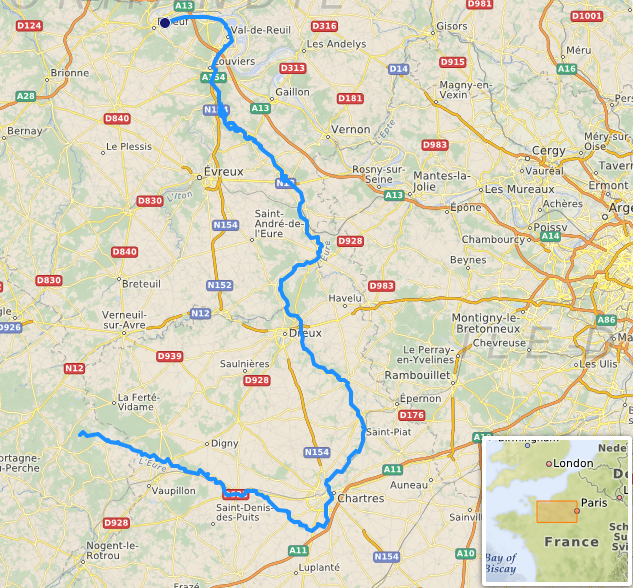
Course and main tributaries
Rising in the inland plateaus of northwestern France, the Eure flows generally north and then northeast before joining the Seine. Along its course it collects several secondary rivers and brooks that enrich the local hydrology and create fertile valleys. Its principal tributaries are the Avre and the Iton, which contribute considerable flow and define important sub-basins.
- Eure — the main river itself, giving its name to towns and departments.
- Avre — a significant tributary feeding the Eure from the west.
- Iton — another major tributary draining nearby plateaus and joining the Eure downstream.
History and cultural importance
The Eure valley has long been occupied for agriculture, milling and small-scale industry because of the river's steady flow and the valleys it carved. In the 17th and 18th centuries the Eure valley attracted major hydraulic engineering projects intended to supply water to royal estates; remnants of ambitious works and aqueduct approaches can still be seen and are points of historical interest. Local towns grew where fords, bridges and mills made the river a focal point of daily life.
Uses, ecology and recreational value
Today the Eure supports a mixture of uses: irrigation for agriculture, local water supply, light industry and recreation such as angling, canoeing and riverside walking. The riparian corridors host diverse plant and animal communities typical of temperate river systems; protected areas and management plans aim to balance human use with habitat conservation.
Towns, administration and notable facts
Several towns and communes developed along the Eure, including administrative and cultural centres that trace their histories to medieval river crossings and mills. The river's name features in departmental titles and place names, underlining its regional significance. For regional overviews and mapping resources see local and national geographic references: regional guide, national context, and specialised hydrology summaries at river basin profiles, tributary details and other studies (river facts).
If you are researching the Eure for travel, ecology or local history, consult municipal records and regional environmental agencies for the most up-to-date information and maps: see also resources linked above and local tourist information centres for walking routes and heritage sites.
Related articles
Author
AlegsaOnline.com Eure (river) — left-bank tributary of the Seine in northwestern France Leandro Alegsa
URL: https://en.alegsaonline.com/art/32553