
Erriapus (Saturnian moon)
Erriapus is a small irregular prograde moon of Saturn (~10 km) discovered in 2000. It orbits at about 17.3 million km with an ~871-day period and belongs to the Gallic group, likely a collisional fragment.
Overview
Erriapus (Saturn XXVIII) is a small, irregularly shaped natural satellite of Saturn. With an estimated diameter of roughly 10 kilometres, it is far too small to be spherical and is best described as a captured or collisionally produced body that follows an elongated orbit well outside the regular satellite system.
Image gallery
1 Image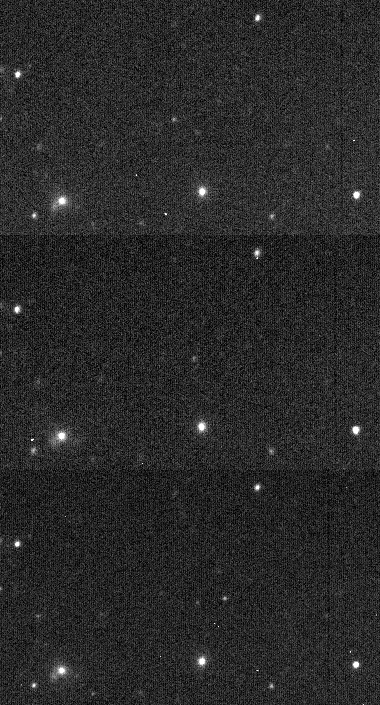
Physical characteristics
Erriapus appears reddish in color when viewed photometrically, a trait it shares with several other outer Saturnian moons. Its irregular form is inferred from brightness variations observed as it rotates, which suggest an uneven surface and non-spherical shape. Detailed surface properties such as composition and albedo remain poorly constrained by available observations.
Discovery and name
The moon was identified in 2000 by a team led by Brett Gladman and John J. Kavelaars and was provisionally designated S/2000 S 10. It received the name Erriapus in August 2003, drawn from a giant of Gaulish tradition often rendered Erriapo; the modern spelling was later standardized as Erriapus. Contemporary discovery notices and catalogs record these details and provide observational ephemerides related to the discovery.
Orbit and group membership
Erriapus orbits Saturn at an average distance of about 17,300,000 kilometres and completes one revolution in approximately 871 days. Its motion is prograde and inclined relative to the planet's equatorial plane, placing it among the irregular satellites rather than the closer, regular moons. Because of its orbital parameters and color, Erriapus is classified as a member of the Gallic group of Saturnian moons (Gallic group), a set of prograde irregular satellites with similar orbits and hues.
Origins and significance
Many researchers regard Erriapus and its Gallic-group companions as fragments of a larger parent body that was disrupted by a past collision. This interpretation is driven by the clustering of orbits and consistent light-red colors across the group. As such, Erriapus contributes to our understanding of the collisional and capture history of the Saturn system and the population of irregular satellites more broadly. For context on irregular shapes and classifications, consult general resources on small bodies and satellites non-spherical satellites.
Related satellites
- Albiorix
- Bebhionn
- Tarvos
- Erriapus
Further observations, especially from targeted photometry or spacecraft encounters, would refine Erriapus's rotation state, surface properties and precise origin scenario.
Related articles
Author
AlegsaOnline.com Erriapus (Saturnian moon) Leandro Alegsa
URL: https://en.alegsaonline.com/art/32053