
Erasmus Bridge (Erasmusbrug) — Rotterdam cable-stayed landmark
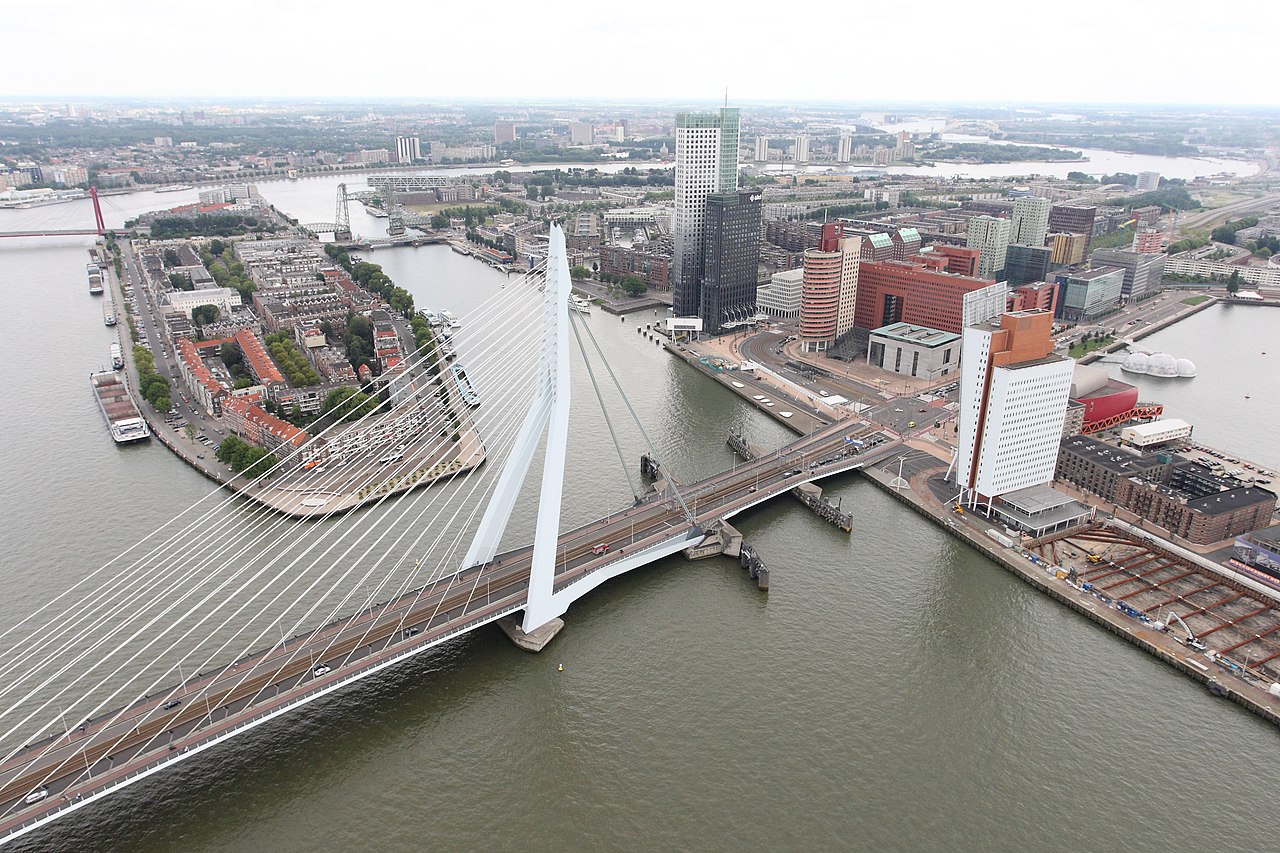
Cable-stayed bridge across the Nieuwe Maas in Rotterdam, opened 1996. Known as "the Swan", it links the city centre with Kop van Zuid and carries road traffic, tram line 20, cyclists and pedestrians.
Overview
The Erasmus Bridge (Dutch: Erasmusbrug) is a landmark cable-stayed crossing of the Nieuwe Maas in Rotterdam, Netherlands. Named after the Renaissance humanist Desiderius Erasmus, the bridge links the historic north-bank city centre with the redeveloped Kop van Zuid area on the south bank. It carries motor traffic, tram line 20, segregated cycle paths and pedestrian walkways, and functions both as an important transport link and as a prominent piece of contemporary urban architecture.
Image gallery
10 Images




Design and dimensions
Designed by the architecture firm Van Berkel & Bos (Ben van Berkel and Caroline Bos) in the late 1980s, the structure is noted for its asymmetrical silhouette: a single, white, inclined pylon that rises above the deck and has earned the bridge the popular nickname "de zwaan" (the swan). The total length of the crossing is about 802 metres. The cable-stayed portion is roughly 410 metres long, with a principal navigation opening of approximately 278 metres. The pylon stands about 139 metres tall. Immediately south of the cable-stayed span there is a bascule (movable) span of about 89 metres to permit passage of larger vessels. The steel superstructure weighs several thousand tonnes; published accounts from the time of construction reported a total steel weight and a project cost in the order of magnitude of a few hundred million euros.
Construction and opening
Construction began in 1994 and required substantial marine engineering and heavy-lift operations. The pylon and large steel elements were installed with floating crane assistance. The bridge was officially opened by Queen Beatrix on 4 September 1996. Soon after opening, structural engineers observed wind- and rain-induced vibrations on some stay cables; these were mitigated by the retrofitting of dynamic dampers to the affected cables. The early experience has since been cited in discussions of stay-cable behaviour and vibration control.
Technical components and operation
- Pylon: a single inclined tower that anchors the cable system and defines the bridge's profile.
- Cable system: a fan-like arrangement of stay cables transferring loads from the deck to the pylon.
- Bascule span: a large movable section that opens to allow deep-draft and commercial shipping to pass along the Nieuwe Maas.
- Deck and routes: carriageways for motor traffic, a dedicated tram track (line 20), and separated paths for cyclists and pedestrians.
Navigation, location and context
The Erasmus Bridge stands over a busy stretch of the Rhine–Meuse delta and is located on the Nieuwe Maas waterway. It lies at a notable position for river navigation and urban planning: the crossing facilitates both river traffic, via the movable span, and dense urban movement between the northern centre and the newly developed southern waterfront. The bridge has been integrated into the fabric of Rotterdam’s port and city life and forms a visual gateway to the redeveloped Kop van Zuid district, which contains offices, residential buildings and cultural venues.
Maintenance, awards and recognition
After the initial retrofit of dampers, the bridge has undergone routine inspection and maintenance typical of major steel and cable-stayed structures. The Erasmus Bridge received recognition in the years following its completion, including industry awards for steel construction. A 1:25 scale model is on display at a national miniature park, underscoring the structure’s role as a modern icon in Dutch architecture.
Cultural significance and public use
Beyond its transport function, the Erasmus Bridge has become an emblem of modern Rotterdam and is widely used in publicity, photography and events. It is often illuminated for festivals and civic occasions and serves as a backdrop for cultural activities on the waterfront. Harbour tour boats commonly embark from the riverfront near the northern bridgehead, offering visitors views of the bridge and the port; typical sightseeing trips operate from that area and provide commentary on Rotterdam’s maritime and architectural development.
Practical notes for visitors
The bridge is a public thoroughfare with pedestrian and cycling access; it provides vantage points for views of the river, skyline and neighbouring architecture. Tram line 20 crosses the bridge and connects central locations on both banks. As an active piece of transport infrastructure, access to some parts of the movable span or technical areas is restricted for safety reasons. The Erasmus Bridge remains one of the most recognisable and frequently photographed modern structures in Rotterdam.


See also
- List of bridges over the Rhine
Related articles
Author
AlegsaOnline.com Erasmus Bridge (Erasmusbrug) — Rotterdam cable-stayed landmark Leandro Alegsa
URL: https://en.alegsaonline.com/art/31851
Sources
- holland.com : "Erasmus Bridge Rotterdam"
- travbuddy.com : "Erasmus Bridge"