
Derby Museum and Art Gallery
Public museum in Derby, England, founded in 1879; known for Joseph Wright paintings, Derby porcelain and local archaeology, natural history and decorative arts collections.
The Derby Museum and Art Gallery is a public museum in Derby, England, established in 1879 when a newly erected building was donated to the town by a local brewer. From modest Victorian beginnings the institution developed into a regional cultural centre, open to the public for display, learning and research. Its displays interpret local artistic, industrial and social history alongside wider themes in British art.
Image gallery
6 Images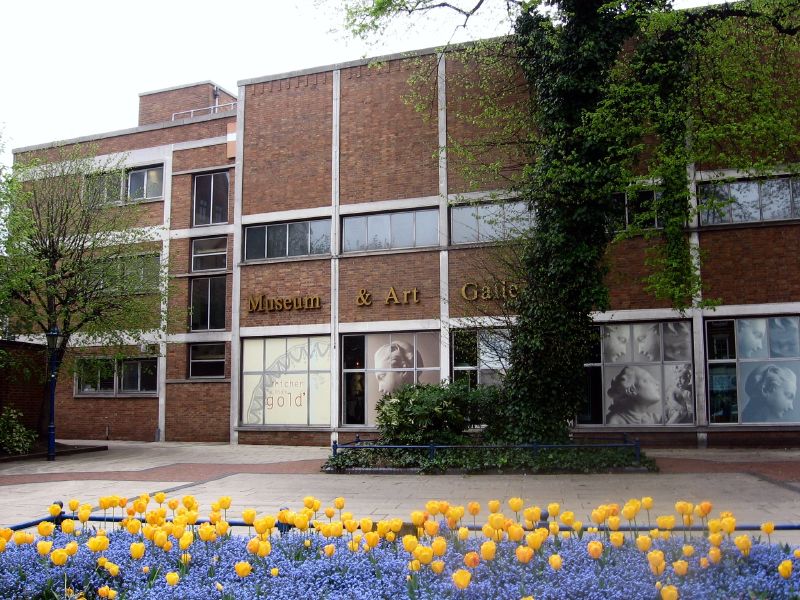


Collections
The museum's holdings span several fields. The most prominent art is a distinctive group of paintings by Joseph Wright of Derby, whose work captures 18th-century experiments with light and images of the early industrial age. The decorative-arts collection includes extensive examples of Derby porcelain produced in the town and neighbouring factories, a notable chapter in English ceramic history. Complementary collections cover archaeology, natural history, costume and social history.
The presentation emphasizes local connections: how artists, potters and scientists based in and around Derby contributed to artistic styles and industrial developments. Galleries combine framed paintings, ceramics on plinths, and cases of archaeological finds and natural-history specimens to tell interlinked stories of place and period.
History and significance
Founded in the late Victorian era, the museum reflects the 19th-century movement to create public institutions for education and civic pride. Over time the collection grew through donations, purchases and bequests, concentrating strengths where the town had historical importance — notably in the fine arts represented by Joseph Wright and in ceramics made locally. The museum is often cited as holding one of the most important public collections of Wright's work.
Today the institution serves multiple roles: it conserves and researches material, stages temporary and permanent exhibitions, provides learning programmes for schools and communities, and supports scholarship about regional art and industry. Visitors and researchers come to study Wright’s dramatic use of light, examine Derby porcelain techniques and explore local archaeology and natural history.
- Key strengths: Joseph Wright paintings, Derby and regional porcelain
- Other areas: archaeology, natural history, decorative arts, social history
- Functions: exhibitions, education, conservation and research
Related articles
Author
AlegsaOnline.com Derby Museum and Art Gallery Leandro Alegsa
URL: https://en.alegsaonline.com/art/26750
Sources
- derby.gov.uk : "Derby Museums and Wikipedia Join Forces to Improve Content"
- mla.gov.uk : MLA.gov.uk