
Democracy in Ancient Athens
A concise account of how Athenian democracy worked: its institutions, who qualified as citizens, key procedures like sortition and assembly, historical development, and its long-term significance.
Ancient Athens developed one of the earliest and best-documented forms of popular government in the classical world. Often described as a direct democracy, it gave a defined class of free males the right to participate directly in decision-making rather than relying solely on representatives. The Athenian system combined popular assemblies, citizen juries, rotating magistracies, and the frequent use of lot as a means to distribute office.
Image gallery
7 Images
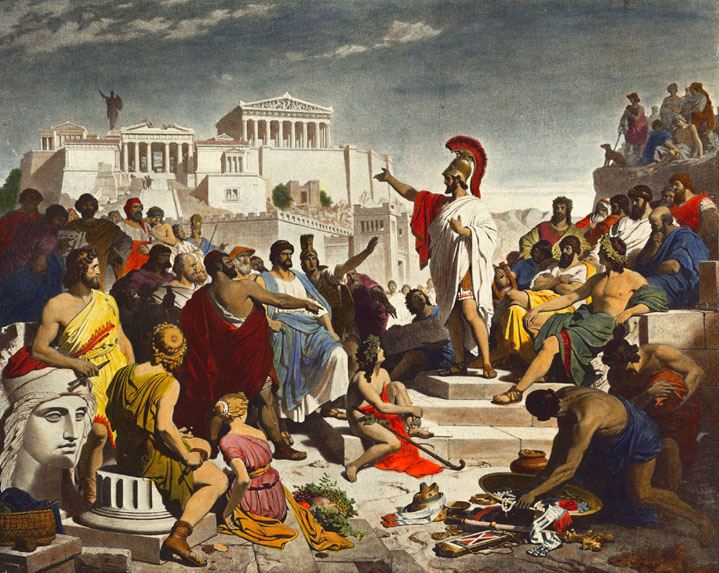


Who counted as a citizen
Citizenship in Athens was restricted. Broadly known requirements included being a free man of adult age, born of Athenian parents, and having completed the period of military training customary for young men. Women, enslaved people, resident foreigners (metics), and many younger residents were excluded from political rights. As a result, only a minority of the total population held full civic status: at various times this core group has been estimated at roughly one-tenth to one-fifth of the inhabitants.
Key institutions and procedures
The Athenian system relied on a handful of interlocking bodies and practices. These included:
- The Assembly (Ekklesia) — the principal forum where citizens met to debate and vote on laws, war, and public policy.
- The Council (Boule) — a body that prepared business for the Assembly and managed some administrative functions; its membership was drawn by lot from citizen tribes.
- Popular courts (Dikasteria) — large citizen juries decided trials and legal disputes; jurors were chosen from the citizen body and could be paid a small fee for service.
- Magistracies and sortition — many public offices were filled by lot to prevent concentration of power, while a few important roles were filled by election on the basis of reputation or skill.
Historical development
Athenian democracy emerged and evolved across the 6th and 5th centuries BCE. Reforms by leaders such as Solon and Cleisthenes laid institutional foundations by reorganizing political units and reducing aristocratic dominance. The system reached a high point in the fifth century BCE during the leadership of statesmen like Pericles, when civic participation and cultural life flourished together. Over time, pressures from war, empire, and internal conflict altered how institutions operated, but the basic commitment to active citizen involvement remained a defining feature.
Practical effects and limitations
In practice, Athenian democracy enabled broad public debate and gave ordinary citizens tools to influence policy, hold officials accountable, and resolve disputes. At the same time it rested on deep exclusions: women and all non-citizens had no political voice, and the economy and social stability depended on slavery and the labor of resident foreigners. The scale of participation also depended on festivals, assemblies, and the logistics of gathering citizens into the city.
Legacy and distinctions
Athenian democracy is important as an early example of direct civic involvement and institutional innovation, such as the use of sortition and mass juries, which contrast with modern representative systems. Scholars and educators often study Athens to understand the strengths and limits of citizen-centered governance and to trace ideas about equality before the law, civic duty, and public deliberation. For more detailed introductions and primary-source material, see relevant summaries and translations available through teaching resources and collections here.
Related articles
Author
AlegsaOnline.com Democracy in Ancient Athens Leandro Alegsa
URL: https://en.alegsaonline.com/art/26483
Sources
- books.google.com : Peloponnese and Athens