
Deadlock: Causes, Examples, and Handling in Computing and Systems
Deadlock is a condition in which two or more actors wait indefinitely for resources held by the other(s), halting progress. It appears across operating systems, databases, networks and real-time systems.
Deadlock describes a situation in which two or more independent agents (processes, threads, or people) are each waiting for the others to release resources or take actions, so none can proceed. This general concept appears in everyday paradoxes — for example the "chicken or the egg" paradox — and in many technical contexts where shared, exclusive resources are involved. In computing, deadlock is a central concern in concurrency and resource management because it can freeze parts of a system until manual intervention or recovery occurs.
Image gallery
3 Images
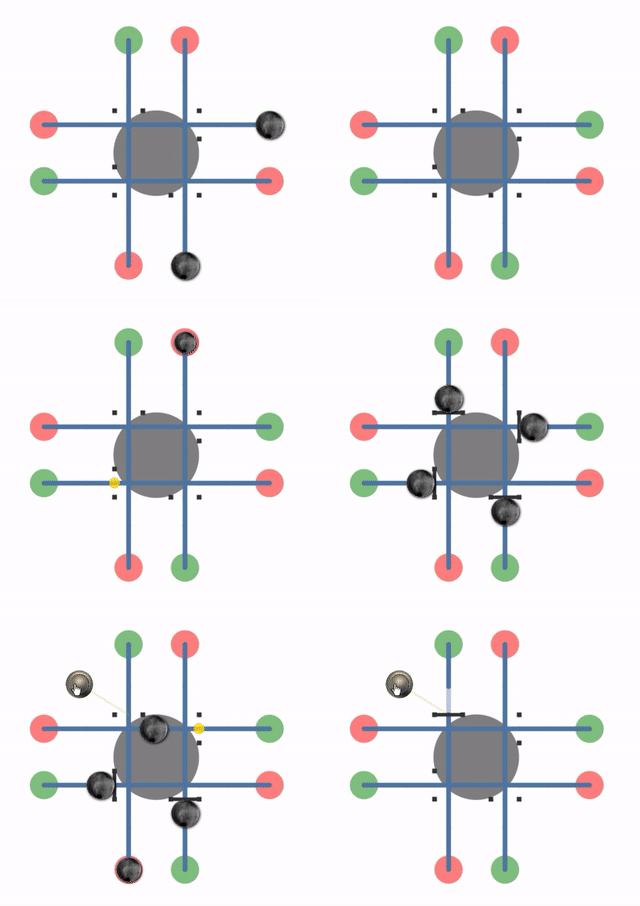

Core conditions that enable deadlock
Deadlock does not happen randomly; it requires a combination of circumstances. Practitioners often refer to four necessary conditions that together allow deadlock to arise:
- Mutual exclusion: Some resources can be held by only one agent at a time (for example a lock on a file).
- Hold and wait: An agent holds at least one resource while waiting to acquire additional resources.
- No preemption: Resources cannot be forcibly taken from an agent; they must be released voluntarily.
- Circular wait: A cycle of agents exists in which each one waits for a resource held by the next.
Common examples and contexts
Simple analogies help make the idea tangible: two people drawing diagrams might deadlock if one holds the pencil and the other the ruler and each needs the other's tool to continue. In computer systems deadlocks occur frequently in multiprogramming and parallel computing when threads or processes compete for mutexes, semaphores, or I/O devices. Classic problems used in teaching include the dining philosophers and producer-consumer variants. Databases can deadlock on transaction locks and indexes; operating systems and device drivers must guard against it; and telecommunications systems define deadlock strictly in terms of process states and empty channels. Systems designed for multiprocessing or for real-time operation use special techniques to reduce or eliminate some classes of deadlock.
Approaches to handling deadlock
Engineers use four broad strategies to manage deadlock risk:
- Prevention: Eliminate one of the necessary conditions—for example, deny hold-and-wait by requiring processes to request all needed resources at once.
- Avoidance: Make allocation decisions with global knowledge (for example algorithms that only grant resources if the system remains in a safe state).
- Detection and recovery: Allow deadlocks to occur but detect them (using wait-for graphs or resource-allocation checks) and then break the cycle by aborting or rolling back chosen processes.
- Mitigation techniques: Use timeouts, resource ordering, reduced privileges, or designing nonblocking algorithms to reduce the chance that cycles form.
Distinctions and notable points
Deadlock is distinct from related problems: livelock occurs when agents continually change state without making progress, while starvation is when a particular agent is perpetually denied resources though others make progress. Some systems use hardware or priority mechanisms to provide exclusive access guarantees, which can reduce software-level deadlocks but never eliminate design errors that create circular waits. Because deadlocks often depend on timing and interaction patterns, there is no single universal fix; instead, designers choose appropriate prevention, avoidance or recovery strategies based on performance, complexity, and correctness trade-offs.
Related articles
Author
AlegsaOnline.com Deadlock: Causes, Examples, and Handling in Computing and Systems Leandro Alegsa
URL: https://en.alegsaonline.com/art/25964