
Deep learning: concepts, architectures, history and applications
Overview of deep learning — its principles, major architectures, training practices, history, typical applications and limitations, with links for further reading.
Overview
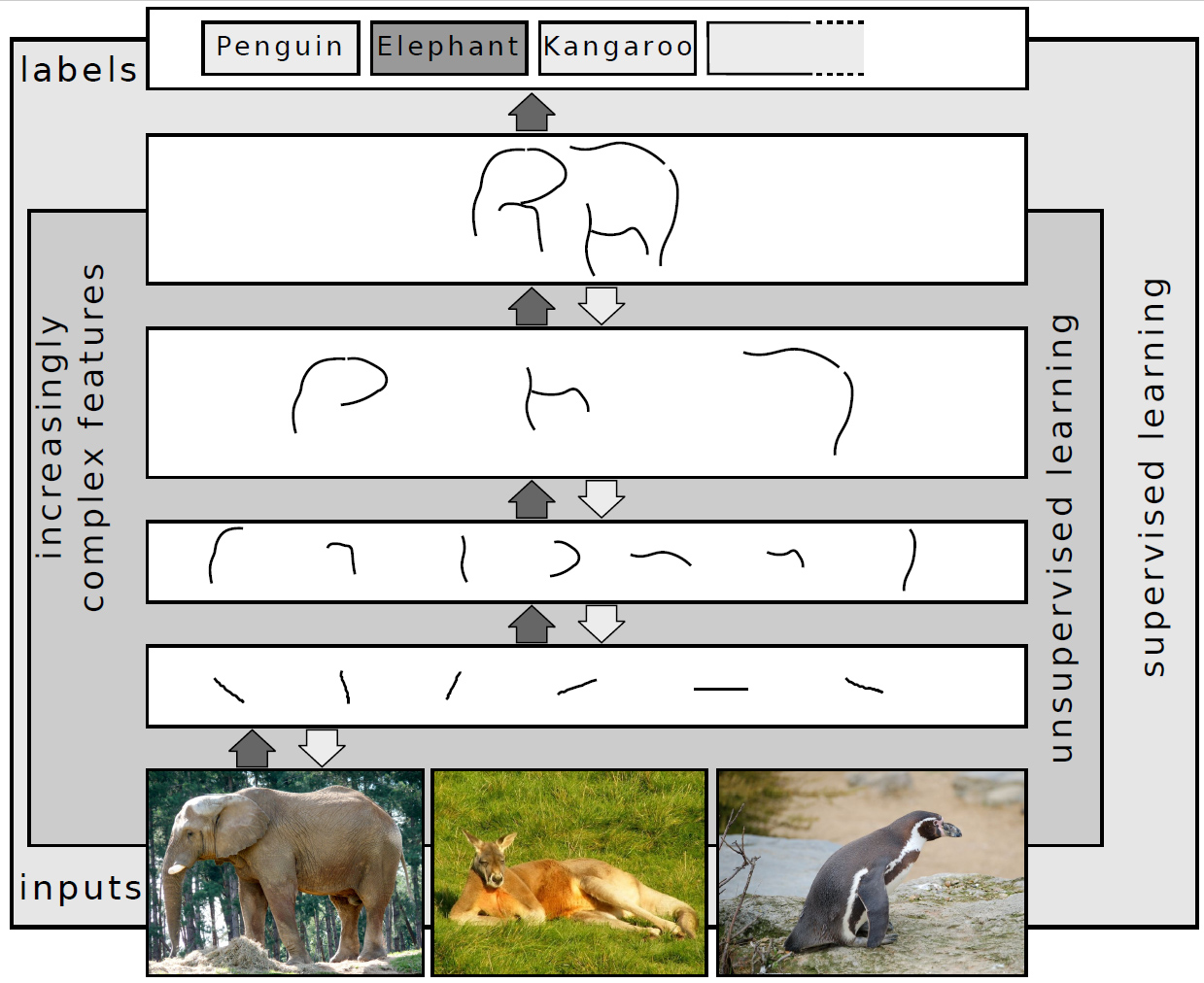
Deep learning is a subset of machine learning that builds predictive models by composing multiple layers of processing units. These layered models learn hierarchical representations of data so that low-level features are combined into progressively more abstract concepts. While often associated with large artificial neural networks, deep learning describes the idea of depth in model structure and representation learning rather than a single algorithm.
Image gallery
3 Images

Core concepts and characteristics
At its core, deep learning trains parametric functions to map inputs to outputs by adjusting internal weights to minimize error on example data. Typical features include multiple hidden layers, nonlinear activation functions, and end-to-end optimization. Training commonly uses variants of gradient-based optimization and backpropagation. Modes of learning can be supervised, unsupervised, or semi-supervised, and many systems use transfer learning to adapt pretrained components to new tasks.
Common architectures
- Feedforward networks: simple layered networks that map inputs to outputs through successive transformations.
- Convolutional neural networks (CNNs): specialized for spatially structured data such as images, exploiting local connectivity and weight sharing.
- Recurrent networks and sequence models: designed for temporal or sequential data; include LSTM/GRU variants and more recently attention-based models.
- Transformers: use self-attention mechanisms to model relationships across elements of a sequence without recurrence and have become dominant in language and other domains.
These architectures all extend the notion of layered processing but differ in how they share parameters, handle structure, and scale with data.
Training, data and practical concerns
Training deep models typically requires large labeled datasets and substantial compute, though techniques such as data augmentation, regularization, and unsupervised pretraining reduce those demands. Common challenges include overfitting, hyperparameter tuning, and sensitivity to data distribution shifts. Tooling and libraries make experimentation more accessible; see resources on neural networks and implementation frameworks via practical guides.
Applications and examples
Deep learning has driven progress in many areas where learning rich representations is advantageous. Notable applications include:
- Computer vision: image classification, object detection, and segmentation.
- Speech and audio: recognition, synthesis, and enhancement.
- Natural language processing: translation, summarization, question answering and conversational agents built on large language models.
- Scientific and industrial domains: drug discovery, medical image analysis, robotics, and anomaly detection.
History, inspiration and limitations
Deep learning draws inspiration from biological nervous systems and early work on artificial neurons, but modern systems differ substantially from biological brains in structure and function. For historical context and biological comparisons see discussions that link research in both directions via biological inspiration and reviews that highlight differences at the level of implementation and evidence: biological vs. artificial. Practitioners also consider social and technical limitations: models can be data-hungry, opaque (interpretability concerns), vulnerable to adversarial inputs, and subject to biases present in training data. Responsible deployment involves evaluation, transparency, and ongoing monitoring.
As the field evolves, hybrid approaches and better understanding of generalization, robustness, and efficiency continue to expand where deep learning can be applied reliably and ethically. For introductory and advanced materials, many readers follow curated tutorials and documentation available through community-maintained portals linked above.
Questions and answers
Q: What is deep learning?
A: Deep learning is a type of machine learning that uses neural networks to process information, and is often organized with at least one intermediate (hidden) layer between the input and output layers.
Q: What are the different kinds of learning sessions used in deep learning?
A: Deep learning can be organized into unsupervised, semi-supervised, and supervised learning sessions.
Q: What are some tasks that are easy for humans but difficult for computers to perform?
A: Tasks such as recognizing and understanding speech, images, or handwriting are easy for humans but difficult for computers to perform.
Q: What happens to information as it is processed in a multi-layer neural network?
A: In a multi-layer neural network, the information processed becomes more abstract with each added layer.
Q: What are deep learning models inspired by?
A: Deep learning models are inspired by information processing and communication patterns in biological nervous systems.
Q: How do deep learning models differ from the properties of biological brains?
A: Deep learning models are different from the structural and functional properties of biological brains, especially the human brain, in many ways, which makes them incompatible with neuroscience evidences.
Q: What is another term for deep learning?
A: Deep learning is also known as deep structured learning or hierarchical learning.
Related articles
Author
AlegsaOnline.com Deep learning: concepts, architectures, history and applications Leandro Alegsa
URL: https://en.alegsaonline.com/art/26216
Sources
- ncbi.nlm.nih.gov : "Toward an Integration of Deep Learning and Neuroscience"
- doi.org : 10.3389/fncom.2016.00094
- pubmed.ncbi.nlm.nih.gov : 27683554
- ui.adsabs.harvard.edu : 1996Natur.381..607O
- doi.org : 10.1038/381607a0
- pubmed.ncbi.nlm.nih.gov : 8637596