
Das Kapital (Capital: A Critique of Political Economy)
Karl Marx's Das Kapital is a foundational critique of capitalist political economy, analysing commodities, value, exploitation, accumulation and crises and influencing economics, politics and social theory.
Das Kapital is Karl Marx's major theoretical work analysing the economic laws and social dynamics of capitalism. First published in full as Volume I on 14 September 1867, the book aims to explain how capitalist production is organized, how profits are generated, and why capitalist societies face recurrent crises. The work is associated with its author, Karl Marx, and has been influential in economics, history, political movements and social theory.
Image gallery
10 Images
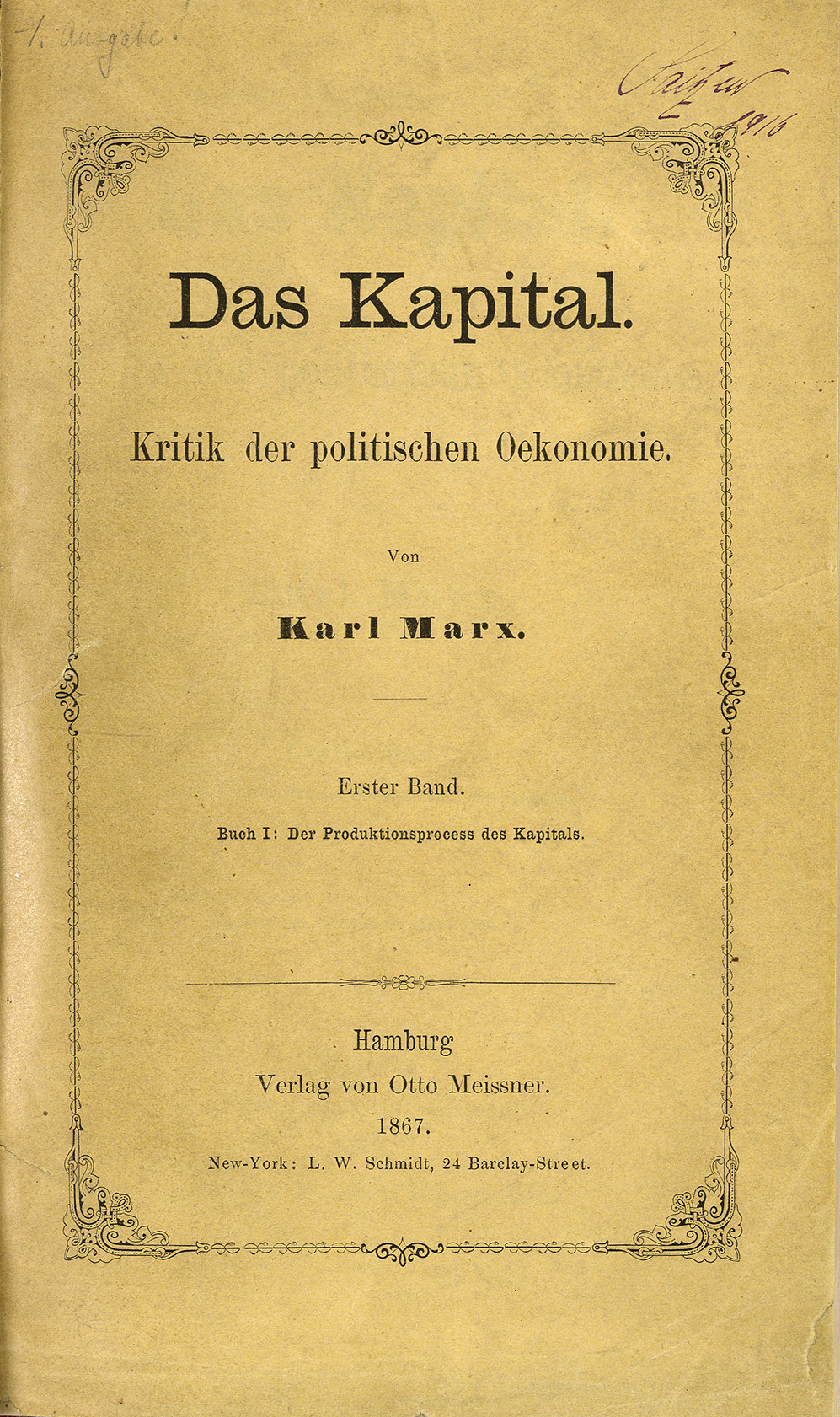





Core arguments and structure
Das Kapital examines the commodity as the basic unit of capitalist economy and develops a theory of value based on labour. Marx distinguishes use-value and exchange-value, introduces the notion of labour power as a commodity, and explains surplus value as the source of profit. He also analyses how capital circulates and accumulates, and how these processes generate periodic crises of overproduction and falling profit rates.
Key concepts
- Commodity, use-value vs exchange-value
- Labour power and the labour theory of value
- Surplus value and exploitation under wage labour
- Commodity fetishism and the social relations concealed by markets
- Accumulation of capital, crises, and imperial expansion including colonization
Marx combined abstract analysis with historical and empirical material. He used a dialectical method to trace development over time and to connect economic categories to social relations. Volumes II and III were assembled and published after his death by Friedrich Engels from Marx's manuscripts, organising circulation, distribution and the overall dynamics of capitalist production.
Das Kapital has been read both as an academic critique of political economy and as a programmatic text for social movements. It shaped later debates about economic theory, labour rights, and the relationship between capital and state power. Critics have challenged aspects of Marx's value theory and empirical claims; defenders note the work's originality in linking economic categories to social and political consequences.
Whether read historically or applied to contemporary debates, Das Kapital remains a central reference for understanding the strengths, contradictions and limits of capitalist economies and the social relations they create.
Further reading and contextual resources: about Marx, original publication details publication date, broader discussion of capitalism, treatments of value, debates on exploitation, and studies of imperialism and colonization.
Related articles
Author
AlegsaOnline.com Das Kapital (Capital: A Critique of Political Economy) Leandro Alegsa
URL: https://en.alegsaonline.com/art/25604