
Cross-platform interchange (railway passenger transfers)
A cross-platform interchange is a station layout that lets passengers change trains by simply crossing a platform, reducing transfer time and improving accessibility in transit networks.
A cross-platform interchange is a station arrangement in which trains on different services or lines stop on opposite faces of the same platform or on two adjacent platforms at the same level, allowing passengers to transfer by walking across rather than using stairs or corridors. This layout is used to shorten transfer times, improve accessibility, and simplify passenger flows in urban rail and metro systems.
Design and common variants
Typical configurations include island platforms serving two directions of different lines, paired island platforms that support same-direction or opposite-direction transfers, and the so-called "Spanish solution" where a train opens doors on both sides to separate boarding and alighting flows. Effective cross-platform interchanges require compatible platform heights, coordinated stopping positions and timetable planning to minimize waiting times.
Benefits and operational uses
Advantages include faster, more intuitive transfers, better accessibility for passengers with luggage or mobility limitations, and potential reductions in station congestion. Transit operators use cross-platform interchanges to link express and local services, connect branches that split or merge, or enable easy reversals where passengers change direction.
Key characteristics:
- Same-level transfer without stairs or escalators
- Platform layouts: island, paired islands, side platforms with careful alignment
- Requires timetable coordination and clear signage
- May be combined with fare gates or through-ticketing to speed movement
Challenges include increased track and platform space, complex signalling to hold trains simultaneously, and potential passenger confusion when services change patterns. In constrained or historic stations retrofitting a cross-platform layout can be costly or impractical.
History and examples: the concept became widespread with 20th-century rapid transit development as networks sought efficient interchange solutions. Many modern metro and suburban systems adopt variants of cross-platform interchange; planners and operators often publish guides or diagrams explaining transfers to passengers. For general references and planning approaches see further reading.


Examples
between subway/urban railway and suburban railway:
- Cologne-Chorweiler station (tunnel, opened in 1973 with tram, from 1975 with S-Bahn)
- Munich-Neuperlach South station (embankment/bridge, since 1980)
- Frankfurt (Main) Konstablerwache station (tunnel, since 1986)
- Berlin Wuhletal station (embankment location, since 1989, built in the GDR)
- Norderstedt Mitte station (tunnel/cut, since 1996 joint station of the U1 (Hamburg underground) and the A2 (AKN railway; suburban railway))
- Leinfelden station (surface, since October 2015 joint station of Stadtbahn Stuttgart and S-Bahn Stuttgart)
- Vienna Heiligenstadt station (surface, since 1987, common station of the underground line U4 and the suburban railway line S45)
between railway or metro and bus (or tram):
- Bocholt train station
- Kleve railway station
- Train station Eschweiler Talbahnhof/Raiffeisenplatz
- Station/bus Oerlinghausen
- Station/Tram/Bus Rhöndorf
- Underground station Oberursel Bahnhof in Oberursel (Taunus)
- Mühlener railway station in Stolberg (Rhineland)
- Ingelheim train station
- Rödermark-Ober Roden station (platform 1: S1 and buses)
- Enkheim underground station in Frankfurt am Main
- Ginnheim underground station in Frankfurt am Main
- Underground station Garching-Hochbrück
- Lebach station (Saarbahn [S1]/RB 73 on one side and bus platforms A-F on the other)
- Kleinblittersdorf train station (track 1: Saarbahn [S1] and buses)
- Heddesheim OEG station (see also: Mannheim-Käfertal-Heddesheim railway line)
- Schriesheim railway station (see also: Weinheim-Heidelberg railway line)
- Großsachsen OEG station (see also: Weinheim-Heidelberg railway line)
- Neuostheim OEG station (see also: Mannheim Kurpfalzbrücke-Edingen-Heidelberg railway line)
- Train station Münstertal (Black Forest)
- Kreuzlingen train station (Switzerland) (Track 1: S14 and post buses)
between tram/light rail and bus:
- Braunschweig main station (forecourt)
- in Saarbrücken
- at the Saarbahn stops Trierer Straße, Landwehrplatz and Hauptbahnhof (main station)
- several variants in the Gera tram network;
- Tram turning loop Zwötzen station (train, tram, bus)
- Interchange stop Heinrichstraße
- Interchange station Berufsakademie
- Interchange stops on tram line 1
- in Jena:
- Burgaupark stop
- Stop Damaschkeweg
- Stop Jenzigweg
- Lobeda East tram turning loop
- Stop Paradiesbahnhof West/Volksbad
- Tram turnaround loop Winzerla
- Mainz main station (forecourt: bus and tram)
- in Munich:
- Stop Albrechtstraße
- Stop Amalienburgerstraße
- Stop Dall'Armistraße
- Stop Fasaneriestraße
- Haidenauplatz stop
- Stop Hans-Thonauer-Straße
- Stop Kölner Platz
- Interchange stop Münchner Freiheit
- Stop Parzivalplatz
- Potsdamer Strasse stop
- Stop Regerplatz
- Scheidplatz stop
- Stop Siglstraße
- Interchange stop Silberhornstraße
- Karlsruhe Hbf (forecourt: bus, tram and light rail)
- several variants in the Hanover light rail network:
- Altwarmbüchen (line 3)
- Anderten (line 5)
- Empelde (line 9)
- Misburg (Line 7)
- Misburger Straße (line 4)
- Four borders (route A: lines 3, 7, 9)
- Wettbergen (line 3+7)
[Since both trams and buses run on the street, there are examples of this at many tram companies].
· 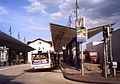
Euregiobahn
· 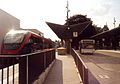
... with wheelchair ramp
· 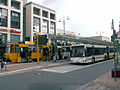
Gera tram and bus
· 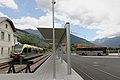
Vinschgerbahn
· 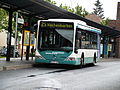
Bus and subway in Frankfurt am Main
Related articles
Author
AlegsaOnline.com Cross-platform interchange (railway passenger transfers) Leandro Alegsa
URL: https://en.alegsaonline.com/art/24327