
Frankfurt U-Bahn
Urban rail network in Frankfurt, Germany. Operated by VGF, it comprises nine lines, a mix of underground and surface sections, about 65 km of route and 86 stations serving the city and nearby towns.
Overview
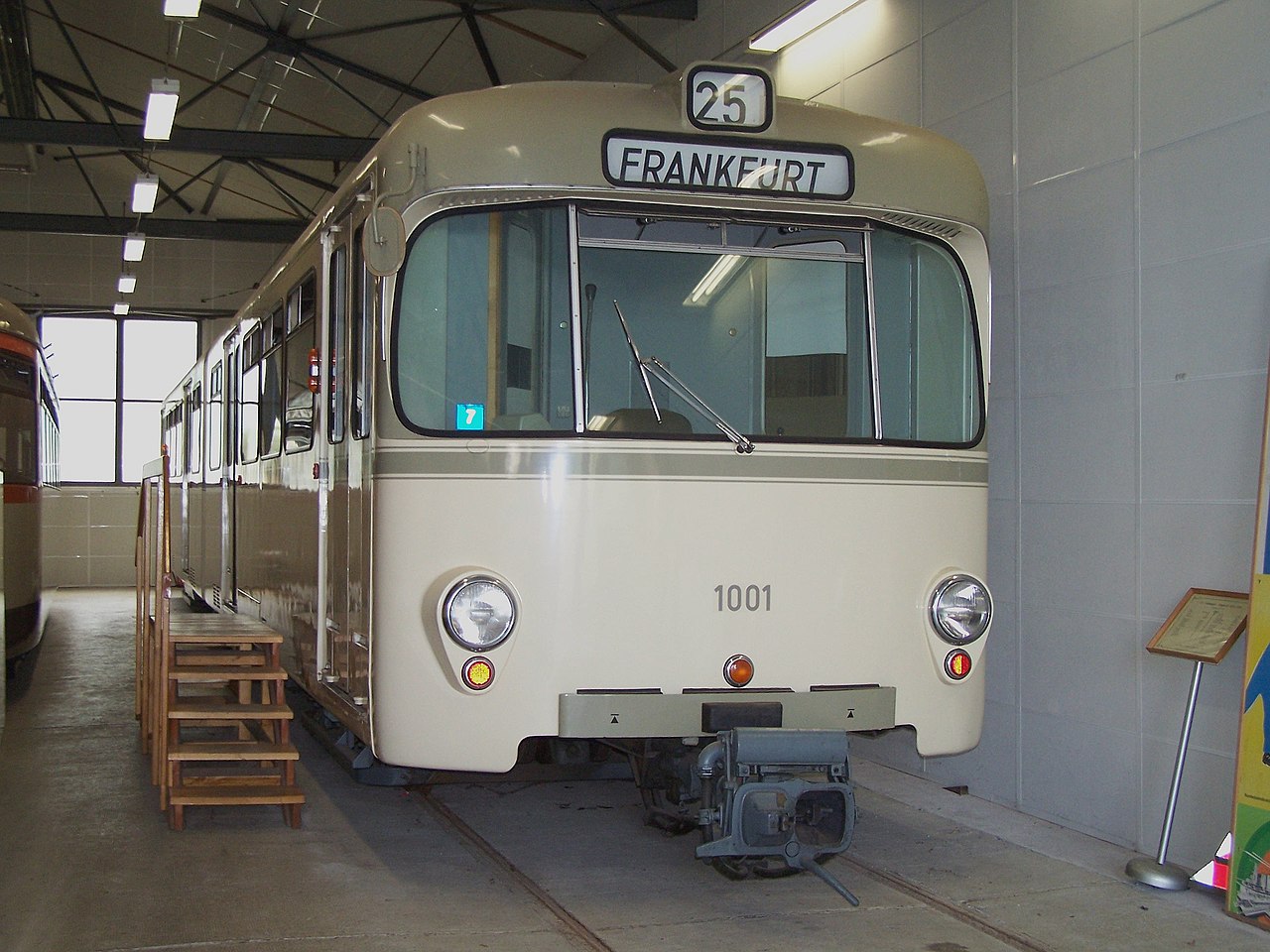
The Frankfurt U-Bahn is the principal light-rail and metro-style rapid transit network serving the city of Frankfurt am Main. Operated by the municipal company Verkehrsgesellschaft Frankfurt (VGF), the system functions as one component of the wider Rhein-Main public-transport network. It is designed to combine high-capacity urban subway service in the central core with tram-like surface operation on many branches to outlying districts.
Image gallery
10 Images




Characteristics and network
The network consists of nine numbered lines (U1–U9) and covers roughly 65 kilometres, serving 86 stations. A substantial portion of the system runs in tunnels beneath the city centre, while suburban stretches are at-grade or on elevated alignments. Key features include frequent services on trunk sections, step-free access at many stations, and interchange points with the regional S-Bahn, trams and bus services.
- Lines: nine (U1–U9)
- Approximate route length: 65 km (map and distances)
- Stations: 86 total — a mix of underground and surface stops
- Cross-boundary service: some lines extend beyond the city limits
History and development
Planning for a modern rapid-transit system in Frankfurt began in the mid-20th century as the city grew and traffic congestion increased. The first sections opened in the late 1960s, and the network expanded over subsequent decades with additional tunnels, surface extensions and rolling-stock modernisations. Rather than a pure deep-metro, the Frankfurt solution evolved as a Stadtbahn-style system: underground where demand is highest, and at-grade where cost or urban form favoured lighter infrastructure.
Uses, connections and importance
The U-Bahn plays a central role in daily mobility for commuters, students and visitors. It provides fast cross-city journeys and links with long-distance and regional transport at major hubs. Frequent transfers to the S-Bahn, tramlines and buses enable integrated travel across the Rhine-Main region under common fares and timetabling arrangements. In several places, lines continue to neighbouring towns such as Oberursel and Bad Homburg, offering suburban connectivity without requiring car travel.
Notable aspects
Unlike systems built exclusively as heavy metro, Frankfurt's network blends metro and light-rail characteristics — this flexibility allowed phased expansion at lower cost. The VGF oversees operations, maintenance and customer services, while infrastructure and fare integration are coordinated regionally to serve both the city and its commuter hinterland.
Questions and answers
Q: What is the Frankfurt U-Bahn?
A: The Frankfurt U-Bahn is an underground railway network in the city of Frankfurt, Germany.
Q: Who operates the Frankfurt U-Bahn?
A: The Frankfurt U-Bahn is run by the Verkehrsgesellschaft Frankfurt, short VGF.
Q: How many lines does the Frankfurt U-Bahn have?
A: The Frankfurt U-Bahn has 9 lines.
Q: What is the total distance of the Frankfurt U-Bahn's network?
A: The Frankfurt U-Bahn has a network of 65 kilometers (40 miles).
Q: How many stations does the Frankfurt U-Bahn have?
A: The Frankfurt U-Bahn has exactly 86 stations, apart 27 underground and 59 above ground.
Q: Which lines of the Frankfurt U-Bahn cross the city border?
A: Two lines, the U2 and the U3, cross the city border in Oberursel and Bad Homburg.
Q: Who is responsible for running the Frankfurt U-Bahn?
A: The Verkehrsgesellschaft Frankfurt (VGF) is responsible for running the Frankfurt U-Bahn.
Related articles
Author
AlegsaOnline.com Frankfurt U-Bahn Leandro Alegsa
URL: https://en.alegsaonline.com/art/36228