
Covalent radius
The covalent radius is an estimate of an atom’s size when it participates in a covalent bond, defined empirically as half the distance between nuclei of two identical bonded atoms and used to estimate bond lengths.
Overview
The covalent radius is a practical measure of an atom's effective size when it forms a covalent connection to another atom. In its simplest definition, it equals one half of the internuclear distance between two identical atoms joined by a covalent bond. The quantity is reported in units such as picometers or ångströms and is widely used as an approximate parameter in structural chemistry and molecular modeling. For context about the kinds of atoms involved see atom, and for the bonding situation see covalent bond.
Image gallery
1 Image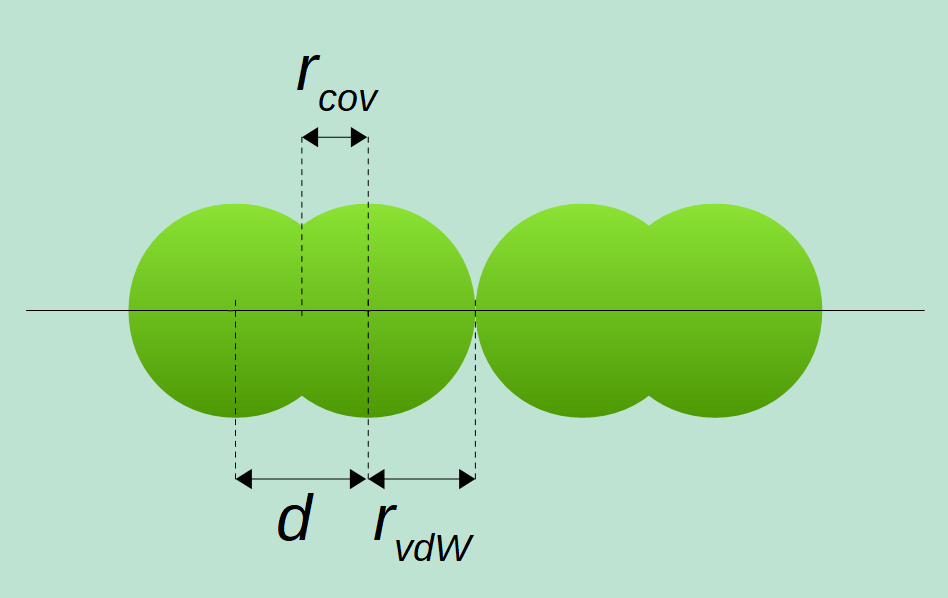
How it is determined
Covalent radii are obtained from experimental measurements of bond lengths and from theoretical analyses. Common experimental techniques include X-ray diffraction and related crystallographic methods that measure distances between atomic nuclei in solids; see X-ray diffraction. Electron diffraction and high-resolution spectroscopy can also contribute data. Researchers compile many measured bond lengths, correct for systematic effects and then define radii for particular bonding situations (for example single-, double- or triple-bond radii).
Characteristics and variation
The covalent radius is not an immutable physical boundary but an empirical parameter that depends on chemical context. Typical trends are:
- Across a period of the periodic table radii tend to decrease as effective nuclear charge increases.
- Down a group radii generally increase as additional electron shells are occupied.
- Bond order affects size: atoms involved in multiple bonds usually exhibit smaller radii than in single bonds.
Factors that influence measured values
Several effects complicate the assignment of a single covalent radius to an element. These include bond polarity (partial ionic character can shift electron density), coordination number in solids, resonance and delocalization in molecules, and relativistic effects for heavy elements. As a result, radii from different authors or compilations may differ slightly depending on the dataset and conventions used.
Uses and examples
Covalent radii are useful as quick estimates of bond lengths by summing the radii of two bonded atoms, and they serve as input for molecular models, visualization software and comparative studies of atomic size. Chemists and materials scientists consult tabulated covalent radii when interpreting crystal structures, designing molecules, or rationalizing trends in bond strength and geometry.
Distinctions and important notes
The covalent radius should be distinguished from related size measures such as the van der Waals radius (which applies to nonbonded contacts) and ionic radius (which describes charged ions in ionic solids). Because it is an empirical construct rather than an exact physical constant, the covalent radius is best used as an approximate, context-dependent tool rather than an absolute measurement.
Related articles
Author
AlegsaOnline.com Covalent radius Leandro Alegsa
URL: https://en.alegsaonline.com/art/23682