
Conglomerate (geology)
A sedimentary rock composed of rounded gravel-size clasts set in finer matrix or cement; indicates high-energy transport and records provenance, environment, and diagenetic history.
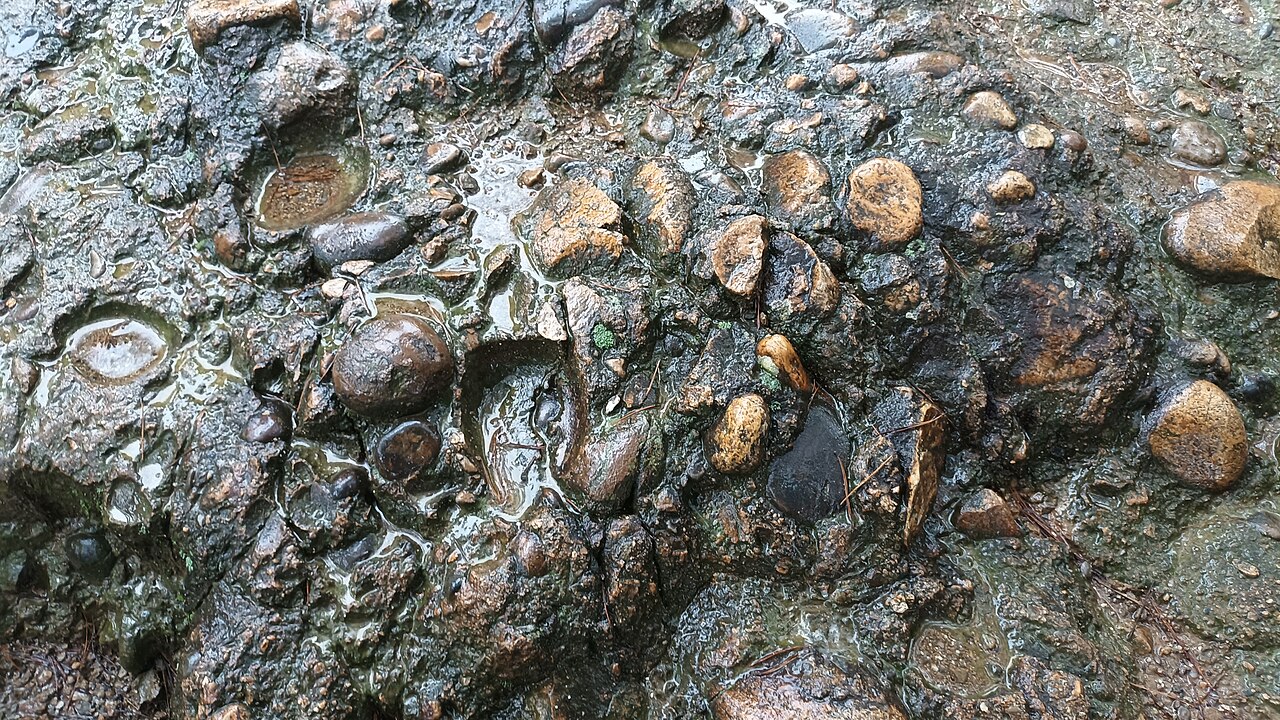
Conglomerate is a coarse-grained clastic sedimentary rock made up of rounded to subrounded gravel-size clasts (particles larger than sand) that are surrounded by a finer-grained matrix or held together by mineral cement. It forms when coarse fragments derived from older rocks are transported, rounded by abrasion, and deposited in environments energetic enough to move large particles. Because its clasts can include pieces of many rock types, conglomerate is useful for interpreting past landscapes and sediment sources.
Image gallery
9 Images




Characteristics and classification
Key features of conglomerate include clast size (commonly >2 millimeters), degree of roundness, sorting, and the nature of the matrix and cement. Geologists classify conglomerates by how clasts are supported and by clast composition:
- Clast-supported (orthoconglomerate): clasts touch each other and form a framework, with little matrix between them.
- Matrix-supported (paraconglomerate): abundant finer material fills the spaces between clasts.
- Compositional terms: polymictic (mixed rock types), monomictic (single rock type), and others.
Formation and depositional environments
Conglomerates develop where transport energy is sufficiently high to move and deposit pebbles and cobbles. Typical settings include river channels and alluvial fans, coarse coastal beaches, and some glacial or nearshore settings. Clasts rounded by long transport indicate sustained fluvial or beach action; angular clasts point to rapid deposition near the source, such as in debris flows or proximal alluvial fans.
Uses, significance and diagenesis
Beyond serving as building stone in some regions, conglomerates are studied for what they reveal about paleogeography: clast types record provenance, and bedding structures indicate flow directions. During burial, the rock undergoes diagenesis—compaction and mineral precipitation (commonly silica, calcite or iron oxides) that cements the grains. Metamorphism of conglomerate produces metaconglomerate, which can preserve stretched or flattened clasts.
Distinctions and notable facts
Conglomerate is distinct from breccia primarily by clast shape: breccia contains angular fragments, indicating little transport. It differs from coarse sandstone by clast size. Because conglomerate clasts often come from older rocks, they can include reworked fossils or exotic pebbles that provide clues to ancient terrains. Its study combines sedimentology, stratigraphy, and provenance analysis to reconstruct Earth's sedimentary history.
Related articles
Author
AlegsaOnline.com Conglomerate (geology) Leandro Alegsa
URL: https://en.alegsaonline.com/art/22499
Sources
- fi.edu : Conglomerate Rocks on Rock Hound.
- simple.wiktionary.org : pebbles