
Continental crust
The continental crust is Earth's relatively light, thick outer layer beneath continents and shelves, composed mainly of felsic rocks; it differs from oceanic crust in composition, thickness, age and tectonic history.
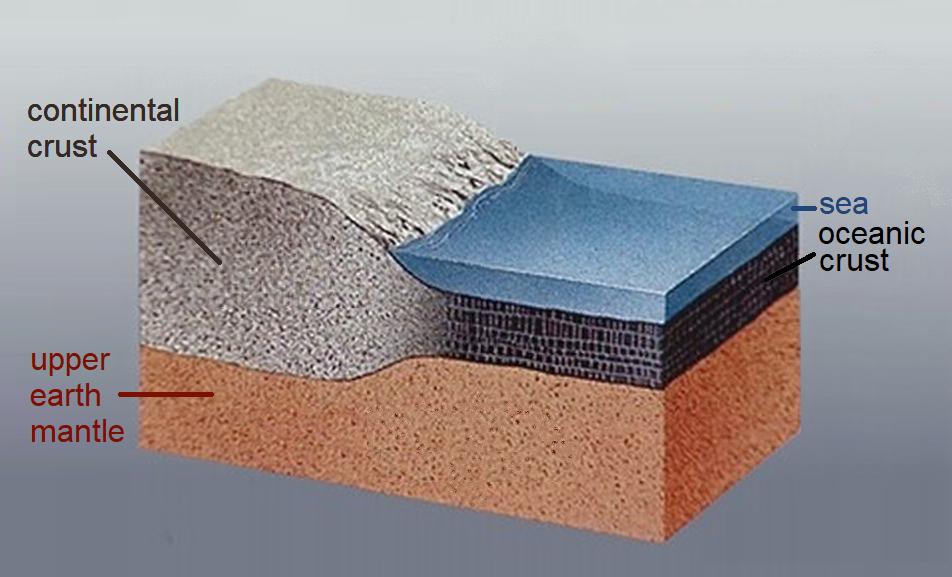
The continental crust is the outermost solid portion of the Earth that underlies the major landmasses and the adjacent shallow seabed known as the continental shelves. It is a composite layer of different rock types, commonly including granitic, sedimentary and metamorphic rocks. These rocks together form the continents and the broad, shallow platforms that surround them, and they contrast markedly in composition and behaviour with the thinner, denser oceanic crust.
Image gallery
2 Images
Composition and physical properties
Continental crust is typically enriched in silica and aluminium and is often described as felsic or sialic in composition. Common rock-forming minerals include feldspar and quartz. These compositional differences make continental crust generally less dense than the underlying mantle, which tends to be dominated by heavier, mafic minerals. The lower density, together with greater thickness, gives the continental crust buoyancy that makes it stand higher than oceanic plates.
- Thickness: typical continental crust thickness is commonly tens of kilometres (many continental regions fall into a range roughly between 30 and 50 km), with mountain roots and orogenic belts reaching greater thicknesses.
- Density and buoyancy: it is less dense than mantle and oceanic crust, which contributes to isostatic support of high topography.
- Variation with depth: the upper crust is often more felsic and brittle, while the middle and lower crust may contain more mafic or metamorphosed rocks.
- Surface coverage: about two fifths of the Earth's surface, including islands and continental shelves, overlies continental crust.
Structure, boundaries and tectonic processes
The base of the crust is commonly identified by a contrast in seismic velocities known as the Mohorovičić discontinuity (the Moho). The margin between continental and oceanic domains is typically defined by the continental margin, which includes the shelf, slope and rise. Continental crust is created, modified and redistributed by a range of tectonic processes: magmatism at convergent margins, crustal melting and differentiation, accretion of terranes, continental collision (orogeny) and rifting. Because continental crust is relatively buoyant it tends to resist subduction, so recycling of continental material back into the mantle is less complete and occurs on longer time scales than the recycling of oceanic crust.
Age, cratons and geological history
Parts of the continental crust are very old. Stable continental cores—cratons and shields—contain rocks that can be billions of years old and preserve evidence of early Earth processes. This contrasts with most oceanic crust, which is relatively young on a global scale because it is continually formed at mid-ocean ridges and consumed at subduction zones. The long-lived nature of many continental fragments makes them important archives for the planet's geologic history.
Resources, environments and human relevance
The continental crust hosts the landforms, soils and ecosystems that support terrestrial life and human societies. It contains the majority of the planet's accessible mineral deposits, ore bodies and many economically important rock units. Large sedimentary basins that develop on continental crust and along continental shelves are major repositories for groundwater, coal, oil and natural gas. Understanding continental crust composition and structure is therefore central to resources, hazard assessment and land-use planning.
Methods of study
Geologists investigate continental crust using a combination of field mapping, petrology, geochemical analysis, isotopic dating, and geophysical imaging such as seismic reflection and refraction. Seismic studies reveal internal layering and the depth to the Moho; petrology and geochemistry trace the sources and evolution of crustal rocks; and geochronology provides timing constraints on crust formation and modification. For introductory material see general summaries of continents, studies of metamorphic processes and overviews of sedimentary basins and granitic petrology.
Understanding the differences between continental and oceanic crust — their composition, thickness, age distribution and tectonic behaviour — helps explain the distribution of mountains, basins and continental shelves and underpins much of modern plate-tectonic theory. Continued advances in seismic imaging and geochemical techniques refine our picture of crustal architecture and evolution and inform exploration for natural resources as well as assessments of geologic hazards.
Questions and answers
Q: What is the continental crust?
A: The continental crust is the layer of granitic, sedimentary, and metamorphic rocks which form the continents and the areas of shallow seabed close to their shores.
Q: What is the composition of the continental crust?
A: The continental crust consists mostly of feldspar and other sialic rocks.
Q: How does the density of continental crust compare to the Earth's mantle?
A: The continental crust is less dense than the material of the Earth's mantle, which consists of mafic rock.
Q: How does the thickness of continental crust compare to oceanic crust?
A: The continental crust is considerably thicker than oceanic crust, mostly 35 to 40 km versus the average oceanic thickness of around 7-10 km.
Q: What percentage of the Earth's surface is covered by continental crust?
A: About 40% of the Earth's surface lies on-top of continental crust.
Q: What separates the continental crust from the oceanic crust?
A: The continental crust is separated from the oceanic crust by the continental margin.
Q: What are some types of rocks that make up the continental crust?
A: The continental crust is mainly composed of granitic, sedimentary, and metamorphic rocks, including feldspar and other sialic rocks.
Related articles
Author
AlegsaOnline.com Continental crust Leandro Alegsa
URL: https://en.alegsaonline.com/art/22768
Sources
- earth.leeds.ac.uk : Making new continents