
Cone: geometric shape, types, formulas, and uses
A cone is a three-dimensional figure with a circular, elliptic, or polygonal base tapering to an apex. This article covers definitions, varieties, surface and volume formulas, history, uses, and related concepts.
Overview
A cone is a solid or surface formed by joining all points of a planar base to a single point called the apex. In everyday language objects that narrow smoothly from a broad base to a point — such as an ice cream cone or a traffic cone — are described as conical. In mathematical contexts the base may be a circle, ellipse, polygon, or more general closed curve; the connecting lines (generators) meet at the apex and define the lateral surface. A simple geometric construction of a right circular cone is obtained by rotating a right triangle about one of its legs; this process and related constructions are often discussed in introductions to classical geometry and calculus, and are described in more detail by texts on cones in geometry.
Image gallery
10 Images


Key characteristics and terminology
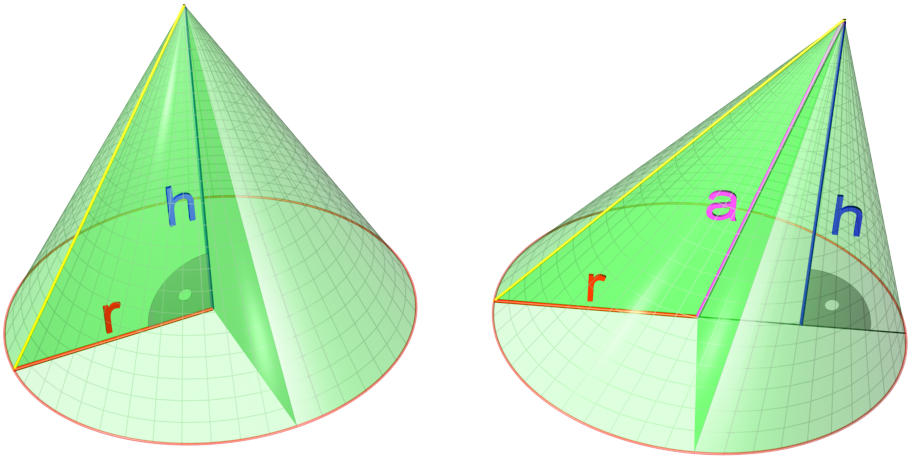
Important parts and measurements of a cone include the base, the apex (or vertex), the axis (the line through the apex perpendicular to the base in a right cone), the height (distance from apex to base plane), and the slant height (the length along a generator from apex to boundary of the base). A cone is called right if the axis meets the base at its center; otherwise it is oblique. When the base is circular the cone is a circular cone; if the cone extends infinitely from the apex it is called a conical surface, and if it extends both directions it becomes a double cone whose two nappes meet at the vertex.
Formulas and simple examples
For a solid (right circular) cone with base radius r and height h, the volume is one third of the base area multiplied by the height: V = (1/3) · π · r² · h. The lateral surface area (the area of the curved surface excluding the base) is π · r · s, where s denotes the slant height. A truncated cone or frustum, obtained by slicing a cone with a plane parallel to the base, has volume V = (1/3) · π · h · (r1² + r1·r2 + r2²) for top and bottom radii r1 and r2 and height h. These formulas and derivations are familiar in elementary calculus and solid geometry and are treated in many introductory sources and reference texts; see also discussions of rotational solids and volume methods on rotational constructions.
History and mathematical context
Cones have been studied since antiquity in the context of conic sections: the curves (circle, ellipse, parabola, hyperbola) generated by intersecting a plane with a cone. Classical geometers investigated these curves and their properties; later work used cones in optics, astronomy, and engineering. The study of cones also extends into modern mathematics: in algebra and optimization a convex cone is a set closed under positive linear combinations, which generalizes the geometric idea into vector spaces. Conic sections and related constructions remain central topics in analytic geometry, calculus, and physics. For more on the classical curves and their relation to three-dimensional cones see a treatment of conic sections.
Uses, examples, and notable distinctions
- Practical examples: ice-cream cones, traffic cones, conical tents, volcanic cones and funnels in engineering.
- Optics and acoustics: parabolic and conical reflectors direct light or sound when shaped appropriately.
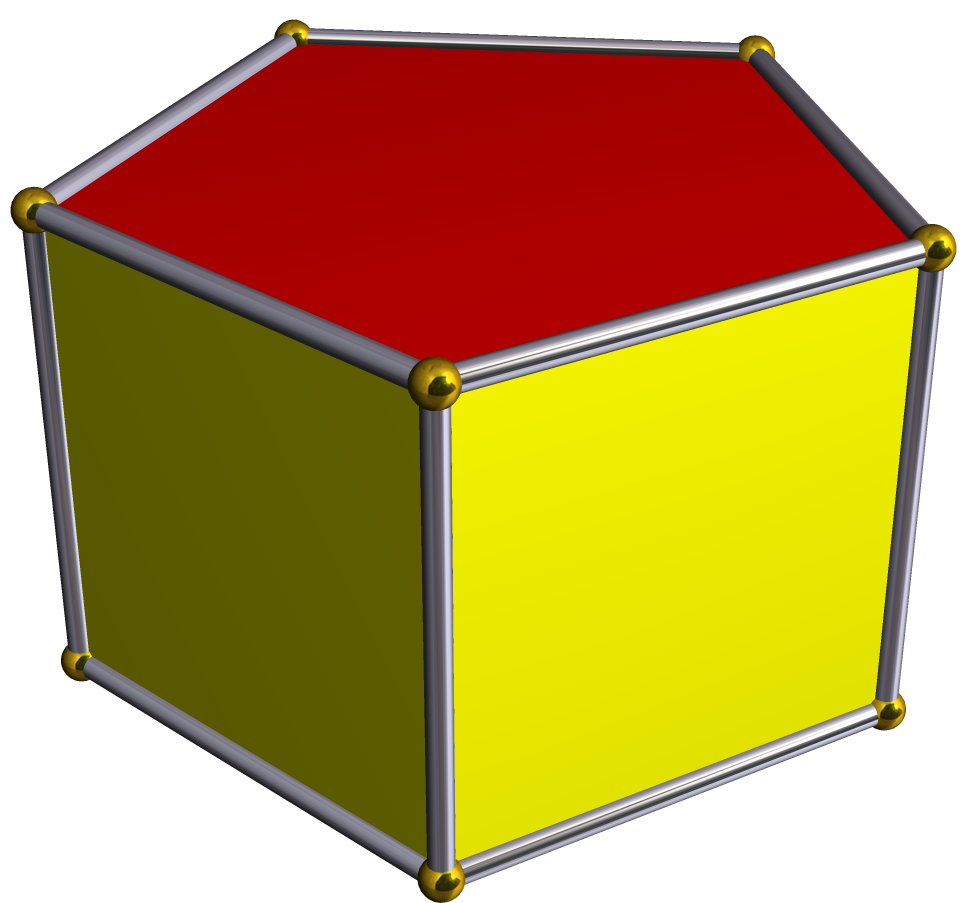
- Distinctions: a cone differs from a pyramid chiefly by having a continuous curved base (often circular) rather than a polygonal base whose generators meet at the apex; cones may be finite (solid) or infinite (surfaces or double cones).
Additional notes and study pointers
When studying cones it is useful to keep distinct the geometric object (solid versus surface), the special cases (right versus oblique, circular versus general base), and algebraic generalizations (cones in vector spaces). Many elementary proofs rely on slicing, similarity of triangles, and integral calculus; visualizing a cone as generated by a moving line segment from apex to the base often clarifies how formulas arise. For practical reference on computations and visualizations consult textbooks and resources on solid geometry and calculus as well as online references that cover volumes and surface areas in more detail, for example introductions to volume formulas.
Related articles
Author
AlegsaOnline.com Cone: geometric shape, types, formulas, and uses Leandro Alegsa
URL: https://en.alegsaonline.com/art/22455
Sources
- commons.wikimedia.org : cones
- books.google.com : Elementary Geometry for College Students