
Conic section
Curves produced by intersecting a plane with a cone: parabolas, ellipses (including circles) and hyperbolas; defined geometrically and algebraically with applications in astronomy, optics and engineering.
Overview
In classical geometry a conic section is any curve obtained by cutting a cone with a plane. The simplest descriptive model uses a right circular cone intersected by a plane; depending on the angle and position of that plane relative to the cone's axis the intersection can be an parabola, an ellipse (of which the circle is a special case) or a hyperbola. The study of these curves sits inside broader geometry and links three-dimensional intuition (a cone and a plane) with planar curve theory.
Image gallery
10 Images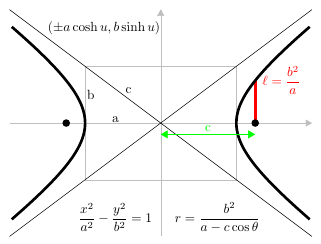



Types and defining properties
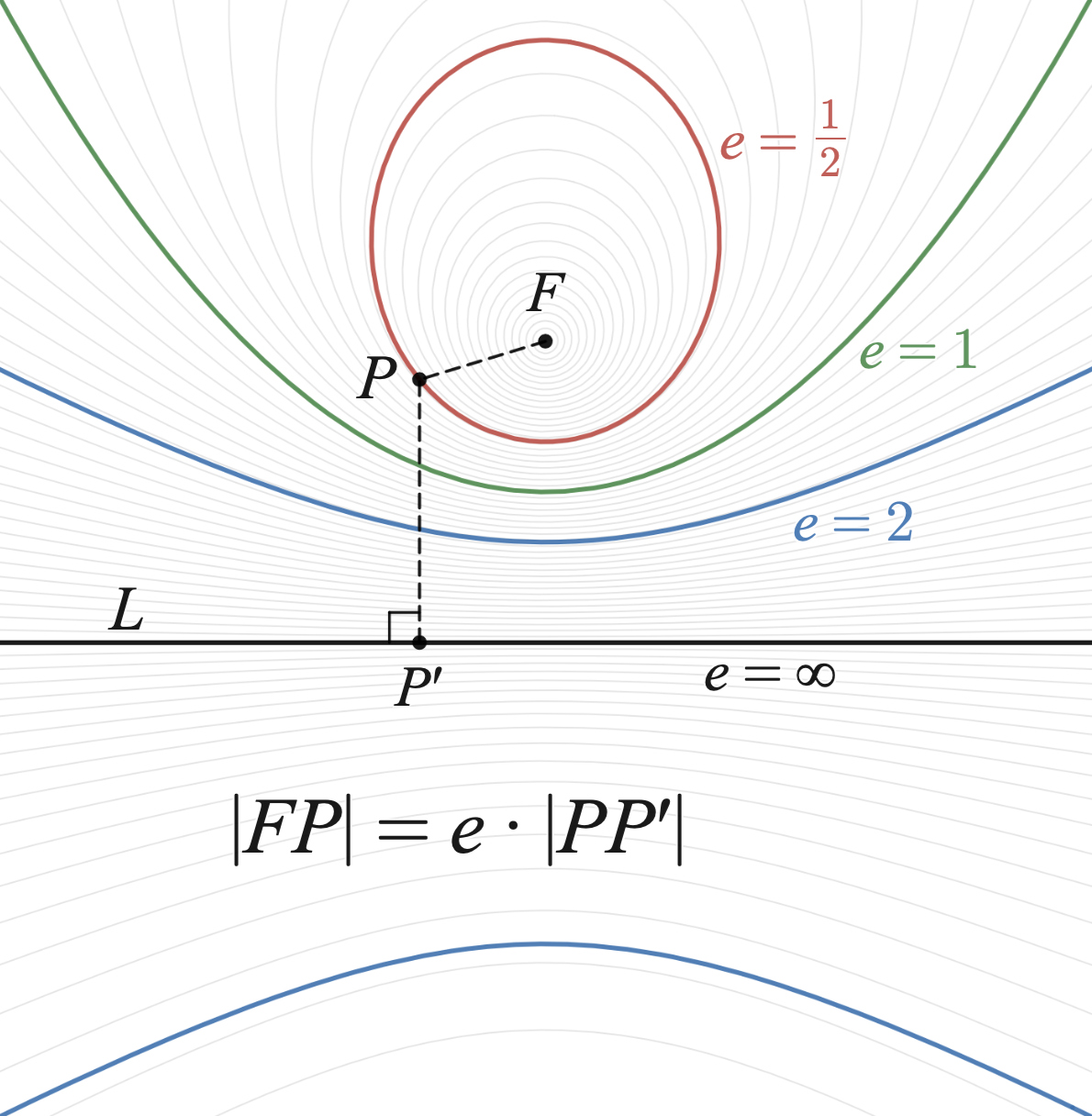
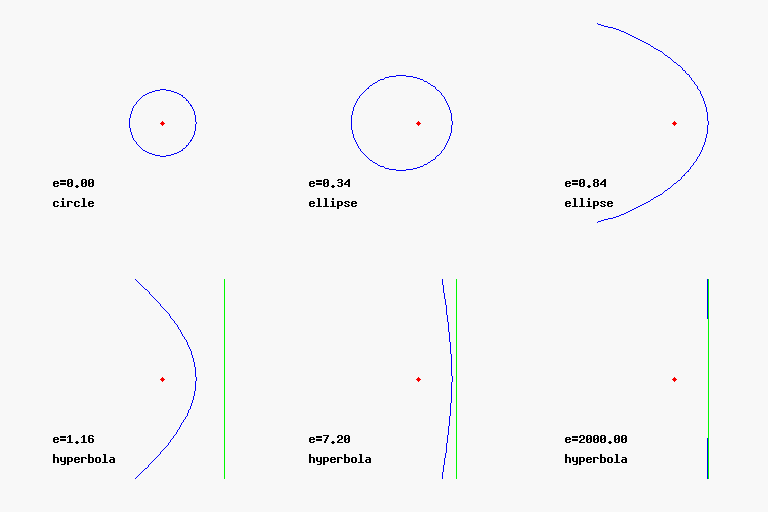
Conics are commonly classified by eccentricity, a nonnegative number that compares distances to a focus and to a corresponding directrix. The classification is:
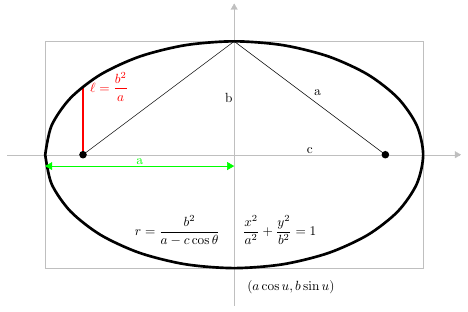
- Ellipse: eccentricity e with 0 < e < 1; the circle occurs when e = 0.
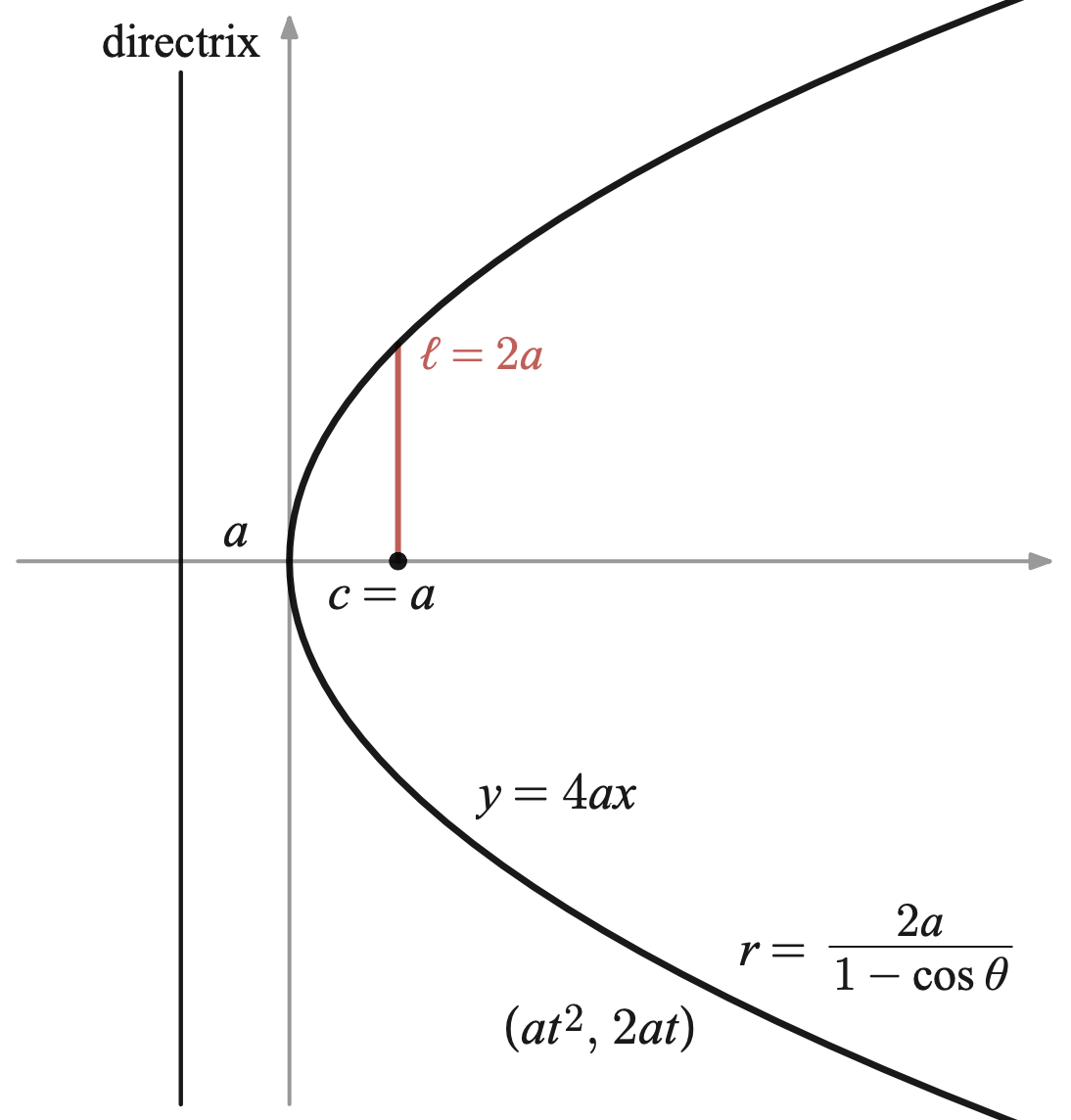
- Parabola: e = 1; the curve is equidistant from a single focus and a line (the directrix).
- Hyperbola: e > 1; formed by the intersection producing two separate branches.
Algebraic description and classification test
On the plane a conic is a nondegenerate solution of a general quadratic equation Ax^2 + Bxy + Cy^2 + Dx + Ey + F = 0. The type can be read from the discriminant B^2 - 4AC:
- Ellipse (or circle) when B^2 - 4AC < 0,
- Parabola when B^2 - 4AC = 0,
- Hyperbola when B^2 - 4AC > 0.
History and mathematical importance
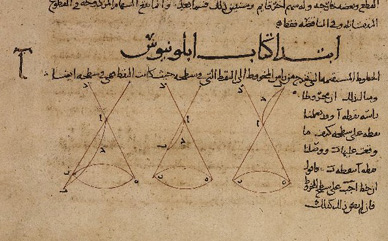
The systematic investigation of conic sections is a classical subject in Greek mathematics. Apollonius of Perga (third century BC) wrote the foundational treatise that studied their properties and terminology. Conics later became central to mechanics and astronomy: the trajectories predicted by the Newtonian two-body model are conic sections, relating ellipses to planetary orbits and hyperbolas or parabolas to certain cometary paths and escape trajectories (two-body problem).
Applications and examples
Conic sections appear widely in science and engineering. Parabolic shapes are used for satellite dishes, headlights and telescopes because of their focusing property. Elliptical reflectors and whispering galleries exploit the two-focus reflection law. Hyperbolic mirrors and lenses can correct certain aberrations in optical systems. In navigation and orbital mechanics, the classification of possible trajectories (bound, parabolic escape, or hyperbolic escape) matches the conic types. For further foundational reading see links in geometry and classical treatments of the subject: geometry, cone, plane.
Notable distinctions and facts
Although often introduced via an intersection picture, conics are equally well characterized by purely planar definitions (focus-directrix and eccentricity) and by quadratic equations. The circle is the only conic with full rotational symmetry and is typically treated as a distinguished special case. Modern approaches connect conics to projective geometry, where they are seen as degree-two curves whose qualitative behavior is preserved under projection and affine transformations.
Related topics and resources: circle, parabola, hyperbola, ellipse.
Questions and answers
Q: What is a conic section?
A: A conic section is a curve formed when a cone and a plane intersect.
Q: What kind of cones are assumed in elementary geometry?
A: Right circular cones are assumed in elementary geometry.
Q: What does circular mean in the context of cones?
A: Circular means that the base of the cone is a circle.
Q: What does right mean in the context of cones?
A: Right means that the axis of the cone passes through the center of the base at right angles to its plane.
Q: What are oblique cones?
A: Oblique cones are cones in which the axis does not pass perpendicularly through the center of the base.
Q: Who first studied the properties of conic sections?
A: Apollonius of Perga studied the properties of conic sections around 200 BC.
Q: What are the three types of conic sections?
A: The three types of conic sections are the parabola, the hyperbola, and the ellipse.
Related articles
Author
AlegsaOnline.com Conic section Leandro Alegsa
URL: https://en.alegsaonline.com/art/22524
Sources
- mathworld.wolfram.com : mathworld.wolfram.com/Cone.html