
Communications satellite
Artificial satellites that relay telecommunications signals between points on Earth, providing broadcast, voice, data and internet services from space using specific orbits and onboard transponders.
Communications satellites are artificial satellites placed into space to receive, amplify, and retransmit signals for telecommunication purposes. They act as radio relays between widely separated locations on Earth, enabling television broadcasts, telephone calls, data links and internet access where terrestrial infrastructure is impractical. Modern systems combine on-board electronics, multiple antenna types and frequency bands to support a variety of services.
Image gallery
8 Images


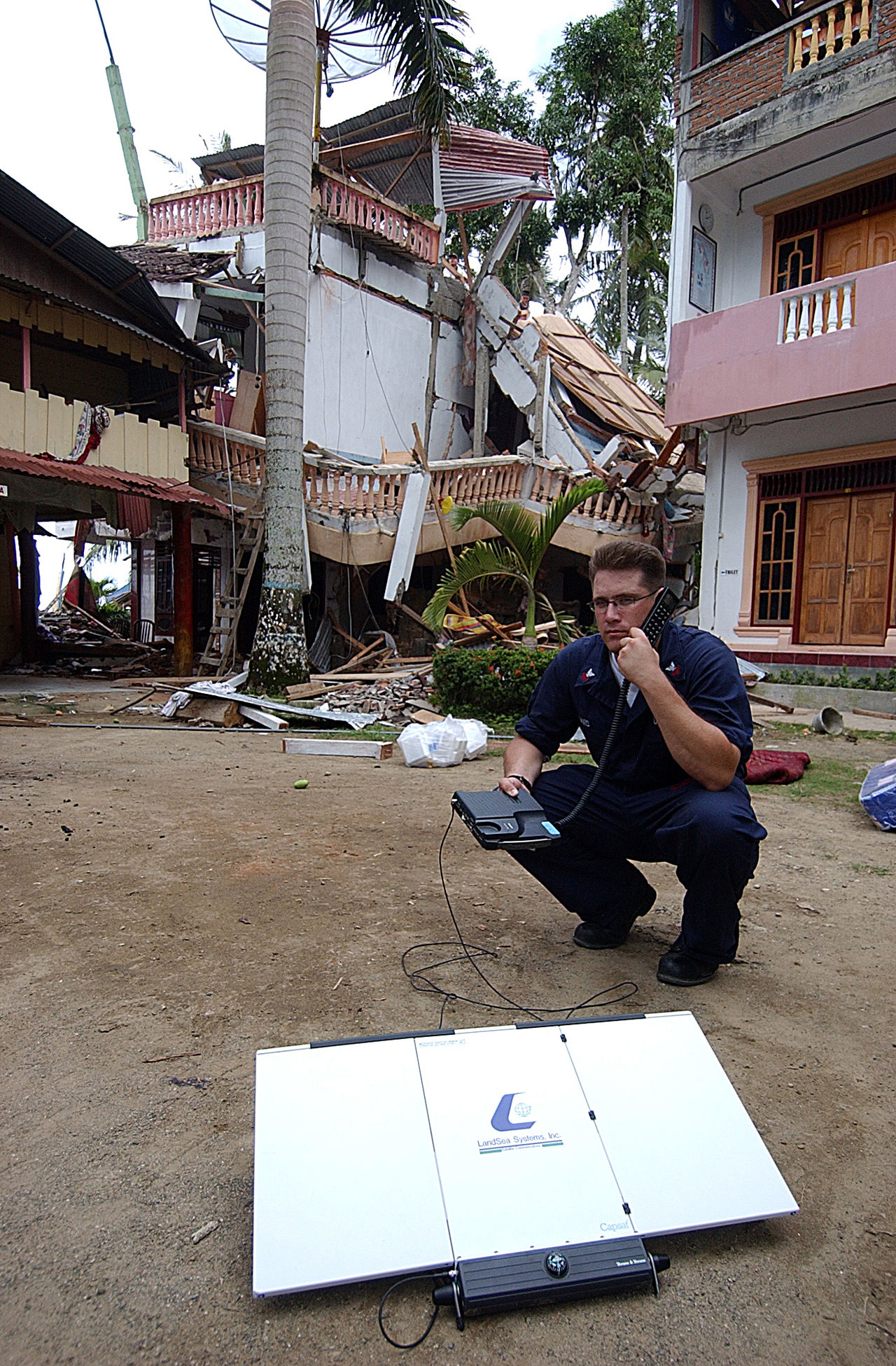



How they work and main components
A communications satellite typically carries transponders — receivers that capture an uplinked signal from a ground station, convert and amplify it, and send it back down as a downlink. Antennas and reflectors direct beams to specific regions. Power is supplied by solar panels and batteries. Control systems maintain orientation (attitude) and orbit, while thermal and shielding systems protect electronics from the space environment.
- Uplink and downlink channels for sending and receiving signals; see radio wave transmission.
- Transponders that handle frequency conversion and amplification.
- Antennas and beam-forming to cover target regions on Earth.
Orbits and operational distinctions
Satellites are placed in different orbits depending on their mission. Geostationary orbits provide a fixed position relative to the ground, making them ideal for continuous broadcast and certain communications links; these are a subset of synchronous orbits. Low Earth orbit (LEO) and medium Earth orbit (MEO) satellites offer lower latency but require constellations to provide continuous coverage. Specialized platforms include direct-broadcast satellites designed for distribution of many channels of television (broadcast television), and satellites optimized for mobile or maritime links.
History and development
Concepts for spaceborne radio relays date back to early 20th-century thinkers and were developed seriously in the mid-20th century. Engineer Herman Potočnik proposed radio communication from orbit, and in October 1945 Arthur C. Clarke published a widely cited essay describing the use of three satellites in geostationary positions to provide global coverage; his article appears in many historical accounts — see Clarke's essay. The general idea of placing artificial satellites into geostationary locations to relay signals influenced later engineering and policy discussions, and Clarke is often credited as a pivotal figure in the concept's popularization (credited inventor in many summaries).
Uses, examples and importance
Communications satellites support a wide range of practical services: long-range telephony and data links, television and radio broadcasting, emergency communications, and internet access in remote or underserved regions. Satellite internet connects ships at sea, isolated communities and remote research stations. Commercial operators, public broadcasters and governments all rely on satellite systems to reach large or hard-to-serve audiences.
Notable features and contemporary trends
From primitive experimental payloads in the 1960s to the emergence of geosynchronous systems in the 1970s, satellite communications have evolved rapidly. Recent trends include high-throughput satellites that use spot-beam technology, large constellations of small LEO satellites for low-latency broadband, and hybrid networks that combine satellite and terrestrial links for resiliency. Regulatory, orbital debris and spectrum-allocation issues are important considerations for operators and policy makers.
For further technical or historical reading, consult satellite manufacturers, national space agencies and telecommunications authorities through suitable reference portals: technical overview, orbital mechanics, and additional background resources at orbit references and satellite history. For service-specific details see consumer broadcast services, television distribution, and policy commentary such as classic essays and modern regulatory reviews (geostationary policy, credit and attribution).
Related articles
Author
AlegsaOnline.com Communications satellite Leandro Alegsa
URL: https://en.alegsaonline.com/art/22165
Sources
- commons.wikimedia.org : Communication satellites
- lsi.usp.br : "Extraterrestrial Relays"
- engadget.com : "Arthur C. Clarke, inventor of satellite, visionary in technology, dead at 90"
- nytimes.com : "Arthur C. Clarke"