
Communes of the Hauts-de-Seine department
Overview of the 36 communes forming Hauts-de-Seine (Île-de-France): administrative role, major towns, intercommunal structures, history, and notable economic and geographic features.
Overview
The Hauts-de-Seine department in the Île-de-France region comprises 36 communes, the smallest official territorial units of local government in France. These communes vary from dense urban centers and business districts to quieter residential neighborhoods. Together they form a suburban ring immediately west of Paris and play a significant role in the region's economy and daily life. For a formal enumeration and official names, see the commune list.
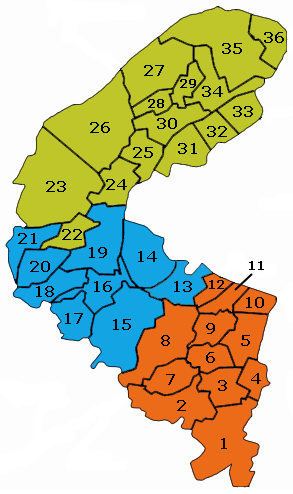
Image gallery
2 Images

Administration and characteristics
Each commune is governed by a municipal council and a mayor who administers local services, urban planning, schools, and municipal budgets. Hauts-de-Seine itself is a département created during the reorganization of the Paris region in the late 1960s and is part of modern France's system of territorial administration. The departmental capital, where many prefectural services are located, is Nanterre; other important communes include Boulogne-Billancourt, Courbevoie, Levallois-Perret and Asnières-sur-Seine.
Intercommunal cooperation
Communes in Hauts-de-Seine often pool resources in intercommunal bodies to manage transport, economic development and infrastructure. Notable communautés d'agglomération include:
- CAA — Communauté d'agglomération des Hauts de Bièvre (created 2003), which extends partly into Essonne.
- CAI — Communauté d'agglomération Arc de Seine (created 2003).
- CAB — Communauté d'agglomération du Val de Seine (created 2004), a cooperative grouping along the Seine valley Val de Seine.
History and development
The communes of Hauts-de-Seine developed rapidly in the 19th and 20th centuries as Paris expanded. Industrial activity, including factories and later service-sector investment, reshaped the urban fabric. In recent decades, large-scale developments such as the La Défense business district transformed parts of several communes into major commercial and high-rise office zones, attracting corporations, commuters and international investment.
Importance and notable distinctions
Although geographically small, Hauts-de-Seine is densely populated and economically influential within Île-de-France, with high concentrations of employment, corporate headquarters and cultural facilities. The communes together balance residential life, transport links into central Paris, and significant economic sites. Administratively, their cooperation through intercommunal structures aims to address metropolitan challenges that no single commune could manage alone.
Further information
Readers seeking details such as population figures, individual municipal services, or contact information for each town hall should consult official departmental resources or the specific commune pages listed in the complete list of communes and on the Hauts-de-Seine departmental portal.

Questions and answers
Q: How many communes are there in the Hauts-de-Seine département in France?
A: There are 36 communes in the Hauts-de-Seine département in France.
Q: When was the Communauté d'agglomération des Hauts de Bièvre created?
A: The Communauté d'agglomération des Hauts de Bièvre was created in 2003.
Q: Is the Communauté d'agglomération des Hauts de Bièvre only located in the Hauts-de-Seine département?
A: No, the Communauté d'agglomération des Hauts de Bièvre is also partly located in the Essonne département.
Q: When was the Communauté d'agglomération Arc de Seine created?
A: The Communauté d'agglomération Arc de Seine was created in 2003.
Q: When was the Communauté d'agglomération du Val de Seine created?
A: The Communauté d'agglomération du Val de Seine was created in 2004.
Q: Are the three mentioned communities all located in the Hauts-de-Seine département?
A: No, the Communauté d'agglomération des Hauts de Bièvre is partly located in the Essonne département.
Q: What is a communauté d'agglomération?
A: A communauté d'agglomération is a type of intercommunal structure in France that functions as a federation of municipalities.
Related articles
Author
AlegsaOnline.com Communes of the Hauts-de-Seine department Leandro Alegsa
URL: https://en.alegsaonline.com/art/22106